


In the steamy heat of central Pakistan, a novelist is writing. He describes a hidden world of servants and their feudal masters, the powerlessness of poverty and the corruption that glues it all together.
These lives, tucked away in the mango groves, grand estates and mud-walled villages of rural Pakistan, are rarely seen by outsiders. But the writer, Daniyal Mueenuddin, a Pakistani-American who lives here, has brought them into focus in a collection of short stories, In Other Rooms, Other Wonders, published this year.
They are intimate portraits that raise some of the biggest questions in Pakistan today. Why does a small elite still control vast swaths of land more than 60 years after Pakistan became a nation? How long will landlords continue to control the law and the lives of the peasants on their land in the same way British rulers did before them?
Mueenuddin, 46, offers a richly observed landscape that is written with the tenderness and familiarity of an old friend. The estate Mueenuddin lives on in southern Punjab, Pakistan’s biggest province, belonged to his father, a prominent Pakistani civil servant, and he used to come here as a boy.
His parents met in the US in the 1950s. His father was negotiating a treaty, and his mother was a young reporter for the Washington Post. They later moved to Pakistan, but the country proved difficult with its web of expectations and relationships, and she took her sons back to the US when Mueenuddin was 13.
Memories of this land stayed with him, however, and he returned after college in 1987 as an aspiring writer. He found upon arrival a decaying, colonial-era system, whose owners — his own family — had long stopped paying attention. The farm’s profits were declining, and its borders were shrinking: The managers were pilfering land and planting their own crops.
“It was in their mouths when I pulled it out,” Mueenuddin said, speaking on the estate, where he now lives with his Norwegian wife.
Mueenuddin slowly became part of the changing Pakistan he wanted to capture in fiction. The managers were powerful when he arrived, and extracting them from the business of running the farm was a delicate procedure. He was alone, without a phone or Internet. He slept with a gun and worried that his food might be poisoned.
“It occurred to me that they could kill me,” he said.
He began to assemble a team of people he trusted: a driver who, as a child, was his playmate, and the Koran instructor in the mosque, Hafiz Sahib, who had been low in the pecking order of the village but was honest. Slowly, he reclaimed the farm, which now does a brisk business in mangoes, sugar cane and cotton.
In person, Mueenuddin is more American than Pakistani. He speaks Urdu, the national language, but his frenetic energy and fast gait sets him apart in this languid, sweltering land, where men walk with their bellies ahead of their torsos.
Mueenuddin says he is a farm manager who does well because he treats his workers fairly. He pays them US$84 a month, triple the going rate, and instituted an American-style annual bonus system for managers. Last year, the most profitable producer on the farm received the equivalent of more than two years’ salary.
That is unusual for Pakistan, where landlords rarely delve into the business of their farms in detail and workers are paid around US$25 a month.
And poverty is becoming more pronounced. Local residents now get only a few hours of electricity daily, down from around six several years ago, and with Pakistan’s exploding population, jobs are ever harder to find.
“People are getting more and more desperate,” he said.
In recent years, there has been another shift in society. Mullahs of the fundamentalist Deobandi school have grown powerful in southern Punjab, spreading an aggressive, anti-Shiite, anti-state message during Friday sermons in the religious schools, or madrasas, that have proliferated since the 1980s.
The spread has touched Mueenuddin. A religious group was building a mosque on the edge of his property, and one day a young man on its roof shouted at him: “The first thing you’ll know is when the bullet hits you in the forehead.”
He ordered a wall erected along the property line.
The religious extremists’ view of world is not unlike that of the Utopians in W.H. Auden’s Horae Canonicae, Mueenuddin said, whose rigid views of the perfect society — oblique references to Soviet communism — are just as true today.
“I find it scary that extremists in Pakistan are trying to force their rigid prescriptions down our throats,” he said, invoking a comparison with Joseph Stalin, who ruthlessly consolidated his power by crushing any dissent.
The Utopian, he said, quoting from a book of Auden, dreams of “some august day of outrage when hellikins cavort through ruined drawing-rooms and fish-wives intervene in the Chamber,” and for a time when “those he hates shall hate themselves instead.”
But is the Pakistani elite in the same position as the Russian aristocracy before the revolution?
“It’s something that keeps me awake at night,” Mueenuddin said.
The fear recedes in daylight. It is unclear how strong the forces of extremism in Mueenabad are, and whether sweeping away the current order is among their aims. For the time being at least, the status quo seems likely to prevail.
“I don’t think the guys I’m dealing with are thinking in revolutionary terms,” Mueenuddin said. “They’ve not gotten that far.”
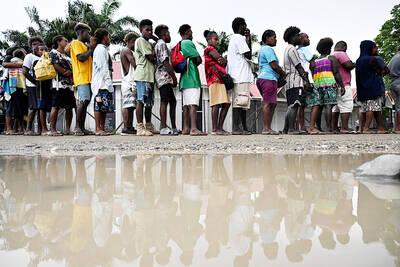
SEEKING CHANGE: A hospital worker said she did not vote in previous elections, but ‘now I can see that maybe my vote can change the system and the country’ Voting closed yesterday across the Solomon Islands in the south Pacific nation’s first general election since the government switched diplomatic allegiance from Taiwan to Beijing and struck a secret security pact that has raised fears of the Chinese navy gaining a foothold in the region. The Solomon Islands’ closer relationship with China and a troubled domestic economy weighed on voters’ minds as they cast their ballots. As many as 420,000 registered voters had their say across 50 national seats. For the first time, the national vote also coincided with elections for eight of the 10 local governments. Esther Maeluma cast her vote in the
Nearly half of China’s major cities are suffering “moderate to severe” levels of subsidence, putting millions of people at risk of flooding, especially as sea levels rise, according to a study of nationwide satellite data released yesterday. The authors of the paper, published by the journal Science, found that 45 percent of China’s urban land was sinking faster than 3mm per year, with 16 percent at more than 10mm per year, driven not only by declining water tables, but also the sheer weight of the built environment. With China’s urban population already in excess of 900 million people, “even a small portion

UNSETTLING IMAGES: The scene took place in front of TV crews covering the Trump trial, with a CNN anchor calling it an ‘emotional and unbelievably disturbing moment’ A man who doused himself in an accelerant and set himself on fire outside the courthouse where former US president Donald Trump is on trial has died, police said yesterday. The New York City Police Department (NYPD) said the man was declared dead by staff at an area hospital. The man was in Collect Pond Park at about 1:30pm on Friday when he took out pamphlets espousing conspiracy theories, tossed them around, then doused himself in an accelerant and set himself on fire, officials and witnesses said. A large number of police officers were nearby when it happened. Some officers and bystanders rushed

HYPOCRISY? The Chinese Ministry of Foreign Affairs yesterday asked whether Biden was talking about China or the US when he used the word ‘xenophobic’ US President Joe Biden on Wednesday called for a hike in steel tariffs on China, accusing Beijing of cheating as he spoke at a campaign event in Pennsylvania. Biden accused China of xenophobia, too, in a speech to union members in Pittsburgh. “They’re not competing, they’re cheating. They’re cheating and we’ve seen the damage here in America,” Biden said. Chinese steel companies “don’t need to worry about making a profit because the Chinese government is subsidizing them so heavily,” he said. Biden said he had called for the US Trade Representative to triple the tariff rates for Chinese steel and aluminum if Beijing was


 RSS
RSS