


US President Barack Obama has proposed a major overhaul of the US financial system, unveiling measures he hopes will restore confidence and prevent a repeat of the worst crisis to hit Wall Street in seven decades.
Treasury Secretary Timothy Geithner was expected to outline the administration’s plan yesterday before the Senate panel and the House Financial Services Committee.
The Obama plan would give new powers to the Federal Reserve — the US central bank — to oversee the entire financial system and create a new consumer protection agency to guard against the types of abuses that played a big role in the current crisis.
The president said his plan was “a sweeping overhaul of the financial regulatory system, a transformation on a scale not seen since the reforms that followed the Great Depression” of the 1930s.
It would also reverse a campaign in the 1980s by former president Ronald Reagan to cut back on federal fiscal regulations.
It is an undertaking so ambitious it has some lawmakers worried about missteps.
“We have to evaluate it, weigh it, slow it down and make sure we do it right,” said Richard Shelby, the top Republican on the Senate Banking Committee. “Because if we don’t, we will pay dearly.”
Obama attributed much of the country’s current problem to “a cascade of mistakes and missed opportunities” that happened over several decades, again blaming “a culture of irresponsibility [that] took root from Wall Street to Washington to Main Street.”
The 88-page proposal will spark intense debate in Congress.
Opponents are already criticizing it as imposing too many restrictions that will harm the ability of US financial companies to compete in the global economy.
The proposal seeks to revamp a regulatory structure that Obama’s economic team say couldn’t cope with burgeoning new credit products and the increasing complexities of the marketplace.
Under Obama’s plan, the Federal Reserve would gain power to supervise holding companies and large financial institutions considered so big that their failure could undermine the financial system. But even as it gains new powers, the central bank would cede some banking authority to a new Consumer Financial Protection Agency.
Working alongside the Federal Reserve, but without power to overrule the central bank, would be a new council of regulators that would monitor the overall financial system with an eye to preventing the unexpected collapse of huge institutions as happened last fall with AIG, the insurance company, and the Lehman Brothers brokerage.
Obama wants Congress to make the plan law by the end of the year, an ambitious goal given that he also is pushing lawmakers to overhaul the US health care system by October.
Both measures face a blizzard of opposition from special interest groups, who fear the changes envisioned will cut into profits or impose undue complexities on their industries.
In a Tuesday television interview, Obama said the plan was “a very strong set of regulatory measures that we think can prevent this kind of crisis from happening again.”
Christina Romer, the chairman of the White House Council of Economic Advisers, said on Wednesday morning that the administration proposal strikes “the appropriate balance” and was “not bulldozing the whole system.”

Republican US lawmakers on Friday criticized US President Joe Biden’s administration after sanctioned Chinese telecoms equipment giant Huawei unveiled a laptop this week powered by an Intel artificial intelligence (AI) chip. The US placed Huawei on a trade restriction list in 2019 for contravening Iran sanctions, part of a broader effort to hobble Beijing’s technological advances. Placement on the list means the company’s suppliers have to seek a special, difficult-to-obtain license before shipping to it. One such license, issued by then-US president Donald Trump’s administration, has allowed Intel to ship central processors to Huawei for use in laptops since 2020. China hardliners
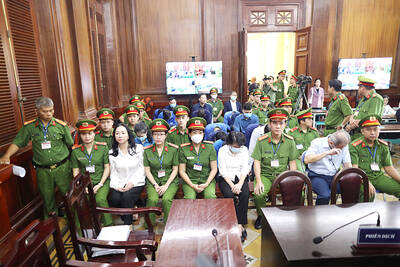
A top Vietnamese property tycoon was on Thursday sentenced to death in one of the biggest corruption cases in history, with an estimated US$27 billion in damages. A panel of three hand-picked jurors and two judges rejected all defense arguments by Truong My Lan, chair of major developer Van Thinh Phat, who was found guilty of swindling cash from Saigon Commercial Bank (SCB) over a decade. “The defendant’s actions ... eroded people’s trust in the leadership of the [Communist] Party and state,” read the verdict at the trial in Ho Chi Minh City. After the five-week trial, 85 others were also sentenced on

‘DELUSIONAL’: Targeting the families of Hamas’ leaders would not push the group to change its position or to give up its demands for Palestinians, Ismail Haniyeh said Israeli aircraft on Wednesday killed three sons of Hamas’ top political leader in the Gaza Strip, striking high-stakes targets at a time when Israel is holding delicate ceasefire negotiations with the militant group. Hamas said four of the leader’s grandchildren were also killed. Ismail Haniyeh’s sons are among the highest-profile figures to be killed in the war so far. Israel said they were Hamas operatives, and Haniyeh accused Israel of acting in “the spirit of revenge and murder.” The deaths threatened to strain the internationally mediated ceasefire talks, which appeared to gain steam in recent days even as the sides remain far

The Taliban’s reclusive supreme leader made a rare public appearance yesterday, an Afghan government spokesman said, leading thousands of worshipers in prayers marking Eid al-Fitr. Hibatullah Akhundzada has made only a handful of public appearances since inheriting the leadership of the Taliban in 2016 and leading the movement back to power with the withdrawal of US forces in 2021. Taliban government spokesman Zabihullah Mujahid said prayer in the largest mosque in Kandahar was “performed under the leadership of the supreme leader.” In a statement on X, he said the early-morning service “was attended by thousands of compatriots” in the southern province considered the


 RSS
RSS