


From remote grasslands to the heart of the capital, Mongolians cast their ballots yesterday to elect a new president that residents and investors hope will facilitate the country’s efforts to tap its vast mineral wealth.
The tight race between incumbent Nambariin Enkhbayar of the ruling Mongolian People’s Revolutionary Party (MPRP) and opposition Democratic Party (DP) candidate Tsakhiagiin Elbegdorj is seen as a barometer of how soon the country will be able to reach a deal with foreign investors on a landmark mining deal.
Any repeat of the type of unrest and ensuing legal struggles that followed last year’s parliamentary elections, in which five died, could postpone approval of a draft investment agreement on developing the pivotal Oyu Tolgoi copper and gold project.
“It’s a beautiful day today and I hope it’s also going to be a very good election. I firmly believe in the bright future of our people and the prosperity of our country,” Enkhbayar said after voting in a university gymnasium in the capital Ulan Bator.
Coming at a time when the young Central Asian democracy has been hit hard by falling mineral prices, the election pits Enkhbayar’s pledge to beef up the rule of law against Elbegdorj’s promises of change and fighting corruption. Both are dangling payouts from mining revenues and further help for students.
“The most important thing the new president needs to do is develop the country, to pull us out of poverty,” said Davaadorjiin Suvdaa, a 56-year-old retired worker.
A win by Elbegdorj could complicate policy making on mining, given his track record of anti-foreign and populist inclinations, analysts say.
Voters turned out in droves in the capital, many dressed in traditional long silk cloaks known as deels, in a sign of their respect for the largely ceremonial head of state and symbol of national unity.
Polling stations close at 10pm and the latest survey put the two parties in a statistical tie. A result could be known early today, but could also take several days if it is a tight race.
In the country’s vast windswept grasslands, many nomadic herders traveled dozens of kilometers on horseback and motorbike to the nearest polling stations.
“Stability is the most important thing to me,” said Sandagyn Bayarmaa, 46, who lives with her husband in a round felt tent and herds goats and sheep like much of the population.
The countryside is the traditional base of support for the MPRP, the reincarnation of the party that ran Mongolia as a Soviet satellite throughout much of the last century, while Elbegdorj draws largely on urban voters.
Exit polls are banned, but if voter turnout is high, meaning around 80 percent, that will probably bode well for challenger Elbegdorj, said Luvsandendev Sumati, director of the Sant Maral Foundation, a group that does polling and surveys.
“What might change the election outcome is only feet,” Sumati said. “The MPRP and their candidates were always better organized so their supporters are voting in an organized manner. But Democratic Party supporters, they are rather those who think, ‘Well, should I go or not?’”
Mongolia, whose empire under Genghis Khan once extended west as far as Hungary, now faces the imperative of uniting on what terms it can accept in working with foreign miners to develop the deposits of copper, gold, uranium, lead, zinc and coal that it hopes will pull its nearly 3 million people out of poverty.
Negotiations over the US$3 billion Oyu Tolgoi project, set to be developed by Ivanhoe Mines and Rio Tinto, have dragged on for years as the government seeks to formulate it as a model for obtaining sufficient revenue from its mineral resources in future.
Sealing the deal quickly is increasingly important if Mongolia hopes to realize its ambitions of becoming a mining powerhouse and take advantage of the next upturn in commodity prices, analysts say.

Republican US lawmakers on Friday criticized US President Joe Biden’s administration after sanctioned Chinese telecoms equipment giant Huawei unveiled a laptop this week powered by an Intel artificial intelligence (AI) chip. The US placed Huawei on a trade restriction list in 2019 for contravening Iran sanctions, part of a broader effort to hobble Beijing’s technological advances. Placement on the list means the company’s suppliers have to seek a special, difficult-to-obtain license before shipping to it. One such license, issued by then-US president Donald Trump’s administration, has allowed Intel to ship central processors to Huawei for use in laptops since 2020. China hardliners
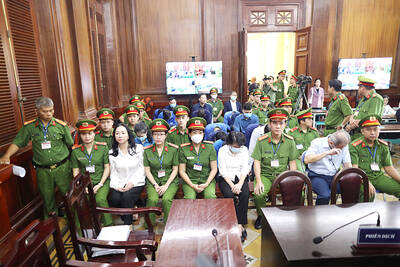
A top Vietnamese property tycoon was on Thursday sentenced to death in one of the biggest corruption cases in history, with an estimated US$27 billion in damages. A panel of three hand-picked jurors and two judges rejected all defense arguments by Truong My Lan, chair of major developer Van Thinh Phat, who was found guilty of swindling cash from Saigon Commercial Bank (SCB) over a decade. “The defendant’s actions ... eroded people’s trust in the leadership of the [Communist] Party and state,” read the verdict at the trial in Ho Chi Minh City. After the five-week trial, 85 others were also sentenced on

Conjoined twins Lori and George Schappell, who pursued separate careers, interests and relationships during lives that defied medical expectations, died this month in Pennsylvania, funeral home officials said. They were 62. The twins, listed by Guinness World Records as the oldest living conjoined twins, died on April 7 at the Hospital of the University of Pennsylvania, obituaries posted by Leibensperger Funeral Homes of Hamburg said. The cause of death was not detailed. “When we were born, the doctors didn’t think we’d make 30, but we proved them wrong,” Lori said in an interview when they turned 50, the Philadelphia Inquirer reported. The
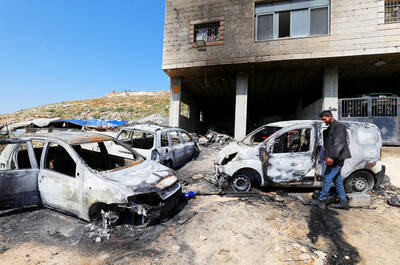
RAMPAGE: A Palestinian man was left dead after dozens of Israeli settlers searching for a missing 14-year-old boy stormed a village in the Israeli-occupied West Bank US President Joe Biden on Friday said he expected Iran to attack Israel “sooner, rather than later” and warned Tehran not to proceed. Asked by reporters about his message to Iran, Biden simply said: “Don’t,” underscoring Washington’s commitment to defend Israel. “We are devoted to the defense of Israel. We will support Israel. We will help defend Israel and Iran will not succeed,” he said. Biden said he would not divulge secure information, but said his expectation was that an attack could come “sooner, rather than later.” Israel braced on Friday for an attack by Iran or its proxies as warnings grew of


 RSS
RSS