


Marilyn French, the writer and feminist whose novel The Women’s Room sold more than 20 million copies and transformed her into a leading figure in the women’s movement, died at 79.
French died of heart failure on Saturday at a Manhattan hospital, said Carol Jenkins, a friend and president of New York’s Women’s Media Center.
She was an academic in 1977 when The Women’s Room, her first novel, was published. Her aim, she said, was “to change the entire social and economic structure of Western civilization, to make it a feminist world.”
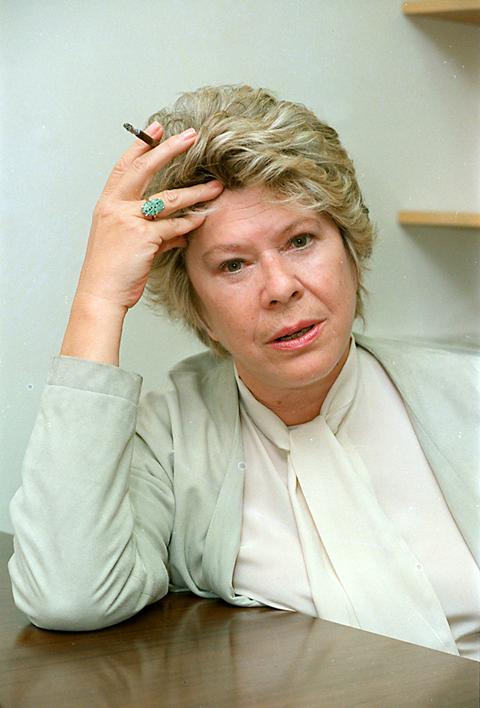
PHOTO: AP
The landmark novel, which was translated into 20 languages, details the journey to independence of a 1950s housewife who gets divorced and goes to graduate school. The book mirrored aspects of French’s own life experiences, including the rape of her daughter.
She was called anti-male after a character in the novel says: “All men are rapists, and that’s all they are. They rape us with their eyes, their laws, and their codes.”
“Those words came from a character, and she was not a man-hater and never said that in her personal life,” Jenkins said. “But she wanted men to accept their part in the domination of women.”
Still, the novel “connected with millions of women who had no way before of claiming their anger and discontent,” Jenkins said.
The male subjugation of women is the main theme of French’s novels, essays, literary criticism and her four-volume, nonfictional From Eve to Dawn: A History of Women.
A Brooklyn native, French graduated from Long Island’s Hofstra University with a master’s degree, studying philosophy and English literature. She taught there in the 1960s. After her divorce, she earned a doctorate from Harvard and was an English professor at the College of the Holy Cross in Worcester, Massachusetts.
A smoker, she survived a battle with esophageal cancer in 1992 that included a 10-day coma she described in Season in Hell: A Memoir.
Her last novel is to be published this fall; she was also working on a memoir.

Crowds in Bangladesh are flocking to snap photographs with an unlikely social media star — an albino buffalo with flowing blond hair nicknamed “Donald Trump” that is due to be sacrificed within days. Owner Zia Uddin Mridha, 38, said his brother named the 700kg bull over its flowing helmet of hair resembling the signature look of the US president. “My younger brother picked this name because of the buffalo’s extraordinary hair,” he said at his farm in Narayanganj, just outside the capital, Dhaka. Mridha said that a constant stream of curious visitors — social media fans, onlookers and children — have come throughout

The Bolivian government on Friday struck a deal with protesting miners, but was still grappling with blockades and demonstrations by other workers across La Paz. Other groups are still blocking access roads into the city, which is also the seat of the government. Police on Thursday prevented the miners from entering the main square by using tear gas, while the demonstrators hurled stones and explosives with slingshots. Protests against the policies of Bolivian President Rodrigo Paz have convulsed the Andean nation since early this month, and roadblocks were choking routes into La Paz throughout Friday, the national road authority said. Miners demanded that Paz
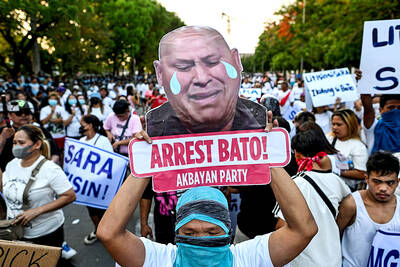
The Philippines said it has asked the country’s Supreme Court to allow it to arrest former Philippine president Rodrigo Duterte’s chief drug war enforcer to stand trial in an international tribunal. The International Criminal Court (ICC) last week unsealed an arrest warrant against Philippine Senator Ronald dela Rosa, accusing him along with Duterte and other “coperpetrators” of the “crime against humanity of murder.” Dela Rosa briefly sought refuge in the Philippine Senate last week while asking the Philippine Supreme Court to stop an ongoing attempt by government agents to arrest him. “By his own conduct, he has placed himself outside the protection of

The researchers in Ireland looked at their computer screen, marveling at a medieval book tracked down in a Roman library. They flipped through its digitized pages and found their sought-after treasure: the oldest surviving English poem. “We were extremely surprised. We were speechless. We couldn’t believe our eyes when we first saw that,” said Elisabetta Magnanti, a visiting research fellow at Trinity College Dublin’s school of English. The poem was also within the main body of Latin text, she said, calling it “extraordinary.” Composed in Old English by a Northumbrian agricultural worker in the 7th century, Caedmon’s Hymn appears within some copies of


 RSS
RSS