


Pakistan is continuing to expand its nuclear bomb-making facilities despite growing international concern that advancing Islamist extremists could overrun one or more of its atomic weapons plants or seize sufficient radioactive material to make a dirty bomb, US nuclear experts and former officials say.
David Albright, previously a senior weapons inspector for the UN’s International Atomic Energy Agency in Iraq, said commercial satellite photos showed two plutonium-producing reactors were nearing completion at Khushab, about 250km southwest of Islamabad.
“In the current climate, with Pakistan’s leadership under duress from daily acts of violence by insurgent Taliban forces and organized political opposition, the security of any nuclear material produced in these reactors is in question,” Albright said in a report issued by the independent Institute for Science and International Security in Washington.
Albright warned that the continuing development of Pakistan’s atomic weapons program could trigger a renewed nuclear arms race with India. But he suggested a more immediate threat to nuclear security arose from recent territorial advances in northwest Pakistan by indigenous Taliban and foreign jihadi forces opposed to the Pakistani government and its US and British allies.
“Current US policy, focused primarily on shoring up Pakistan’s resources for fighting the Taliban and al-Qaeda, has had the unfortunate effect of turning the US into more of a concerned bystander of Pakistan’s expansion of its ability to produce nuclear weapons,” Albright said in the report, co-authored with Paul Brannan.
The Khushab reactors are situated on the border of Punjab and North-West Frontier province, the scene of heavy fighting between Taliban and government forces. Another allegedly vulnerable facility is the Gadwal uranium enrichment plant, less than 100km south of Buner district, where some of the fiercest clashes have taken place in recent days. A suicide bomber blew himself up outside an air weapons complex near Gadwal in December 2007, injuring several people.
Uncertainty has long surrounded Pakistan’s nuclear stockpile. The country is not a signatory to the nuclear non-proliferation treaty or the comprehensive test ban treaty. Nor has it submitted its nuclear facilities to international inspection since joining the nuclear club in 1998, when it detonated five nuclear devices. It is estimated to have about 200 atomic bombs.
US Secretary of State Hillary Clinton told US Congress recently that Pakistan had dispersed its nuclear warheads to different locations across the country in order to improve their security.
But John Bolton, a former senior official in the Bush administration, said at the weekend that this move could have the opposite effect to that intended.
“There is a tangible risk that several weapons could slip out of military control. Such weapons could then find their way to al-Qaeda or other terrorists,” he said in an article in the Wall Street Journal.
Since there was a real risk of governmental collapse, Bolton said the US must be prepared for military intervention to seize control of Pakistan’s nuclear stockpile and safeguard western interests.
Pakistani Ambassador to the US Husain Haqqani dismissed the warnings, saying: “The specter of extremist Taliban taking over a nuclear-armed Pakistan is not only a gross exaggeration, it could also lead to misguided policy prescriptions from Pakistan’s allies.”
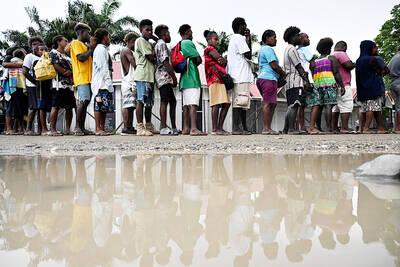
SEEKING CHANGE: A hospital worker said she did not vote in previous elections, but ‘now I can see that maybe my vote can change the system and the country’ Voting closed yesterday across the Solomon Islands in the south Pacific nation’s first general election since the government switched diplomatic allegiance from Taiwan to Beijing and struck a secret security pact that has raised fears of the Chinese navy gaining a foothold in the region. The Solomon Islands’ closer relationship with China and a troubled domestic economy weighed on voters’ minds as they cast their ballots. As many as 420,000 registered voters had their say across 50 national seats. For the first time, the national vote also coincided with elections for eight of the 10 local governments. Esther Maeluma cast her vote in the
Nearly half of China’s major cities are suffering “moderate to severe” levels of subsidence, putting millions of people at risk of flooding, especially as sea levels rise, according to a study of nationwide satellite data released yesterday. The authors of the paper, published by the journal Science, found that 45 percent of China’s urban land was sinking faster than 3mm per year, with 16 percent at more than 10mm per year, driven not only by declining water tables, but also the sheer weight of the built environment. With China’s urban population already in excess of 900 million people, “even a small portion

UNSETTLING IMAGES: The scene took place in front of TV crews covering the Trump trial, with a CNN anchor calling it an ‘emotional and unbelievably disturbing moment’ A man who doused himself in an accelerant and set himself on fire outside the courthouse where former US president Donald Trump is on trial has died, police said yesterday. The New York City Police Department (NYPD) said the man was declared dead by staff at an area hospital. The man was in Collect Pond Park at about 1:30pm on Friday when he took out pamphlets espousing conspiracy theories, tossed them around, then doused himself in an accelerant and set himself on fire, officials and witnesses said. A large number of police officers were nearby when it happened. Some officers and bystanders rushed

HYPOCRISY? The Chinese Ministry of Foreign Affairs yesterday asked whether Biden was talking about China or the US when he used the word ‘xenophobic’ US President Joe Biden on Wednesday called for a hike in steel tariffs on China, accusing Beijing of cheating as he spoke at a campaign event in Pennsylvania. Biden accused China of xenophobia, too, in a speech to union members in Pittsburgh. “They’re not competing, they’re cheating. They’re cheating and we’ve seen the damage here in America,” Biden said. Chinese steel companies “don’t need to worry about making a profit because the Chinese government is subsidizing them so heavily,” he said. Biden said he had called for the US Trade Representative to triple the tariff rates for Chinese steel and aluminum if Beijing was


 RSS
RSS