


Australia yesterday increased concessions for big polluters and delayed the start date of its emissions trading scheme because of the global financial crisis, in a stark shift on climate policy.
Australian Prime Minister Kevin Rudd said the deepening global recession meant local emissions trading could not begin until July 2011, one year later than previously planned.
In a concession to green groups, Rudd said Australia would cut its greenhouse gas emissions to 25 percent of 2000 levels by 2020 — up from 15 percent previously.
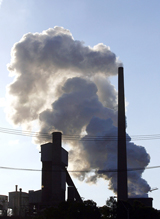
PHOTO: REUTERS
But he said the revised target would only apply if world leaders also signed up to an “ambitious” reduction goal in Copenhagen in December. Without an agreement, Australia’s target would remain unchanged at 5 percent.
“The worst global recession since the Great Depression means we must adapt our climate change measures but not abandon them,” Rudd told reporters.
“The start date of the carbon pollution reduction scheme will be delayed one year to commence from July 1, 2011,” he said.
It was a marked change in position by Rudd, who has for months insisted his government would proceed with emissions trading next year, despite the global market turmoil.
With Australia already suffering its worst drought in a century, the prime minister said late last year that failure to act on climate change could be disastrous, labeling any delay “reckless and irresponsible.”
But in a change of tack, Rudd pushed back the trading scheme start date and said a one-year fixed-price period for carbon pollution permits would apply until July 2012 to assist businesses hit hard by the credit crunch.
Rudd said that during the fixed-price phase, an unlimited number of permits would be issued to eligible companies at a price of A$10 (US$7) per tonne.
He also said a “global recession buffer” would be provided for emissions-intensive trade-exposed industries, extending their pollution allowances for a “finite period.”
Rudd won office on a strongly pro-green platform in late 2007 and the delay means the politically contentious emissions trading scheme, which critics say will cost jobs, will not begin until after the next election late next year.
The prime minister rejected claims the changes softened his center-left government’s stance on climate change, saying the slower start would mean a “stronger, greener conclusion.”
“I believe [this] is the most sensible, rational, balanced response to a fundamental change in economic circumstances,” Rudd said.
If agreement was reached in Copenhagen to stabilize carbon dioxide levels in the atmosphere by at least 450 parts per million by 2050, Rudd said Australia would reduce its emissions by 25 percent by 2020.
Such an agreement would mean it was possible to save the Great Barrier Reef, Rudd said, adding that Canberra would agree to realize 5 percent of its commitment by purchasing international carbon credits.
Rudd, who ratified the Kyoto Protocol as his first act of government, is now faced with the task of pushing his climate laws through a hostile parliament.
Opposition party leader Malcolm Turnbull said he would not support the amended scheme, which he described as a “massive backdown” and “panic response” to criticism.
The minority Greens party accused Rudd of “browning down” his stance by giving major polluters A$2.2 billion (US$1.61 billion) in free permits and described the revised 25 percent target as an “almost irrelevant green distraction.”
Nearly half of China’s major cities are suffering “moderate to severe” levels of subsidence, putting millions of people at risk of flooding, especially as sea levels rise, according to a study of nationwide satellite data released yesterday. The authors of the paper, published by the journal Science, found that 45 percent of China’s urban land was sinking faster than 3mm per year, with 16 percent at more than 10mm per year, driven not only by declining water tables, but also the sheer weight of the built environment. With China’s urban population already in excess of 900 million people, “even a small portion

UNSETTLING IMAGES: The scene took place in front of TV crews covering the Trump trial, with a CNN anchor calling it an ‘emotional and unbelievably disturbing moment’ A man who doused himself in an accelerant and set himself on fire outside the courthouse where former US president Donald Trump is on trial has died, police said yesterday. The New York City Police Department (NYPD) said the man was declared dead by staff at an area hospital. The man was in Collect Pond Park at about 1:30pm on Friday when he took out pamphlets espousing conspiracy theories, tossed them around, then doused himself in an accelerant and set himself on fire, officials and witnesses said. A large number of police officers were nearby when it happened. Some officers and bystanders rushed

Beijing is continuing to commit genocide and crimes against humanity against Uyghurs and other Muslim minorities in its western Xinjiang province, U.S. Secretary of State Antony Blinken said in a report published on Monday, ahead of his planned visit to China this week. The State Department’s annual human rights report, which documents abuses recorded all over the world during the previous calendar year, repeated language from previous years on the treatment of Muslims in Xinjiang, but the publication raises the issue ahead of delicate talks, including on the war in Ukraine and global trade, between the top U.S. diplomat and Chinese

HYPOCRISY? The Chinese Ministry of Foreign Affairs yesterday asked whether Biden was talking about China or the US when he used the word ‘xenophobic’ US President Joe Biden on Wednesday called for a hike in steel tariffs on China, accusing Beijing of cheating as he spoke at a campaign event in Pennsylvania. Biden accused China of xenophobia, too, in a speech to union members in Pittsburgh. “They’re not competing, they’re cheating. They’re cheating and we’ve seen the damage here in America,” Biden said. Chinese steel companies “don’t need to worry about making a profit because the Chinese government is subsidizing them so heavily,” he said. Biden said he had called for the US Trade Representative to triple the tariff rates for Chinese steel and aluminum if Beijing was


 RSS
RSS