


Y.D. Gaur enforces one paramount rule at the speciality hospital where he works in New Delhi: No patient, once cured, is ever allowed to return home. Instead, they just fly away.
As chief veterinarian at the Indian capital’s 80-year-old Birds’ Hospital, Gaur deals with a daily influx of patients suffering a wide range of ailments, from ulcers and asthma to paralysis and tumors.
Those requiring extensive treatment are admitted and, in some cases, prepared for surgery, while others are dealt with on the spot and allowed to leave the same day.
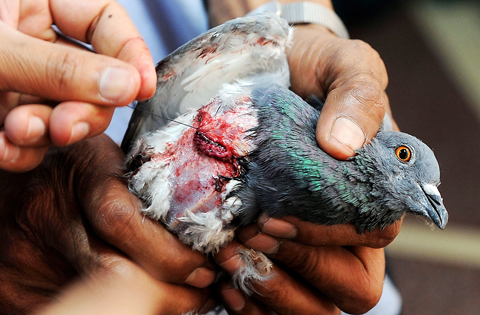
PHOTO: AFP
Many are brought in by worried owners who must balance their concern for their pets with the knowledge that admitting them to the hospital means giving them away for good.
Since it opened in 1927, the hospital has operated a policy whereby all birds must be released after treatment, rather than returned to their owners or the person who brought them in.
The hospital is managed by followers of Jainism, one of the oldest religions originating in India, who believe that every living thing has a soul that is potentially divine.
Such is their commitment to avoid harming any living being that Jain monks wear masks over their mouths to avoid accidentally swallowing insects.
Funded entirely by private donations — all treatments are free — the three-story hospital has a dedicated following that never lets it go short of money, medicines or bird feed.
Bolstering the hospital’s reputation further is its startlingly clean environment, with no bird droppings or foul smells.
“It’s cleaner than many government hospitals,” said Rinki Patel, a housewife and first-time visitor to the facility that boasts an operating room, an intensive care unit and a general ward.
At any one time, the hospital looks after 3,000 to 5,000 “resident” patients.
The most common are pigeons, doves, parrots and budgies, with the odd peacock to brighten things up.
The seriously ill are put into intensive care on the first floor, where they have a cage to themselves. On other “wards” dozens of birds share large cages.
Broken wings and bones are carefully set and bandaged. Those in “post operative care” are dosed with antibiotics and carefully monitored for infections. Those too weak to eat are hand fed.
“That bird has paralysis caused by a virus,” Gaur said, pointing to a black pigeon.
“It looks as if it has just cocked its head or twisted its neck, but it’s a serious condition. Some nerve soothing medication will cure it,” he said.
The hospital claims a recovery rate of 90 percent.
Common injuries include those caused by children throwing stones, or birds getting caught in the blades of ventilators or ceiling fans, but some ailments require highly specialized treatment.
“Recently we operated on two peacocks with eye tumors. The growth was removed in both cases. One was as big as a tennis ball,” Gaur said, adding that both patients were well on the way to recovery.
Delhi’s high pollution levels have also led to a rise in avian asthma cases. All patients are put on a high-nutrient diet of seeds, grain, fruits and vegetables during their stay.
“We have had some eagles as patients. But they were also kept on a vegetarian diet,” said Gaur’s assistant vet, Vinod Kumar.
Once a week, those deemed to have recovered are taken to the hospital roof to be set free, although a fair number opt to resist the call of the wild.
“Though we encourage them to fly, only a few do. Others stay back because they are used to the easily available food here,” Kumar said. “They show no inclination to leave.”
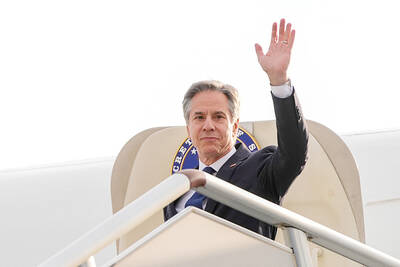
‘IN A DIFFERENT PLACE’: The envoy first visited Shanghai, where he attended a Chinese basketball playoff match, and is to meet top officials in Beijing tomorrow US Secretary of State Antony Blinken yesterday arrived in China on his second visit in a year as the US ramps up pressure on its rival over its support for Russia while also seeking to manage tensions with Beijing. The US diplomat tomorrow is to meet China’s top brass in Beijing, where he is also expected to plead for restraint as Taiwan inaugurates president-elect William Lai (賴清德), and to raise US concerns on Chinese trade practices. However, Blinken is also seeking to stabilize ties, with tensions between the world’s two largest economies easing since his previous visit in June last year. At the
Nearly half of China’s major cities are suffering “moderate to severe” levels of subsidence, putting millions of people at risk of flooding, especially as sea levels rise, according to a study of nationwide satellite data released yesterday. The authors of the paper, published by the journal Science, found that 45 percent of China’s urban land was sinking faster than 3mm per year, with 16 percent at more than 10mm per year, driven not only by declining water tables, but also the sheer weight of the built environment. With China’s urban population already in excess of 900 million people, “even a small portion

UNSETTLING IMAGES: The scene took place in front of TV crews covering the Trump trial, with a CNN anchor calling it an ‘emotional and unbelievably disturbing moment’ A man who doused himself in an accelerant and set himself on fire outside the courthouse where former US president Donald Trump is on trial has died, police said yesterday. The New York City Police Department (NYPD) said the man was declared dead by staff at an area hospital. The man was in Collect Pond Park at about 1:30pm on Friday when he took out pamphlets espousing conspiracy theories, tossed them around, then doused himself in an accelerant and set himself on fire, officials and witnesses said. A large number of police officers were nearby when it happened. Some officers and bystanders rushed

Beijing is continuing to commit genocide and crimes against humanity against Uyghurs and other Muslim minorities in its western Xinjiang province, U.S. Secretary of State Antony Blinken said in a report published on Monday, ahead of his planned visit to China this week. The State Department’s annual human rights report, which documents abuses recorded all over the world during the previous calendar year, repeated language from previous years on the treatment of Muslims in Xinjiang, but the publication raises the issue ahead of delicate talks, including on the war in Ukraine and global trade, between the top U.S. diplomat and Chinese


 RSS
RSS