


Iranians shouted “independence, liberty, Islamic republic” during the revolution that toppled the US-backed monarchy, but hopes for freedom and democracy have yet to be fulfilled 30 years down the road.
Veteran revolutionaries see the Islamic republic system as a far cry from the “despotic” rule of the shah that ended on Feb. 10, 1979, and are proud Iran is an independent state free from foreign meddling.
For many conservatives it is an ideal state where people choose their rulers and even the supreme leader — the undisputed number one who has the final say in all key policy issues — is elected by an indirect vote.

PHOTO: AFP
However, moderates and reformists complain that the current system, where a powerful watchdog vets candidates running for public office, prevents people from determining their fate through a truly democratic process.
The revolution’s founder, the late Ayatollah Ruhollah Khomeini, “wanted an Islamic republic reliant on people’s votes where Islam is observed,” pro-reform cleric and two-time parliament speaker Mehdi Karroubi said.
“We have elections, but there are interventions which hurt the republican nature of the system,” he said.
“Some intervention is legal such as that of the Guardians Council, but it has vastly expanded its control and reads too much into its overseeing role,” Karroubi said.
The council is a non-elected body tasked with overseeing elections under the Constitution and screening parliamentary legislation to ensure it abides by Islam and the Constitution.
It is made up of six senior clerics appointed by the supreme leader and six legal experts named by the judiciary chief — who is also appointed by the leader — whose names are submitted to parliament for approval.
The council has over the past years disqualified thousands of mostly reformist parliamentary and presidential hopefuls, after scrutinizing their allegiance to supreme leader Ayatollah Ali Khamenei and the Constitution.
It has also trashed many bills, especially those adopted by the reformist-dominated parliament of between 2000 and 2004.
But conservatives regard the vetting as a blessing “because incompetent people and secularists should not come to power,” said Asadollah Badamchian, deputy head of the conservative Islamic Coalition Party.
He also dismissed criticism about lack of freedom in the Islamic republic, adding that his imprisonment and torture under the shah for political dissent.
“Naturally no system can tolerate those who seek to overthrow it, but now we have about 250 political parties and groups who freely meet and a press that harshly criticizes the government,” Badamchian said.
His views, however, are not shared by everyone.
Non-Islamic parties such as those with Marxist and liberal leanings are banned in Iran and several groups that played a key role in the revolution have been forced out of politics, with their candidates disqualified in most polls.
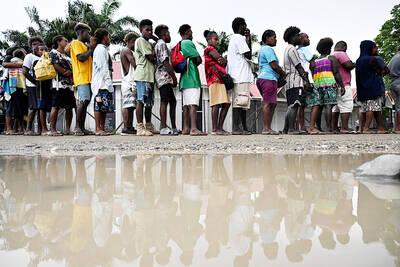
SEEKING CHANGE: A hospital worker said she did not vote in previous elections, but ‘now I can see that maybe my vote can change the system and the country’ Voting closed yesterday across the Solomon Islands in the south Pacific nation’s first general election since the government switched diplomatic allegiance from Taiwan to Beijing and struck a secret security pact that has raised fears of the Chinese navy gaining a foothold in the region. The Solomon Islands’ closer relationship with China and a troubled domestic economy weighed on voters’ minds as they cast their ballots. As many as 420,000 registered voters had their say across 50 national seats. For the first time, the national vote also coincided with elections for eight of the 10 local governments. Esther Maeluma cast her vote in the
Nearly half of China’s major cities are suffering “moderate to severe” levels of subsidence, putting millions of people at risk of flooding, especially as sea levels rise, according to a study of nationwide satellite data released yesterday. The authors of the paper, published by the journal Science, found that 45 percent of China’s urban land was sinking faster than 3mm per year, with 16 percent at more than 10mm per year, driven not only by declining water tables, but also the sheer weight of the built environment. With China’s urban population already in excess of 900 million people, “even a small portion

UNSETTLING IMAGES: The scene took place in front of TV crews covering the Trump trial, with a CNN anchor calling it an ‘emotional and unbelievably disturbing moment’ A man who doused himself in an accelerant and set himself on fire outside the courthouse where former US president Donald Trump is on trial has died, police said yesterday. The New York City Police Department (NYPD) said the man was declared dead by staff at an area hospital. The man was in Collect Pond Park at about 1:30pm on Friday when he took out pamphlets espousing conspiracy theories, tossed them around, then doused himself in an accelerant and set himself on fire, officials and witnesses said. A large number of police officers were nearby when it happened. Some officers and bystanders rushed

HYPOCRISY? The Chinese Ministry of Foreign Affairs yesterday asked whether Biden was talking about China or the US when he used the word ‘xenophobic’ US President Joe Biden on Wednesday called for a hike in steel tariffs on China, accusing Beijing of cheating as he spoke at a campaign event in Pennsylvania. Biden accused China of xenophobia, too, in a speech to union members in Pittsburgh. “They’re not competing, they’re cheating. They’re cheating and we’ve seen the damage here in America,” Biden said. Chinese steel companies “don’t need to worry about making a profit because the Chinese government is subsidizing them so heavily,” he said. Biden said he had called for the US Trade Representative to triple the tariff rates for Chinese steel and aluminum if Beijing was


 RSS
RSS