


Russia’s deepening strategic partnership with Venezuela took a dramatic step forward on Tuesday when it emerged that Moscow has agreed to build Venezuela’s first nuclear reactor.
Russian President Dmitry Medvedev is expected to sign a nuclear cooperation agreement with Venezuelan President Hugo Chavez, during a visit to Latin America next week, part of a determined Russian push into the region.
The reactor is to be named after Humberto Fernandez Moran, a late Venezuelan research scientist and former science minister, Chavez has announced. It is one of many accords he hopes to sign while hosting Medvedev in Caracas next week.
The prospect of a nuclear deal between Moscow and Caracas, following a surge in Russian economic, military, political and intelligence activity in Latin America, is likely to alarm the US and present an early challenge to the Obama administration.
“Hugo Chavez joins the nuclear club,” Russian’s Vedomosti newspaper trumpeted yesterday.
Venezuela’s socialist leader said the reactor may be based in the eastern state of Zulia. He stressed that the project would be for peaceful purposes. As if to underline that point, four Japanese survivors from the Hiroshima and Nagasaki bombs visited Venezuela this week at the government’s invitation.
The energy ministry, which is scouting locations, said the project was at a very early stage. A report which mooted a nuclear reactor long before Chavez came to power has been dusted off.
Despite abundant oil reserves, Venezuela’s energy infrastructure is creaking and prone to blackouts. A nuclear reactor would enable the country to utilize its rich uranium deposits and allay criticism that the government has neglected energy investment.
More importantly for Moscow and Caracas, a nuclear deal will showcase a partnership which advocates creating new “poles” of power to check US hegemony.
Nick Day, a Latin American specialist, said the nuclear deal was deliberately timed to pile pressure on the US administration during a moment of transition and weakness.
“Russia is maneuvering hard in the time between Obama’s election and his inauguration. What the Russians are trying to do is to set up a chessboard that gives them greater mobility in negotiations when he [Obama] comes to power,” Day said.
He added: “Russia’s message is: ‘We can exert influence in your backyard if you continue to exert influence in our backyard. If you don’t take your missiles out of Poland and end NATO expansion we’re going to increase our influence in Latin America and do things to provoke you.’”
Sergei Novikov, spokesman for Russia’s federal nuclear agency, said no reactor can be built until both countries have signed a preliminary agreement on nuclear cooperation. This will be signed next week, Novikov told Vedomosti.
Both presidents are also expected to firm up details of a Russian-Venezuelan energy consortium to jointly produce and sell oil and gas.
Russian companies which are already exploring oilfields in Venezuela could then extend their reach to fields in Ecuador and Bolivia.
Venezuela has bought US$4 billion in Russian arms, including Sukhoi fighter jets, making it one of Moscow’s best clients. Chavez has spoken of also buying Project 636 diesel submarines, Mi-28 combat helicopters, T72 tanks and air-defense systems.
Despite the spending spree, Venezuela’s military has not tipped the regional balance of power.
Chavez’s armed forces lag behind that of Brazil, Chile and Colombia and analysts question Venezuelan effectiveness.
For Russia’s president, however, Caracas is a valuable springboard into Latin America. In addition to Venezuela, Medvedev will visit Peru, Brazil and Cuba — the first trip by a Russian leader to Havana in eight years.
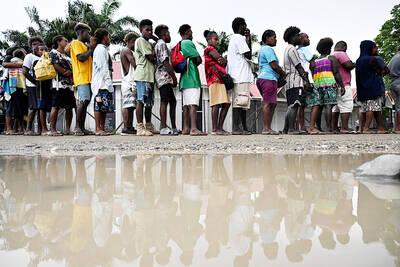
SEEKING CHANGE: A hospital worker said she did not vote in previous elections, but ‘now I can see that maybe my vote can change the system and the country’ Voting closed yesterday across the Solomon Islands in the south Pacific nation’s first general election since the government switched diplomatic allegiance from Taiwan to Beijing and struck a secret security pact that has raised fears of the Chinese navy gaining a foothold in the region. The Solomon Islands’ closer relationship with China and a troubled domestic economy weighed on voters’ minds as they cast their ballots. As many as 420,000 registered voters had their say across 50 national seats. For the first time, the national vote also coincided with elections for eight of the 10 local governments. Esther Maeluma cast her vote in the
Nearly half of China’s major cities are suffering “moderate to severe” levels of subsidence, putting millions of people at risk of flooding, especially as sea levels rise, according to a study of nationwide satellite data released yesterday. The authors of the paper, published by the journal Science, found that 45 percent of China’s urban land was sinking faster than 3mm per year, with 16 percent at more than 10mm per year, driven not only by declining water tables, but also the sheer weight of the built environment. With China’s urban population already in excess of 900 million people, “even a small portion

UNSETTLING IMAGES: The scene took place in front of TV crews covering the Trump trial, with a CNN anchor calling it an ‘emotional and unbelievably disturbing moment’ A man who doused himself in an accelerant and set himself on fire outside the courthouse where former US president Donald Trump is on trial has died, police said yesterday. The New York City Police Department (NYPD) said the man was declared dead by staff at an area hospital. The man was in Collect Pond Park at about 1:30pm on Friday when he took out pamphlets espousing conspiracy theories, tossed them around, then doused himself in an accelerant and set himself on fire, officials and witnesses said. A large number of police officers were nearby when it happened. Some officers and bystanders rushed

HYPOCRISY? The Chinese Ministry of Foreign Affairs yesterday asked whether Biden was talking about China or the US when he used the word ‘xenophobic’ US President Joe Biden on Wednesday called for a hike in steel tariffs on China, accusing Beijing of cheating as he spoke at a campaign event in Pennsylvania. Biden accused China of xenophobia, too, in a speech to union members in Pittsburgh. “They’re not competing, they’re cheating. They’re cheating and we’ve seen the damage here in America,” Biden said. Chinese steel companies “don’t need to worry about making a profit because the Chinese government is subsidizing them so heavily,” he said. Biden said he had called for the US Trade Representative to triple the tariff rates for Chinese steel and aluminum if Beijing was


 RSS
RSS