


French President Nicolas Sarkozy arrived in Moscow yesterday to seek a lasting peace deal for Georgia that will persuade Russia to pull its troops out of positions deep inside the ex-Soviet state.
Four weeks after Sarkozy brokered the ceasefire deal between Russia and its smaller neighbor, the West says Moscow has yet to honor half of the six-point plan, including pulling troops back to positions they held before a brief war with Georgia.
The Kremlin says a provision in the deal allowing it to conduct “special measures” permits the stationing of troops in a buffer zone around the regions of South Ossetia and Abkhazia — an interpretation Tbilisi, and the West, denies.
Sarkozy is returning to Moscow with the backing of the EU, whose leaders agreed last week to postpone talks with Russia on a new partnership pact scheduled for later this month if Moscow did not pull back its forces.
“We will ask Russia to apply the six-point plan scrupulously,” Sarkozy told a news conference at the end of the EU leaders’ summit last week.
“The return of spheres of influence is unacceptable. Yalta is over,” he said, referring to the 1945 major powers’ meeting in the Crimea which helped shape post-World War II Europe.
Sarkozy, whose country holds the rotating EU presidency, was to be accompanied by European Commission President Jose Manuel Barroso and EU foreign policy chief Javier Solana. They were scheduled to meet Russian President Dmitry Medvedev in a palace near Moscow.
In addition to a withdrawal, Sarkozy was to press Medvedev to accept more international observers to monitor the pullout and to set up talks on security arrangements in the rebel regions of South Ossetia and Abkhazia, which Russia stormed after Georgia tried to take back South Ossetia last month, officials said.
“It seems to us that it would be good to manage in Moscow to set a date and a place for these international discussions,” an official close to Sarkozy told reporters ahead of the trip.
The talks are part of the six-point plan agreed by both sides.
In related news, the UN’s highest court started hearings yesterday in a bid by Georgia to end alleged rights abuses by Russia in the two countries’ showdown over the rebel regions of South Ossetia and Abkhazia.
The International Court of Justice (ICJ) in The Hague would hear three days of argument in a Georgian application for interim protection against “ethnic cleansing” it accuses Russia of committing on Georgian territory.
Georgia says Russia has assumed control over South Ossetia, Abkhazia and adjacent areas within Georgian territory. It claims that ethnic Georgians in these areas have been subjected to physical violence causing civilian deaths, terror and a mass exodus of inhabitants.
“The manifest objective of this discriminatory campaign is the mass-expulsion of the ethnic Georgian population from South Ossetia, Abkhazia and other neighbouring areas of Georgia,” the application states.
“It reflects a Russian policy, commencing in the 1990s, to consolidate the authority of ethnic separatists under Russia’s direction and control over Georgia’s territory through ethnic cleansing and denial of the right of return,” it says.
It asks the court to order Russia to stop discriminatory acts and to allow refugees to return.
Georgia instituted proceedings against Russia before the ICJ on Aug. 12, accusing it of breaches of the 1965 International Convention on the Elimination of All Forms of Racial Discrimination.
As it can take months for the ICJ to decide whether or not to entertain the case, Georgia brought another application two days later asking for interim protection measures.
A decision is expected within weeks. Russia has not indicated on what grounds it intends to contest the application.
The ICJ has no powers to enforce its judgments, which have on occasion been simply ignored by state parties.
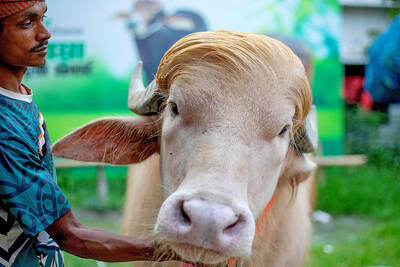
Crowds in Bangladesh are flocking to snap photographs with an unlikely social media star — an albino buffalo with flowing blond hair nicknamed “Donald Trump” that is due to be sacrificed within days. Owner Zia Uddin Mridha, 38, said his brother named the 700kg bull over its flowing helmet of hair resembling the signature look of the US president. “My younger brother picked this name because of the buffalo’s extraordinary hair,” he said at his farm in Narayanganj, just outside the capital, Dhaka. Mridha said that a constant stream of curious visitors — social media fans, onlookers and children — have come throughout
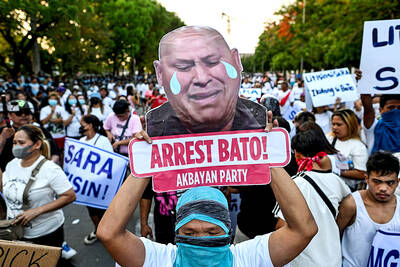
The Philippines said it has asked the country’s Supreme Court to allow it to arrest former Philippine president Rodrigo Duterte’s chief drug war enforcer to stand trial in an international tribunal. The International Criminal Court (ICC) last week unsealed an arrest warrant against Philippine Senator Ronald dela Rosa, accusing him along with Duterte and other “coperpetrators” of the “crime against humanity of murder.” Dela Rosa briefly sought refuge in the Philippine Senate last week while asking the Philippine Supreme Court to stop an ongoing attempt by government agents to arrest him. “By his own conduct, he has placed himself outside the protection of

It began as a satirical online project. Now millions of young people in India are flocking to it as an outlet for their frustration. A parody political party called the Cockroach Janta Party, with the insect as its symbol, has exploded across India’s social media by turning absurdist humor into protest. Memes and short videos mocking corruption, joblessness and political dysfunction have flooded social media sites, where millions of users are embracing the cockroach — known for its ability to survive harsh conditions — as a tongue-in-cheek symbol of endurance. The online movement’s rise has been unusually rapid. The Cockroach Janta Party (CJP)
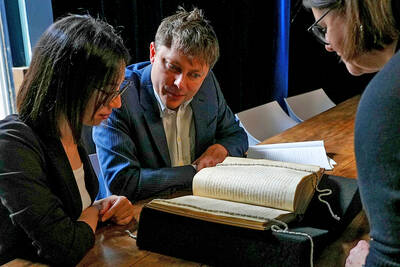
The researchers in Ireland looked at their computer screen, marveling at a medieval book tracked down in a Roman library. They flipped through its digitized pages and found their sought-after treasure: the oldest surviving English poem. “We were extremely surprised. We were speechless. We couldn’t believe our eyes when we first saw that,” said Elisabetta Magnanti, a visiting research fellow at Trinity College Dublin’s school of English. The poem was also within the main body of Latin text, she said, calling it “extraordinary.” Composed in Old English by a Northumbrian agricultural worker in the 7th century, Caedmon’s Hymn appears within some copies of


 RSS
RSS