


In a calm voice, Isabel Miranda Wallace explained how her son’s kidnapping transformed her family into a team of sleuths: trailing suspects, taking on false identities, physically capturing kidnappers and even digging up a body.
“In Mexico, authorities don’t care about kidnappers or the families of kidnap victims. They never do anything,” Wallace said in her gated home in southern Mexico City, guarded by three armed police since she escaped an assassination attempt last month.
In the three long years since her 31-year-old son Hugo was snatched, the search for his captors has taken over Wallace’s life. She stopped her work as a teacher on July 12, 2005, the day after he disappeared.
“Why do I continue? Because I think that any mother who has her son stolen from her has to look for him,” the 57-year-old said.
With kidnappings at an epidemic pace — 323 cases in Mexico City in the first half of this year, official figures show, and 400 according to a rights group, compared with 438 for the whole of last year — Mexico has surpassed Colombia as the world’s kidnapping center, Dutch NGO Pax Christi says.
The federal government has proposed new measures to tackle kidnapping in recent weeks, including tougher sentences, and a national security summit on kidnapping is scheduled on Thursday.
But for families affected, there is little patience or trust for state action.
Wallace’s family’s efforts led to the arrest of four members of the kidnapping gang, and the leader was a former police officer, Cesar Freyre.
Although the case is extreme, it reflects widespread frustration with the impunity kidnappers exhibit, from whisking off victims in a taxi to empty their bank accounts in “express” kidnappings, to fake kidnappings involving a telephone call and a lie that a relative is being held, to brutal murders after ransoms are paid.
“They say that in Mexico there’s a kidnapping for every level of society,” said lawyer Max Morales, a kidnapping and security consultant for 20 years.
Kidnappings are also growing more violent.
The recent high-profile kidnapping and assassination teenager Fernando Marti — abducted on his way to school in Mexico City with a driver and bodyguard — in which police were allegedly involved, unleashed a new wave of public anger.
Of 8,000 abductions reported across the country since 1994, the National Council for Public Security and Penal Justice says 700 victims died although their families had paid a ransom.
Some blame the violence on the involvement of drug gangs seeking extra money to survive a government crackdown begun in 2006.
But experts say it is also a natural progression as kidnappers compete for more money and renown, cutting off an extra ear or finger from a victim or, in the Marti case, leaving behind a signature flower with the victim’s body.
Police involvement is also deep-rooted.
“Today, in 70 or 80 percent of cases, police or ex-police belong to kidnapping groups in Mexico City,” Morales says.
Alejandro Marti, the father of Fernando, defended his decision to hire a private negotiator to help find his son, who was abducted at a fake police roadblock.
Nearly half of China’s major cities are suffering “moderate to severe” levels of subsidence, putting millions of people at risk of flooding, especially as sea levels rise, according to a study of nationwide satellite data released yesterday. The authors of the paper, published by the journal Science, found that 45 percent of China’s urban land was sinking faster than 3mm per year, with 16 percent at more than 10mm per year, driven not only by declining water tables, but also the sheer weight of the built environment. With China’s urban population already in excess of 900 million people, “even a small portion

UNSETTLING IMAGES: The scene took place in front of TV crews covering the Trump trial, with a CNN anchor calling it an ‘emotional and unbelievably disturbing moment’ A man who doused himself in an accelerant and set himself on fire outside the courthouse where former US president Donald Trump is on trial has died, police said yesterday. The New York City Police Department (NYPD) said the man was declared dead by staff at an area hospital. The man was in Collect Pond Park at about 1:30pm on Friday when he took out pamphlets espousing conspiracy theories, tossed them around, then doused himself in an accelerant and set himself on fire, officials and witnesses said. A large number of police officers were nearby when it happened. Some officers and bystanders rushed
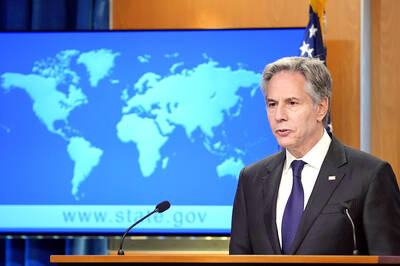
Beijing is continuing to commit genocide and crimes against humanity against Uyghurs and other Muslim minorities in its western Xinjiang province, U.S. Secretary of State Antony Blinken said in a report published on Monday, ahead of his planned visit to China this week. The State Department’s annual human rights report, which documents abuses recorded all over the world during the previous calendar year, repeated language from previous years on the treatment of Muslims in Xinjiang, but the publication raises the issue ahead of delicate talks, including on the war in Ukraine and global trade, between the top U.S. diplomat and Chinese

HYPOCRISY? The Chinese Ministry of Foreign Affairs yesterday asked whether Biden was talking about China or the US when he used the word ‘xenophobic’ US President Joe Biden on Wednesday called for a hike in steel tariffs on China, accusing Beijing of cheating as he spoke at a campaign event in Pennsylvania. Biden accused China of xenophobia, too, in a speech to union members in Pittsburgh. “They’re not competing, they’re cheating. They’re cheating and we’ve seen the damage here in America,” Biden said. Chinese steel companies “don’t need to worry about making a profit because the Chinese government is subsidizing them so heavily,” he said. Biden said he had called for the US Trade Representative to triple the tariff rates for Chinese steel and aluminum if Beijing was


 RSS
RSS