


For 40 years, this base on the coast of French Guiana has been the prestigious symbol of French, and then European, ambitions in space. But today, the Guiana Space Center is girding for a new era when it will host Russian rockets and engineers who just a short while ago were Europe’s space rivals.
A freighter was due to dock in Cayenne today, bearing a first consignment of 150 containers of equipment to fit out a launch pad at the center, where, from the second half of next year, the first “European” Soyuz is scheduled to blast into space.
“The challenge will be to put together everything that was made in Russia with what’s been built here in Guiana and to ensure that it works,” said Jean-Yves Le Gall of Arianespace, the European company that has signed the Soyuz deal.
“All the civil engineering work on the pad will be finished by the end of August and after that, the task will be to install the Russian equipment,” said Frederic Munoz, a launch executive with France’s National Center for Space Studies.
A team of 14 Russian technicians will be working on the first consignment, to be followed by nearly 90 more in the following weeks.
Two more shiploads will arrive by the end of the year, followed by a fourth next year, which will bring the first rocket. At peak period next year, between 200 and 300 Russians will be on site in Kourou, assembling and testing the equipment.
A tried-and-trusted veteran of the space race, Soyuz is being brought to Kourou to help Arianespace, which markets Europe’s Ariane rocket for satellite launches, fill a gap in its service range.
Its sole vehicle is the Ariane 5 ECA heavy rocket, which has the capacity to place a massive 9.5-tonne payload into geostationary orbit.
That’s fine for multiple satellite launches and big single charges, such as the European Space Agency’s robot cargo ship, the Automated Transfer Vehicle.
But using a rocket this size makes no economic sense for the burgeoning market to launch smaller satellites in single operations.
At the bottom of Arianespace’s product range will be a small rocket called Vega, capable of place 1.5 tonnes into a low orbit of up to 700km. Vega is being built under an ESA program by the Italian Space Agency and Avio SpA of Italy.
In Kourou, the main engineering work has been an assembly hall for the launcher, which is put together horizontally and then raised vertically for blast-off.
In contrast, Ariane is constructed vertically.
There is also a command post, protected by a 1m-thick wall in case of any accidental explosion.
Arianespace has shareholders in 10 European countries, most of which are commercial aerospace companies.

Republican US lawmakers on Friday criticized US President Joe Biden’s administration after sanctioned Chinese telecoms equipment giant Huawei unveiled a laptop this week powered by an Intel artificial intelligence (AI) chip. The US placed Huawei on a trade restriction list in 2019 for contravening Iran sanctions, part of a broader effort to hobble Beijing’s technological advances. Placement on the list means the company’s suppliers have to seek a special, difficult-to-obtain license before shipping to it. One such license, issued by then-US president Donald Trump’s administration, has allowed Intel to ship central processors to Huawei for use in laptops since 2020. China hardliners
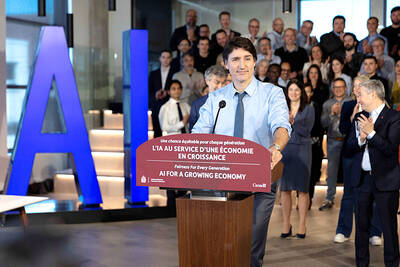
DISADVANTAGE: Erin O’Toole, who led the Conservatives during the election campaign in 2021, estimated that the interference cost his party as many as nine legislative seats Canada’s domestic spy agency on Monday concluded that China interfered in the past two elections, an official probe heard, the firmest evidence so far of suspected Chinese meddling in Canadian politics. Canadian Prime Minister Justin Trudeau’s Liberal Party won both the elections, held in 2019 and 2021. Under pressure from opposition lawmakers unhappy about media reports on China’s possible role, Trudeau set up a commission into foreign interference. The commission was shown a slide on Monday containing an extract of a briefing in February last year from the Canadian Security Intelligence Service (CSIS). “We know that the PRC [People’s Republic of China] clandestinely
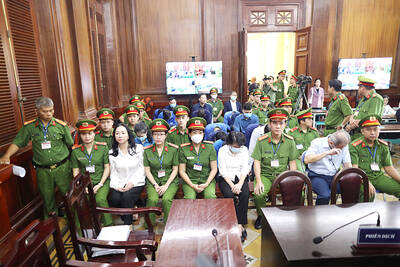
A top Vietnamese property tycoon was on Thursday sentenced to death in one of the biggest corruption cases in history, with an estimated US$27 billion in damages. A panel of three hand-picked jurors and two judges rejected all defense arguments by Truong My Lan, chair of major developer Van Thinh Phat, who was found guilty of swindling cash from Saigon Commercial Bank (SCB) over a decade. “The defendant’s actions ... eroded people’s trust in the leadership of the [Communist] Party and state,” read the verdict at the trial in Ho Chi Minh City. After the five-week trial, 85 others were also sentenced on

‘DELUSIONAL’: Targeting the families of Hamas’ leaders would not push the group to change its position or to give up its demands for Palestinians, Ismail Haniyeh said Israeli aircraft on Wednesday killed three sons of Hamas’ top political leader in the Gaza Strip, striking high-stakes targets at a time when Israel is holding delicate ceasefire negotiations with the militant group. Hamas said four of the leader’s grandchildren were also killed. Ismail Haniyeh’s sons are among the highest-profile figures to be killed in the war so far. Israel said they were Hamas operatives, and Haniyeh accused Israel of acting in “the spirit of revenge and murder.” The deaths threatened to strain the internationally mediated ceasefire talks, which appeared to gain steam in recent days even as the sides remain far


 RSS
RSS