


Belgium woke up to a new political crisis yesterday after Belgian Prime Minister Yves Leterme resigned overnight, unable to broker a power-sharing agreement that has split the country in two for more than a year.
King Albert II, informed by Leterme of his decision, is “weighing” whether to accept the move, a palace statement said in the early hours of the morning, and will begin consulting political leaders immediately.
“It appears that the communities’ conflicting visions of how to give a new equilibrium to our state have become incompatible,” Leterme said in a statement, after his shock move overnight.
But he said “state reform remains essential” implying that with or without him at the head of government the community issue will continue to haunt Belgium.
It is the third time that the 48-year-old Flemish conservative has failed to bridge the deep divisions between Belgium’s two main linguistic communities over whether, and how, to devolve federal powers down to them.
Leterme had set himself a deadline of yesterday to reconcile the parties from Flanders — representing some 60 percent of Belgium’s 10.5 million people — and Wallonia on a way to extensively reform the federal state.
Flanders, Belgium’s Dutch-speaking northern half, craves more regional powers to reflect its prosperity. It also resents subsidizing the less affluent, French-speaking Wallonia region to its south.
Leterme’s resignation ushers in a new period of uncertainty, just as Belgium appeared to have found some sense of stability following a six-month period in which no government could be formed after June 10 elections last year.
Since that crisis, French speakers have agreed to enter into reform talks, realizing it was perhaps the only way to stop Belgium breaking up, and they expressed surprise early yesterday that the prime minister had thrown in the towel.
“There is a strong willingness among French parties to go deep into these reforms,” Belgian Deputy Prime Minister Didier Reynders, who leads the French-speaking Liberals, told Belgium’s Premiere Radio.
“I think we still have time to find a solution in the hours and next few days within the framework of what we already have,” he said. “Otherwise we’ll have to look for something else.”
It was not clear yesterday what would happen next. The king could refuse to accept Leterme’s resignation — the prime minister only took office in March — and demand that he stay on, either in his current capacity or with a fixed and limited mandate.
In this tense climate, no one wants early elections, analysts say, and indeed the problem needs to be resolved to avoid boosting fringe parties in the fast-approaching regional elections next June.
“The king now has to be given time to consult a number of people,” Reynders said. “It’s far too early to say what will happen next.”
A recent opinion poll found that 49.7 percent of Flemish people are in favor of Belgium splitting along linguistic lines.
Yet despite the risks, French speakers have rejected any attempt to break “national solidarity” by, for example, dividing up the social security system into regional branches for each linguistic community.
Another key problem is how to meet the Flemish demand for a special voting district around Brussels to be split up.
This would in effect do away with an arrangement that allows French-speakers in the Flemish suburbs to vote for Francophone politicians in the capital, where they are in the majority.
The complex issue has remained a political hot button, but Leterme had been expected to push back negotiations on the thorniest issues, even though that would probably have created a backlash among his partners.
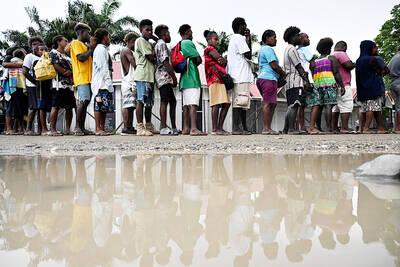
SEEKING CHANGE: A hospital worker said she did not vote in previous elections, but ‘now I can see that maybe my vote can change the system and the country’ Voting closed yesterday across the Solomon Islands in the south Pacific nation’s first general election since the government switched diplomatic allegiance from Taiwan to Beijing and struck a secret security pact that has raised fears of the Chinese navy gaining a foothold in the region. The Solomon Islands’ closer relationship with China and a troubled domestic economy weighed on voters’ minds as they cast their ballots. As many as 420,000 registered voters had their say across 50 national seats. For the first time, the national vote also coincided with elections for eight of the 10 local governments. Esther Maeluma cast her vote in the
Nearly half of China’s major cities are suffering “moderate to severe” levels of subsidence, putting millions of people at risk of flooding, especially as sea levels rise, according to a study of nationwide satellite data released yesterday. The authors of the paper, published by the journal Science, found that 45 percent of China’s urban land was sinking faster than 3mm per year, with 16 percent at more than 10mm per year, driven not only by declining water tables, but also the sheer weight of the built environment. With China’s urban population already in excess of 900 million people, “even a small portion

UNSETTLING IMAGES: The scene took place in front of TV crews covering the Trump trial, with a CNN anchor calling it an ‘emotional and unbelievably disturbing moment’ A man who doused himself in an accelerant and set himself on fire outside the courthouse where former US president Donald Trump is on trial has died, police said yesterday. The New York City Police Department (NYPD) said the man was declared dead by staff at an area hospital. The man was in Collect Pond Park at about 1:30pm on Friday when he took out pamphlets espousing conspiracy theories, tossed them around, then doused himself in an accelerant and set himself on fire, officials and witnesses said. A large number of police officers were nearby when it happened. Some officers and bystanders rushed

HYPOCRISY? The Chinese Ministry of Foreign Affairs yesterday asked whether Biden was talking about China or the US when he used the word ‘xenophobic’ US President Joe Biden on Wednesday called for a hike in steel tariffs on China, accusing Beijing of cheating as he spoke at a campaign event in Pennsylvania. Biden accused China of xenophobia, too, in a speech to union members in Pittsburgh. “They’re not competing, they’re cheating. They’re cheating and we’ve seen the damage here in America,” Biden said. Chinese steel companies “don’t need to worry about making a profit because the Chinese government is subsidizing them so heavily,” he said. Biden said he had called for the US Trade Representative to triple the tariff rates for Chinese steel and aluminum if Beijing was


 RSS
RSS