


A Hindu temple in Cambodia, two historic Malaysian trading towns and an early agricultural site from Papua New Guinea were added to UNESCO’s World Heritage List on Monday.
Honored were the 11th century Preah Vihear temple site, perched on a mountaintop on the Thai-Cambodia border; the cities of the Straits of Malacca, Melaka and George Town in Malaysia; and the Kuk Early Agricultural Site in Papua New Guinea, marking the country’s first entry on the list.
Also earning UNESCO heritage recognition was a sweeping part of the coral reef and lagoon around the French territory of New Caledonia, east of Australia.
The UNESCO committee has been meeting in the oldest of Canadian cities since last Wednesday to consider adding to its coveted list of protected architectural and natural wonders.
A total of 45 new sites were vying for inclusion, with the most controversial the Preah Vihear temple on the Cambodia-Thai border.
Cambodians celebrated in the streets yesterday over their country’s success in having Preah Vihear named a world heritage landmark despite objections in neighboring Thailand, which claims territory around the site.
Thousands danced, sang and waved Cambodian flags, chanting “Long live Preah Vihear temple!” in response to news that UNESCO had granted the temple World Heritage Site status.
“This is a very auspicious day for us. We’re very delighted,” said Ti Vansi, a medical student who joined his peers in skipping class to hold a celebration rally.
In a statement yesterday, Prime Minister Hun Sen called the temple’s designation “a new pride for the people of Cambodia.”
Last week, Cambodia deployed riot police to protect the Thai embassy and Thai-owned businesses in Phnom Penh in fear that continued claims to the temple by some Thais could spark violent protests.
In 1962, the World Court ruled that the 11th-century Khmer Empire temple belonged to Cambodia, although the main entrance lies at the foot of a mountain inside Thailand.
The long-standing row appeared resolved last month, after Thailand endorsed Cambodia’s plan to seek World Heritage status at the UNESCO meeting.
But the deal sparked a political controversy in Thailand, and last week Cambodia closed the mountaintop temple after more than 100 Thais marched to the compound to protest. A Thai court then forced the government to suspend its endorsement of the plan.
The ruins of the Hindu temple are the most important example of ancient Khmer architecture outside of Cambodia’s famed Angkor Wat, and have weathered centuries of wars and dueling territorial claims with Thailand.
Built to honor the Hindu god Shiva, Preah Vihear stretches dramatically up to a cliff-top in the Dangrek mountain range.
UNESCO deemed the site exceptional for its location on a plateau with cliffs overlooking a vast plain and mountain range; its rare architecture and the religious function of the temple; and its carved stone ornamentation.
The UN agency also named as a heritage site 15,000km² of the New Caledonia lagoon, the world’s second largest continuous coral reef in the world after Australia’s Great Barrier reef.
“We are delighted,” said Isabelle Ohlen, vice president of the New Caledonia Congress.
Also on Monday, the heritage committee included examples of the 17th century military architecture of Sebastien Le Prestre de Vauban, who built or upgraded more than 300 fortifications along France’s borders.
Other sites added to the UNESCO list include Slovakian wooden churches, German early 20th century low-income housing, the Renaissance towns of Mantua and Sabbioneta in Italy, and the Stari Grad Plain on the Adriatic island of Hvar, farmed for 2,400 years.
San Marino, too, entered the coveted ranks of the heritage list, said the committee, “as a testimony to the continuity of a free republic since the Middle Ages.”
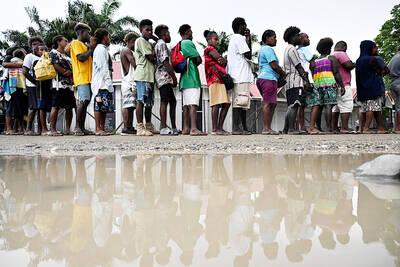
SEEKING CHANGE: A hospital worker said she did not vote in previous elections, but ‘now I can see that maybe my vote can change the system and the country’ Voting closed yesterday across the Solomon Islands in the south Pacific nation’s first general election since the government switched diplomatic allegiance from Taiwan to Beijing and struck a secret security pact that has raised fears of the Chinese navy gaining a foothold in the region. The Solomon Islands’ closer relationship with China and a troubled domestic economy weighed on voters’ minds as they cast their ballots. As many as 420,000 registered voters had their say across 50 national seats. For the first time, the national vote also coincided with elections for eight of the 10 local governments. Esther Maeluma cast her vote in the
Nearly half of China’s major cities are suffering “moderate to severe” levels of subsidence, putting millions of people at risk of flooding, especially as sea levels rise, according to a study of nationwide satellite data released yesterday. The authors of the paper, published by the journal Science, found that 45 percent of China’s urban land was sinking faster than 3mm per year, with 16 percent at more than 10mm per year, driven not only by declining water tables, but also the sheer weight of the built environment. With China’s urban population already in excess of 900 million people, “even a small portion

UNSETTLING IMAGES: The scene took place in front of TV crews covering the Trump trial, with a CNN anchor calling it an ‘emotional and unbelievably disturbing moment’ A man who doused himself in an accelerant and set himself on fire outside the courthouse where former US president Donald Trump is on trial has died, police said yesterday. The New York City Police Department (NYPD) said the man was declared dead by staff at an area hospital. The man was in Collect Pond Park at about 1:30pm on Friday when he took out pamphlets espousing conspiracy theories, tossed them around, then doused himself in an accelerant and set himself on fire, officials and witnesses said. A large number of police officers were nearby when it happened. Some officers and bystanders rushed

HYPOCRISY? The Chinese Ministry of Foreign Affairs yesterday asked whether Biden was talking about China or the US when he used the word ‘xenophobic’ US President Joe Biden on Wednesday called for a hike in steel tariffs on China, accusing Beijing of cheating as he spoke at a campaign event in Pennsylvania. Biden accused China of xenophobia, too, in a speech to union members in Pittsburgh. “They’re not competing, they’re cheating. They’re cheating and we’ve seen the damage here in America,” Biden said. Chinese steel companies “don’t need to worry about making a profit because the Chinese government is subsidizing them so heavily,” he said. Biden said he had called for the US Trade Representative to triple the tariff rates for Chinese steel and aluminum if Beijing was


 RSS
RSS