


The May 12 earthquake in southwestern China has boosted seismic stress in parts of the Sichuan basin, increasing the risk of a dangerous aftershock on some faults that are close to inhabited areas, US geologists warned yesterday.
Their study, published in the British journal Nature, attempts to identify areas where a quake could erupt through “stress transfer,” meaning the process by which a massive quake hikes pressure on adjacent or nearby faults.
The 7.9-magnitude May 12 quake ripped open a fault running from the southwest to the northeast at the boundary between the Longmen Shan highlands and the Sichuan basin. It caused land to slip by as much as 9m.
South of this boundary is a region that is a complex geological mosaic, with faults that can move horizontally, known as “strike-slip” faults, and ones that move up and down, known as “thrust” faults.
The scientists believe the big quake eased pressure on several faults around the northeastern end of the boundary, and also reduced stress on a thrust fault, known as the East Chengdu fault, that runs southeast of the city of Chengdu.
But southwest of Chengdu, in a region inhabited by millions of people, the picture is different.
Several faults, including one near the city of Yaan and another at Xiongpo, have come under greater stress.
Lead researcher Tom Parsons of the US Geological Survey said that the stress increases on these faults were at least sufficient to trigger a big aftershock, if evidence from other temblors worldwide were a guide.
But when this feared event will happen and its magnitude are unknown, he emphasized.
Sometimes a big aftershock occurs very soon after the initial quake.
In 1999, for instance, a 7.1-magnitude quake hit Duzce, northwestern Turkey, shortly after the 7.4-magnitude Izmit quake, while the 2004 9.3-magnitude Sumatra quake, which unleashed the Indian Ocean tsunami, was followed a few months later by a quake measuring 8.7.
Other aftershocks can occur years later, though.
“Globally, the period of concern can last for months, years and up to decades, with an average of seven to 10 years,” Parsons said.
So far, there have been only a few large aftershocks in the Sichuan basin since May 12, with a notable lack of shocks in the six-magnitude range, he said.
This points to two possibilities, one good and the other bad, said Parsons: Either regions surrounding the main shock are not very highly stressed, “or we may still expect a few more large events.”
The other authors of the paper are Chen Ji of the University of California at Santa Barbara and Eric Kirby of Penn State University, Pennsylvania.
They hope the study will help the Chinese authorities seeking to strengthen earthquake protection, such as building standards and civilian awareness, in vulnerable areas.

‘IN A DIFFERENT PLACE’: The envoy first visited Shanghai, where he attended a Chinese basketball playoff match, and is to meet top officials in Beijing tomorrow US Secretary of State Antony Blinken yesterday arrived in China on his second visit in a year as the US ramps up pressure on its rival over its support for Russia while also seeking to manage tensions with Beijing. The US diplomat tomorrow is to meet China’s top brass in Beijing, where he is also expected to plead for restraint as Taiwan inaugurates president-elect William Lai (賴清德), and to raise US concerns on Chinese trade practices. However, Blinken is also seeking to stabilize ties, with tensions between the world’s two largest economies easing since his previous visit in June last year. At the
Nearly half of China’s major cities are suffering “moderate to severe” levels of subsidence, putting millions of people at risk of flooding, especially as sea levels rise, according to a study of nationwide satellite data released yesterday. The authors of the paper, published by the journal Science, found that 45 percent of China’s urban land was sinking faster than 3mm per year, with 16 percent at more than 10mm per year, driven not only by declining water tables, but also the sheer weight of the built environment. With China’s urban population already in excess of 900 million people, “even a small portion
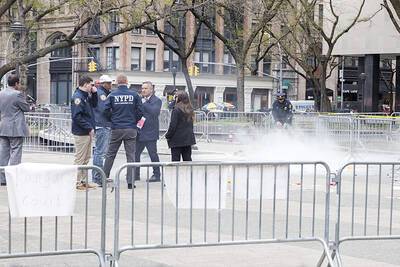
UNSETTLING IMAGES: The scene took place in front of TV crews covering the Trump trial, with a CNN anchor calling it an ‘emotional and unbelievably disturbing moment’ A man who doused himself in an accelerant and set himself on fire outside the courthouse where former US president Donald Trump is on trial has died, police said yesterday. The New York City Police Department (NYPD) said the man was declared dead by staff at an area hospital. The man was in Collect Pond Park at about 1:30pm on Friday when he took out pamphlets espousing conspiracy theories, tossed them around, then doused himself in an accelerant and set himself on fire, officials and witnesses said. A large number of police officers were nearby when it happened. Some officers and bystanders rushed
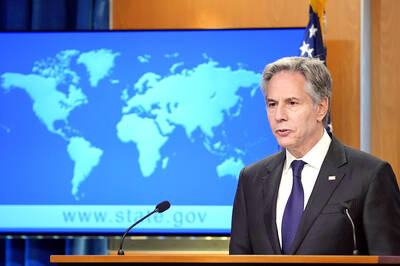
Beijing is continuing to commit genocide and crimes against humanity against Uyghurs and other Muslim minorities in its western Xinjiang province, U.S. Secretary of State Antony Blinken said in a report published on Monday, ahead of his planned visit to China this week. The State Department’s annual human rights report, which documents abuses recorded all over the world during the previous calendar year, repeated language from previous years on the treatment of Muslims in Xinjiang, but the publication raises the issue ahead of delicate talks, including on the war in Ukraine and global trade, between the top U.S. diplomat and Chinese


 RSS
RSS