


Mongolian voters dressed in traditional silk cloaks tied with colorful sashes streamed into polling stations yesterday as the nation began crucial parliamentary elections.
A total of 356 candidates, including 28 incumbent members of parliament, are fighting for 76 seats in the Great Hural.
Early risers had queued ahead of the polls opening and watched as election officials locked ballot boxes and provided voting instructions.
Many came dressed in silk cloaks reserved for special occasions such as holidays.
Inside a Sukhbaatar District polling station — usually used as a basketball court — elders with war medals pinned to their chests were invited to cast the first ballots of the day.
The elections are widely viewed as a political reshuffle necessary to kick-start mining legislation and business contracts leftover by the outgoing parliament.
The nascent mining industry has given the government a budget surplus for the past three years and greater riches are expected from a soon-to-be tapped US$38 billion copper deposit in the Gobi Desert.
The two major parties, the Democrats and the Mongolian People’s Revolutionary Party (MPRP), have each promised large payouts to the general public if they win the election.
In the final days of campaigning the two remained close in tracking polls, but the non-profit Sant Maral Foundation gave a slight advantage to the MPRP.
“The Democrats made a promise to give 1 million tugrik [US$860] to every Mongolian, but they were trumped by the MPRP who offered 1.5 million tugrik,” Sant Maral director Luvsandendeviin Sumati said. “After that the Democrats had nothing else to offer.”
In 2004, Mongolia’s last general election, the two parties nearly split the vote and were forced into a fragile coalition that produced three different prime ministers.
The instability held up economic reforms and shook investor confidence but the economy still grew by 9.9 percent last year.
But the electorate is hungry for new leadership and many voters have indicated they may switch to smaller parties and independents.
“I didn’t vote for the Democrats or the MPRP,” said 74-year-old Namkhai Sanjid as she left a polling station in Sukhbaatar. “They have been power for many years but didn’t do enough for the people. So I chose young candidates.”
Early results should trickle in today but the new voting process is widely expected to cause delays in counting.

Republican US lawmakers on Friday criticized US President Joe Biden’s administration after sanctioned Chinese telecoms equipment giant Huawei unveiled a laptop this week powered by an Intel artificial intelligence (AI) chip. The US placed Huawei on a trade restriction list in 2019 for contravening Iran sanctions, part of a broader effort to hobble Beijing’s technological advances. Placement on the list means the company’s suppliers have to seek a special, difficult-to-obtain license before shipping to it. One such license, issued by then-US president Donald Trump’s administration, has allowed Intel to ship central processors to Huawei for use in laptops since 2020. China hardliners
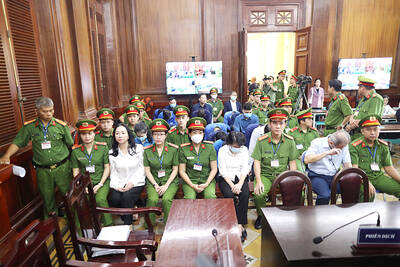
A top Vietnamese property tycoon was on Thursday sentenced to death in one of the biggest corruption cases in history, with an estimated US$27 billion in damages. A panel of three hand-picked jurors and two judges rejected all defense arguments by Truong My Lan, chair of major developer Van Thinh Phat, who was found guilty of swindling cash from Saigon Commercial Bank (SCB) over a decade. “The defendant’s actions ... eroded people’s trust in the leadership of the [Communist] Party and state,” read the verdict at the trial in Ho Chi Minh City. After the five-week trial, 85 others were also sentenced on

Conjoined twins Lori and George Schappell, who pursued separate careers, interests and relationships during lives that defied medical expectations, died this month in Pennsylvania, funeral home officials said. They were 62. The twins, listed by Guinness World Records as the oldest living conjoined twins, died on April 7 at the Hospital of the University of Pennsylvania, obituaries posted by Leibensperger Funeral Homes of Hamburg said. The cause of death was not detailed. “When we were born, the doctors didn’t think we’d make 30, but we proved them wrong,” Lori said in an interview when they turned 50, the Philadelphia Inquirer reported. The
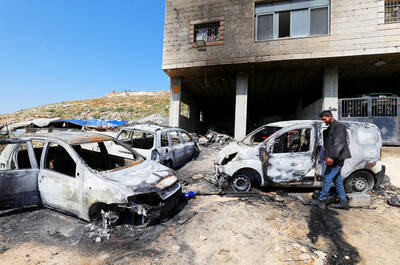
RAMPAGE: A Palestinian man was left dead after dozens of Israeli settlers searching for a missing 14-year-old boy stormed a village in the Israeli-occupied West Bank US President Joe Biden on Friday said he expected Iran to attack Israel “sooner, rather than later” and warned Tehran not to proceed. Asked by reporters about his message to Iran, Biden simply said: “Don’t,” underscoring Washington’s commitment to defend Israel. “We are devoted to the defense of Israel. We will support Israel. We will help defend Israel and Iran will not succeed,” he said. Biden said he would not divulge secure information, but said his expectation was that an attack could come “sooner, rather than later.” Israel braced on Friday for an attack by Iran or its proxies as warnings grew of


 RSS
RSS