


He nudged her gently. She nuzzled him back. And, almost as one, the dozen herpetologists, vets, conservationists and zoo officials who were gathered around the enclosure let out a sigh of relief.
He may be 100 years old and she a sprightly 80, but all hope for one of the most critically endangered species on the planet, the Yangtze giant soft-shell turtle, is vested in them. Nature must take its course and, say scientists, the first signs are more than encouraging.
Only four Yangtze turtles are known to exist. Three are male — one in a zoo in Suzhou in Jiangsu Province, one in Vietnam’s famous Hoan Kiem lake in Hanoi and another in the wild in a lake east of Hanoi.
Until recently there was no known female. Barring a miracle, the species was to die out, mirroring the destiny of Lonesome George, the sole survivor of the Galapagos’s Pinta Island tortoises.
The US-based Wildlife Conservation Society sent urgent circulars to every zoo in China asking for information on large turtles. It seemed futile. Repeated searches have yielded no others in the wild and the few specimens recorded in captivity were male or had died.
Then Changsha Zoo in Hunan Province responded. It had a turtle, but had no idea what kind. It had been bought from a travelling circus about 50 years earlier and had spent the past half century alone and largely unnoticed in a man-made pond.
With its stained, leathery shell, it attracted little interest among visitors to the rundown zoo. But its pig-like snout and wide, flattened dorsal shell resembled the photograph on the conservation society circular. Experts rushed to Changsha. Not only was it indeed a Yangtze turtle, but it was female and, though no teenager, she was still fertile.
“Can you imagine the excitement?” asked Paul Calle, the society’s director of zoological health. “There’s four left in the world and only one of them is female. You can’t get much more endangered than that.”
Today China Girl, as she has been affectionately named, is in a specially adapted enclosure at Suzhou Zoo. She was moved three weeks ago and almost immediately the pair began preliminary breeding activities.
The zoo’s pool was divided into three sections, she on one side, he on the other, with the middle empty. On the second day he was moved into the middle section and swam towards her.
“They saw each other and began sniffing each other through the grate,” said Rick Hudson, from the Turtle Survival Alliance. “The day after that the grate was completely removed. The male was following the female when she moved, then she would move away and then come back to him. It was kind of flirtatious.”
“We had mounting attempts within a couple of days,” he said. “We were worried. We didn’t know when either of them last saw another one of their species.
“If it all continues to go well over the next few weeks, she will lay eggs,” Calle said.
Much of the reptile’s gradual demise has been attributed to the sale of its meat, bones and shells.
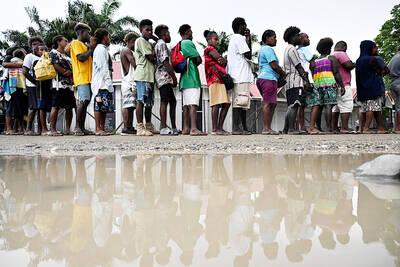
SEEKING CHANGE: A hospital worker said she did not vote in previous elections, but ‘now I can see that maybe my vote can change the system and the country’ Voting closed yesterday across the Solomon Islands in the south Pacific nation’s first general election since the government switched diplomatic allegiance from Taiwan to Beijing and struck a secret security pact that has raised fears of the Chinese navy gaining a foothold in the region. The Solomon Islands’ closer relationship with China and a troubled domestic economy weighed on voters’ minds as they cast their ballots. As many as 420,000 registered voters had their say across 50 national seats. For the first time, the national vote also coincided with elections for eight of the 10 local governments. Esther Maeluma cast her vote in the
Nearly half of China’s major cities are suffering “moderate to severe” levels of subsidence, putting millions of people at risk of flooding, especially as sea levels rise, according to a study of nationwide satellite data released yesterday. The authors of the paper, published by the journal Science, found that 45 percent of China’s urban land was sinking faster than 3mm per year, with 16 percent at more than 10mm per year, driven not only by declining water tables, but also the sheer weight of the built environment. With China’s urban population already in excess of 900 million people, “even a small portion

UNSETTLING IMAGES: The scene took place in front of TV crews covering the Trump trial, with a CNN anchor calling it an ‘emotional and unbelievably disturbing moment’ A man who doused himself in an accelerant and set himself on fire outside the courthouse where former US president Donald Trump is on trial has died, police said yesterday. The New York City Police Department (NYPD) said the man was declared dead by staff at an area hospital. The man was in Collect Pond Park at about 1:30pm on Friday when he took out pamphlets espousing conspiracy theories, tossed them around, then doused himself in an accelerant and set himself on fire, officials and witnesses said. A large number of police officers were nearby when it happened. Some officers and bystanders rushed

HYPOCRISY? The Chinese Ministry of Foreign Affairs yesterday asked whether Biden was talking about China or the US when he used the word ‘xenophobic’ US President Joe Biden on Wednesday called for a hike in steel tariffs on China, accusing Beijing of cheating as he spoke at a campaign event in Pennsylvania. Biden accused China of xenophobia, too, in a speech to union members in Pittsburgh. “They’re not competing, they’re cheating. They’re cheating and we’ve seen the damage here in America,” Biden said. Chinese steel companies “don’t need to worry about making a profit because the Chinese government is subsidizing them so heavily,” he said. Biden said he had called for the US Trade Representative to triple the tariff rates for Chinese steel and aluminum if Beijing was


 RSS
RSS