


There is only silence in Garmser, a ghost town on the edge of the desert in southern Afghanistan. The bazaar is a lonely line of abandoned shops and debris-strewn streets. There is just one trader — a baker — whose sole customers are British soldiers and Afghan police.
Further out, giant bomb craters dot the broken gardens and shredded fruit orchards of empty houses. Now they are inhabited by the British.
Squatting on a rickety rooftop, Corporal Lachlan MacNeil pointed to a cluster of long, low buildings.

PHOTO: AP
“That’s the madrasa [Islamic school]. It’s a training camp for the Taliban,” he said, his face glistening from the morning heat. “Mostly foreigners inside, we hear — central Asians and Arabs, but especially Pakistanis.”
For many Taliban fighters, this deserted, dog-eared town is where the war starts. Garmser is the gateway to Afghanistan for insurgents who stream across the border from Pakistan, 193km to the south. The British base here is their first encounter with the “infidels.”
“They blood themselves against UK forces here, then graduate into the upper valleys,” said Major Neil Den-McKay, commanding officer of a Scottish infantry company stationed at Garmser’s agricultural college.
The fighters that pass before the British doorstep are as diverse as the Taliban has become. There are hard-bitten ideologues from the original Taliban movement of the 1990s, hired local fighters known as “$10 Taliban,” Baluch drug smugglers and al-Qaeda-linked Arabs.
But most, Afghan and British officials say, are Pakistani — ideologically driven young men who consider the war as a religious obligation of struggle, or jihad.
“Our understanding is that the madrasas of northern Pakistan are a major breeding ground that provide the bulk of brainwashed Taliban fighters,” said Lieutenant Colonel Nick Borton, commanding officer of Battlegroup South.
Up to 60 percent of the fighters in Garmser are Pakistani, the Afghan intelligence chief in Garmser, Mir Hamza, said. They come from militant hotspots such as Waziristan and Swat, but also from Punjab, a rich agricultural province with a history of producing radical Islamists.
“Sometimes the Pakistanis have trouble communicating with local [Pashto-speaking] fighters, because they only speak Urdu or Punjabi,” he said.
The insurgents cross from Baluchistan, a sprawling province in western Pakistan whose capital, Quetta, is considered to be the Taliban headquarters by NATO commanders. They muster in remote refugee camps west of Quetta — Girdi Jungle is most frequently mentioned — before slipping across the border in four-wheel drive convoys that split up to avoid detection, Den-McKay said. Sometimes sympathetic border guards help them on their way, he said.
Inside Afghanistan the fighters thunder across the Dasht-i-Margo — a harsh expanse of ancient smuggling trails which means “desert of death” — before reaching the river Helmand. Here, the sand turns to lush fields of poppy and wheat, and they reach Garmser, home to the most southerly British base in Helmand.
A wall-sized map in the British base shows the balance of forces. The British control the town center; the Taliban a sprawl of mud- walled farmhouses that spills south and east. With its irrigation canals, World War I-style trenches and thick vegetation, the area makes for fine guerrilla ground.
“This is one of the few places in Afghanistan where there is a visible frontline,” said Captain Ross Boyd, sitting in an outpost surrounded by barbed wire.
Last week US marines joined the battle, sending more than 1,000 troops to punch through the Taliban lines around Garmser. Their mission is to disrupt the two-way traffic of fighters scooting north and opium shipments headed south. The US met with sporadic, but dogged resistance. Black-clad fighters ambushed them with small arms and rocket propelled grenades, drawing deadly ripostes from helicopter gunships and fighter jets.
The combat continued on Sunday as US heavy guns pounded Taliban positions near Garmser.
At the British base, the UK’s ambassador to Afghanistan, Sherard Cowper-Coles, had a taste of the action. As he was being briefed on the fighting, Taliban machine gun fire erupted close to the camp. The exchange ended when British attack helicopters and mortars opened fire on the suspected Taliban positions.
British officers say they have ample evidence that many of the enemy are Pakistani. While remaining coy about their sources of intelligence, they speak of hearing Punjab accents and of finding Pakistani papers and telephone contacts on dead fighters.
Four months ago, Den-McKay said, British Gurkhas shot dead a Taliban militant near a small outpost known as “Hamburger Hill.” Searching the fighter’s body, they discovered a Pakistani identity card and handwritten notes in Punjabi.
The issue of cross-border infiltration has vexed relations between Pakistan and Afghanistan. Afghan officials say that Islamabad at best turns a blind eye to the flow, at worst encourages it.
The debate has a very different tone in Pakistan. A spate of Islamist bombs has rocked major cities in the past year. But Pakistanis blame US and Nato aggression in Afghanistan for inflaming Islamist passions, and see the Taliban as an expression of Pashtun nationalism.
In Garmser, the Scottish infantrymen hope to push the Taliban back and fill the town with people again.
And as the poppy harvest draws to a close, commanders expect a fresh spurt of fighting in the coming weeks.
Nearly half of China’s major cities are suffering “moderate to severe” levels of subsidence, putting millions of people at risk of flooding, especially as sea levels rise, according to a study of nationwide satellite data released yesterday. The authors of the paper, published by the journal Science, found that 45 percent of China’s urban land was sinking faster than 3mm per year, with 16 percent at more than 10mm per year, driven not only by declining water tables, but also the sheer weight of the built environment. With China’s urban population already in excess of 900 million people, “even a small portion

UNSETTLING IMAGES: The scene took place in front of TV crews covering the Trump trial, with a CNN anchor calling it an ‘emotional and unbelievably disturbing moment’ A man who doused himself in an accelerant and set himself on fire outside the courthouse where former US president Donald Trump is on trial has died, police said yesterday. The New York City Police Department (NYPD) said the man was declared dead by staff at an area hospital. The man was in Collect Pond Park at about 1:30pm on Friday when he took out pamphlets espousing conspiracy theories, tossed them around, then doused himself in an accelerant and set himself on fire, officials and witnesses said. A large number of police officers were nearby when it happened. Some officers and bystanders rushed
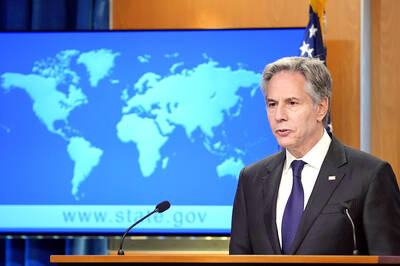
Beijing is continuing to commit genocide and crimes against humanity against Uyghurs and other Muslim minorities in its western Xinjiang province, U.S. Secretary of State Antony Blinken said in a report published on Monday, ahead of his planned visit to China this week. The State Department’s annual human rights report, which documents abuses recorded all over the world during the previous calendar year, repeated language from previous years on the treatment of Muslims in Xinjiang, but the publication raises the issue ahead of delicate talks, including on the war in Ukraine and global trade, between the top U.S. diplomat and Chinese

HYPOCRISY? The Chinese Ministry of Foreign Affairs yesterday asked whether Biden was talking about China or the US when he used the word ‘xenophobic’ US President Joe Biden on Wednesday called for a hike in steel tariffs on China, accusing Beijing of cheating as he spoke at a campaign event in Pennsylvania. Biden accused China of xenophobia, too, in a speech to union members in Pittsburgh. “They’re not competing, they’re cheating. They’re cheating and we’ve seen the damage here in America,” Biden said. Chinese steel companies “don’t need to worry about making a profit because the Chinese government is subsidizing them so heavily,” he said. Biden said he had called for the US Trade Representative to triple the tariff rates for Chinese steel and aluminum if Beijing was


 RSS
RSS