


In Los Angeles, a corporation that runs several small businesses is demonstrating that the training and discipline of working in a small company can make a big contribution to changing the lives of former gang members.
The corporation, Homeboy Industries, runs a silkscreen business, for example, that produced revenue of US$1.1 million last year from sales of custom T-shirts and other apparel for radio stations running promotions and college and private groups holding events. The business employs former gang members to make the T-shirts and uses the money to help offset the corporation's expenses.
Homeboy Silkscreen started 12 years ago in a converted warehouse under a freeway overpass near downtown Los Angeles and now has 18 employees.
Homeboy Bakery has a new plant that has US$3 million in ovens and machinery and its managers hope to produce millions of dollars in revenue within a year or two, said the master baker, Alvaro Ocegueda. He supervises 25 former gang members who have become bakers under his guidance and with professional training at Los Angeles Trade-Technical College, a two-year community college.
There is also a Homegirl Cafe, which has a staff of 27 girls who were "gang impacted" either as auxiliary gang members or as residents of neighborhoods under gang influence. The cafe has brought in more than US$220,000 in five months of serving breakfast and lunch six days a week, said Patricia Zarate, who cooks for and manages the business.
Homeboy Maintenance takes in about US$6,000 a month and a Homeboy store sold US$25,000 in Homeboy shirts and caps in a three-month period.
Though it may sound like a budding conglomerate, Homeboy is a nonprofit charitable corporation that last year had a budget of US$5 million and goals that emphasize rehabilitation over revenue.
"The aim of the cash-producing businesses is that they bring in enough to pay for the free services," said Reverend Gregory Boyle, a Jesuit priest who founded Homeboy Industries in East Los Angeles two decades ago and is now its executive director.
Those services include mental therapy for former gang members, housing assistance, job development counseling and tattoo removal treatments.
The tattoo removals are not a fashion statement but a safety concern. Tattoos are a marker of the rivalries among the 26,000 members of Los Angeles' 250 gangs, the Los Angeles Police Department said.
Nearly half of China’s major cities are suffering “moderate to severe” levels of subsidence, putting millions of people at risk of flooding, especially as sea levels rise, according to a study of nationwide satellite data released yesterday. The authors of the paper, published by the journal Science, found that 45 percent of China’s urban land was sinking faster than 3mm per year, with 16 percent at more than 10mm per year, driven not only by declining water tables, but also the sheer weight of the built environment. With China’s urban population already in excess of 900 million people, “even a small portion

UNSETTLING IMAGES: The scene took place in front of TV crews covering the Trump trial, with a CNN anchor calling it an ‘emotional and unbelievably disturbing moment’ A man who doused himself in an accelerant and set himself on fire outside the courthouse where former US president Donald Trump is on trial has died, police said yesterday. The New York City Police Department (NYPD) said the man was declared dead by staff at an area hospital. The man was in Collect Pond Park at about 1:30pm on Friday when he took out pamphlets espousing conspiracy theories, tossed them around, then doused himself in an accelerant and set himself on fire, officials and witnesses said. A large number of police officers were nearby when it happened. Some officers and bystanders rushed

HYPOCRISY? The Chinese Ministry of Foreign Affairs yesterday asked whether Biden was talking about China or the US when he used the word ‘xenophobic’ US President Joe Biden on Wednesday called for a hike in steel tariffs on China, accusing Beijing of cheating as he spoke at a campaign event in Pennsylvania. Biden accused China of xenophobia, too, in a speech to union members in Pittsburgh. “They’re not competing, they’re cheating. They’re cheating and we’ve seen the damage here in America,” Biden said. Chinese steel companies “don’t need to worry about making a profit because the Chinese government is subsidizing them so heavily,” he said. Biden said he had called for the US Trade Representative to triple the tariff rates for Chinese steel and aluminum if Beijing was
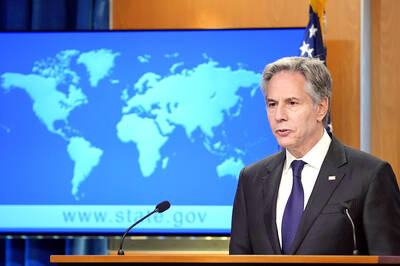
Beijing is continuing to commit genocide and crimes against humanity against Uyghurs and other Muslim minorities in its western Xinjiang province, U.S. Secretary of State Antony Blinken said in a report published on Monday, ahead of his planned visit to China this week. The State Department’s annual human rights report, which documents abuses recorded all over the world during the previous calendar year, repeated language from previous years on the treatment of Muslims in Xinjiang, but the publication raises the issue ahead of delicate talks, including on the war in Ukraine and global trade, between the top U.S. diplomat and Chinese


 RSS
RSS