


A joke going around among Russians these days has President Vladimir Putin and Dmitry Medvedev waking up in the Kremlin in 2023 with a vicious hangover.
Putin says to Medvedev: "Which of us is president and which of us is prime minister today?"
"I don't remember," Medvedev replies. "I could be prime minister today."
"Then go fetch some beer," Putin says.
It tidily sums up the ambiguities of the new power-sharing agreement whereby the baby-faced Medvedev will serve as president with the stern Putin serving below him as prime minister -- tapping into widespread speculation that it's really Putin who will be the boss.
This new odd couple at the pinnacle of power has become ideal fodder for the cherished and once dangerous Russian tradition of poking fun at leaders through satirical jokes called anekdoty.
The latest crop play on the contrast between Putin and Medvedev, riff off of the novelty of a two-headed state, or spin puns out of Medvedev's last name, which stems from the Russian word for bear.
Anekdoty have long been a litmus test of public opinion -- and individual liberties -- in a country where in the past people faced exile, prison or worse for expressing their opinions directly.
"Anekdoty sometimes live for a day and sometimes survive for centuries," linguist Sandjar Yanyshev said. "They remain the main genre of oral tradition in Russian folk culture."
George Orwell once called the joke "a tiny revolution," and nowhere was that taken more literally than in the Soviet Union.
Despite the danger, Soviet citizens told stories lampooning Josef Stalin's heavy Georgian accent. His successor Nikita Khrushchev was ridiculed for his redneck joviality and introduction of corn on collective farms, in regions where it was too cold to grow the crop.
Leonid Brezhnev was mocked for his mumbling speech and, toward the end, his senility, and the last Soviet leader Mikhail Gorbachev was ridiculed for his reputedly domineering wife and for his short-lived campaign to eradicate alcoholism.
Anekdoty remained mostly an oral tradition until the collapse of the Soviet Union, when the first printed anthologies often outsold serious novels.
Russians told tall tales built around former president Boris Yeltsin's heavy drinking, and even the popular Putin could not escape barbed jokes about his KGB history and his use of salty slang.
With the emergence of online media and text messages on mobile phones, Russians today can openly joke about their political leaders -- although not on national TV. Kukly (Puppets), a popular satirical TV show on Russian politics, was closed down in 2001 after the Kremlin objected to Putin being lampooned.
Over the years, the Kremlin has tightened controls on the mass media, and that, perhaps, has led to a modest revival of anekdoty.
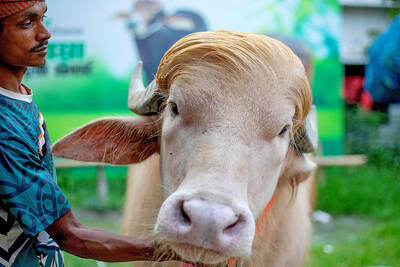
Crowds in Bangladesh are flocking to snap photographs with an unlikely social media star — an albino buffalo with flowing blond hair nicknamed “Donald Trump” that is due to be sacrificed within days. Owner Zia Uddin Mridha, 38, said his brother named the 700kg bull over its flowing helmet of hair resembling the signature look of the US president. “My younger brother picked this name because of the buffalo’s extraordinary hair,” he said at his farm in Narayanganj, just outside the capital, Dhaka. Mridha said that a constant stream of curious visitors — social media fans, onlookers and children — have come throughout
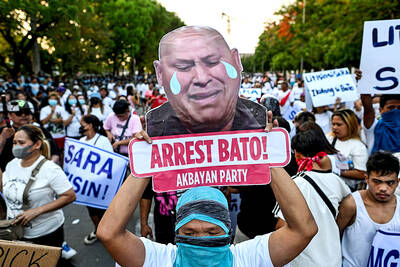
The Philippines said it has asked the country’s Supreme Court to allow it to arrest former Philippine president Rodrigo Duterte’s chief drug war enforcer to stand trial in an international tribunal. The International Criminal Court (ICC) last week unsealed an arrest warrant against Philippine Senator Ronald dela Rosa, accusing him along with Duterte and other “coperpetrators” of the “crime against humanity of murder.” Dela Rosa briefly sought refuge in the Philippine Senate last week while asking the Philippine Supreme Court to stop an ongoing attempt by government agents to arrest him. “By his own conduct, he has placed himself outside the protection of

It began as a satirical online project. Now millions of young people in India are flocking to it as an outlet for their frustration. A parody political party called the Cockroach Janta Party, with the insect as its symbol, has exploded across India’s social media by turning absurdist humor into protest. Memes and short videos mocking corruption, joblessness and political dysfunction have flooded social media sites, where millions of users are embracing the cockroach — known for its ability to survive harsh conditions — as a tongue-in-cheek symbol of endurance. The online movement’s rise has been unusually rapid. The Cockroach Janta Party (CJP)
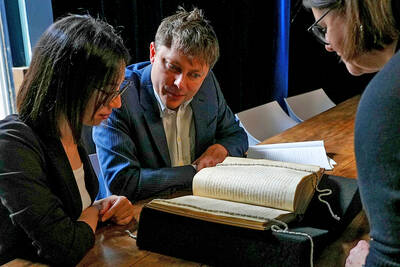
The researchers in Ireland looked at their computer screen, marveling at a medieval book tracked down in a Roman library. They flipped through its digitized pages and found their sought-after treasure: the oldest surviving English poem. “We were extremely surprised. We were speechless. We couldn’t believe our eyes when we first saw that,” said Elisabetta Magnanti, a visiting research fellow at Trinity College Dublin’s school of English. The poem was also within the main body of Latin text, she said, calling it “extraordinary.” Composed in Old English by a Northumbrian agricultural worker in the 7th century, Caedmon’s Hymn appears within some copies of


 RSS
RSS