


Military experts sounded the alarm yesterday over the Japanese military's ability to defend the country after one of its most advanced naval destroyers crashed into a fishing boat, leaving two missing.
Tuesday's collision came as Japan steps up security to ensure safety during July's G8 summit, to be held in the northern resort town of Toyako.
The 165m-long Atago destroyer, returning from a visit to Hawaii to its home port of Yokosuka, crashed into the tuna-fishing boat off the Pacific coast south of Tokyo.
Planes, boats and divers continued their search for a second day yesterday for a father and son who were onboard when the small boat was smashed in half.
The accident sparked bewilderment in Japan as the Atago is the latest and largest of Japan's destroyers, equipped with an Aegis radar system developed by the US, seen as a frontline defense against a North Korean missile attack.
"I may not come off as an expert, but I wonder whether the fishing boat was not detected by the radar," said Yoshimi Watanabe, Japan's state minister in charge of administrative and regulatory reforms.
"What if it had been a terrorist boat on a suicide bombing [mission]?" he asked.
The Aegis system can track incoming missiles by radar, a concern since North Korea fired a missile over Japan's main island in 1998.
"Japan's security cannot be ensured if an Aegis-equipped destroyer fails to avert a collision with a fishing boat," the Yomiuri Shimbun said in an editorial.
The destroyer reportedly hit the brakes only one minute before the collision -- suggesting it spotted the small boat very late.
"If they cannot act in an actual case like this, it is a problem no matter how high quality their equipment and training," said Hisao Iwashima, a military analyst and professor at Seigakuin University Graduate School.
"I believe it was nothing but their carelessness that caused the accident," he said.
Japanese forces have not fired a shot in combat since the end of World War II when the country became constitutionally pacifist and formed a security alliance with the US.
Iwashima asked if the military -- known as the Self-Defense Forces because of the Constitution -- were too dependent on machines at the expense of human ability.
"They must not be alert enough as they had finished an exercise in Hawaii and were reaching their home port," he said.
But Tadasu Kumagai, another military specialist, said it was a misunderstanding that ships with the Aegis system were looking at threats in the immediate vicinity.
"It has an advanced radar for air defense, but its navigational radar is about the same quality as that of a fishing boat," he said.
Kumagai said that worries over suicide attacks from small boats going undetected were very real.
"A small boat is difficult to find on a navigational radar," he said. "That would be a problem."
The Mainichi Shimbun said the Atago, built at a cost of ¥140 billion (US$1.3 billion), could face public criticism as a waste of money.

Republican US lawmakers on Friday criticized US President Joe Biden’s administration after sanctioned Chinese telecoms equipment giant Huawei unveiled a laptop this week powered by an Intel artificial intelligence (AI) chip. The US placed Huawei on a trade restriction list in 2019 for contravening Iran sanctions, part of a broader effort to hobble Beijing’s technological advances. Placement on the list means the company’s suppliers have to seek a special, difficult-to-obtain license before shipping to it. One such license, issued by then-US president Donald Trump’s administration, has allowed Intel to ship central processors to Huawei for use in laptops since 2020. China hardliners

Conjoined twins Lori and George Schappell, who pursued separate careers, interests and relationships during lives that defied medical expectations, died this month in Pennsylvania, funeral home officials said. They were 62. The twins, listed by Guinness World Records as the oldest living conjoined twins, died on April 7 at the Hospital of the University of Pennsylvania, obituaries posted by Leibensperger Funeral Homes of Hamburg said. The cause of death was not detailed. “When we were born, the doctors didn’t think we’d make 30, but we proved them wrong,” Lori said in an interview when they turned 50, the Philadelphia Inquirer reported. The
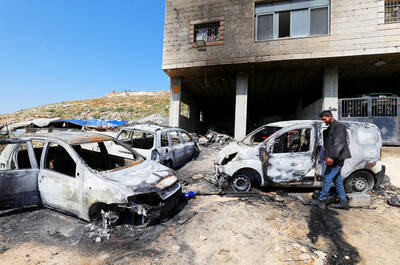
RAMPAGE: A Palestinian man was left dead after dozens of Israeli settlers searching for a missing 14-year-old boy stormed a village in the Israeli-occupied West Bank US President Joe Biden on Friday said he expected Iran to attack Israel “sooner, rather than later” and warned Tehran not to proceed. Asked by reporters about his message to Iran, Biden simply said: “Don’t,” underscoring Washington’s commitment to defend Israel. “We are devoted to the defense of Israel. We will support Israel. We will help defend Israel and Iran will not succeed,” he said. Biden said he would not divulge secure information, but said his expectation was that an attack could come “sooner, rather than later.” Israel braced on Friday for an attack by Iran or its proxies as warnings grew of

A prominent Christian leader has allegedly been stabbed at the altar during a Mass yesterday in southwest Sydney. Bishop Mar Mari Emmanuel was saying Mass at Christ The Good Shepherd Church in Wakeley just after 7pm when a man approached him at the altar and allegedly stabbed toward his head multiple times. A live stream of the Mass shows the congregation swarm forward toward Emmanuel before it was cut off. The church leader gained prominence during the COVID-19 pandemic, amassing a large online following, Officers attached to Fairfield City police area command attended a location on Welcome Street, Wakeley following reports a number


 RSS
RSS