


The US Senate approved new rules to govern how the government eavesdrops on phone calls and e-mails. The legislation gives US President George W. Bush much of the latitude he wanted and grants retroactive legal immunity to telecommunications companies that helped in the snooping after the Sept. 11, 2001, terror attacks on the US.
Protection for the telecoms companies is the most prominent feature of the legislation approved on Tuesday. Bush had insisted on that as essential to getting private sector cooperation in spying on foreign terrorists and other targets. It would give protection to companies that had helped the government eavesdrop on their customers without court permission after Sept. 11.
The House of Representatives, which passed its own version of the bill last year, did not include the immunity provision. House Republicans now want the House to adopt the Senate bill, which would avoid potentially contentious negotiations to work out differences between the competing versions of the bill.
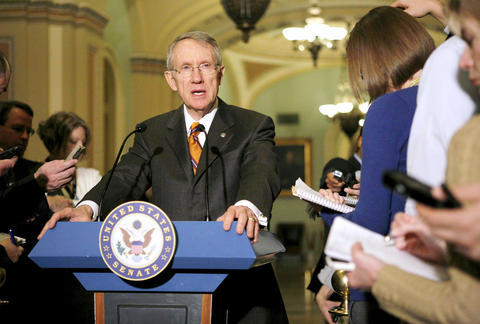
PHOTO: EPA
About 40 lawsuits have been filed against telecom companies by people alleging violations of wiretapping and privacy laws.
Bush has promised to veto any new surveillance bill that does not protect the companies that helped the government in its warrantless wiretapping program on grounds that it is essential if the private sector is to give the government the help it needs.
The president called the Senate bill a good piece of legislation that allows intelligence agencies to monitor communications of foreign terrorists while protecting Americans' liberties. He urged the House to pass the bill and send it to his desk without delay.
The Senate bill provides "fair and just liability protection to those private companies who have been sued for billions of dollars only because they are believed to have done the right thing and assisted the nation after the September 11th terrorist attacks," Bush said.
House of Representatives Judiciary Committee Chairman John Conyers said he still opposes retroactive immunity.
"There is no basis for the broad telecommunications company amnesty provisions advocated by the administration," he wrote in a letter to White House Counsel Fred Fielding asking that documents about the wiretapping program still being withheld from Congress be handed over.
Tuesday's 68-29 Senate vote to update the 1978 Foreign Intelligence Surveillance Act belied the nearly two months of stops and starts and bitter political wrangling that preceded it, as the two sides battled to balance civil liberties with the need to conduct surveillance on potential adversaries.
At issue is the government's post-Sept. 11 Terrorist Surveillance Program, which circumvented a secret court created 30 years ago to oversee such activities. The court was part of the 1978 Foreign Intelligence Surveillance Act, a law written in response to government abuse of its surveillance authority against Americans.
The surveillance law has been updated repeatedly since then, most recently last summer. Congress hastily adopted a FISA modification in August in the face of dire warnings from the White House that changes in telecommunications technology and FISA court rulings were dangerously constraining the government's ability to intercept terrorist communications.
Shortly after its passage, privacy and civil liberties groups said the new law gave the government unprecedented authority to spy on Americans, particularly those who communicate with foreigners.
That law, already extended once, expires on Saturday.
Doubtful they could work out the differences in the bills by then to present a final version to the White House, Democrats in both the Senate and the House have prepared short-term extensions they hope to pass that would keep current law in effect for several more weeks. Representative Lamar Smith, the senior Republican on the House Judiciary Committee, said House Republicans would fight another extension and said Bush would not sign it. Senate Republican Leader Mitch McConnell of Kentucky also opposes an extension.
The White House said Bush would not sign another 15-day extension of the law.
"The intelligence community needs this good, long-term legislation, not a patchwork of extensions," presidential spokeswoman Dana Perino said. "The House is risking national security by delaying action, and the president will not sign another extension."
On the way to passage, the Senate rejected by a vote of 31 to 67 a move to strip away a grant of retroactive legal immunity for the companies. It also rejected two amendments that sought to water down the immunity provision.
One, co-sponsored by Republican Arlen Specter and Democrat Sheldon Whitehouse, would have substituted the government for the telecom companies in lawsuits, allowing the court cases to go forward but shifting the cost and burden of defending the program.
The other, pushed by California Democrat Dianne Feinstein, would have given a secret court that oversees government surveillance inside the US the power to dismiss lawsuits if it found that the companies acted in good faith and on the request of the president or attorney general.
While giving the White House what it wants on immunity, the Senate also expanded the power of the court to oversee government eavesdropping on Americans. The amendment would give the FISA court the authority to monitor whether the government is complying with procedures designed to protect the privacy of Americans whose telephone or computer communications are captured during surveillance of a foreign target.
The bill would also require FISA court orders to eavesdrop on Americans who are overseas. Under current law, the government can wiretap or search the possessions of anyone outside the US -- even a soldier serving overseas -- without court permission if it believes the person may be a foreign agent.
"You don't lose your rights when you leave American soil," Democratic Senator Ron Wyden said in an interview.
Wyden wrote the provision into the bill when it was still being considered by the Senate Intelligence Committee.
"In the digital age, an American's rights shouldn't depend on their physical geography," he said.

Republican US lawmakers on Friday criticized US President Joe Biden’s administration after sanctioned Chinese telecoms equipment giant Huawei unveiled a laptop this week powered by an Intel artificial intelligence (AI) chip. The US placed Huawei on a trade restriction list in 2019 for contravening Iran sanctions, part of a broader effort to hobble Beijing’s technological advances. Placement on the list means the company’s suppliers have to seek a special, difficult-to-obtain license before shipping to it. One such license, issued by then-US president Donald Trump’s administration, has allowed Intel to ship central processors to Huawei for use in laptops since 2020. China hardliners

A top Vietnamese property tycoon was on Thursday sentenced to death in one of the biggest corruption cases in history, with an estimated US$27 billion in damages. A panel of three hand-picked jurors and two judges rejected all defense arguments by Truong My Lan, chair of major developer Van Thinh Phat, who was found guilty of swindling cash from Saigon Commercial Bank (SCB) over a decade. “The defendant’s actions ... eroded people’s trust in the leadership of the [Communist] Party and state,” read the verdict at the trial in Ho Chi Minh City. After the five-week trial, 85 others were also sentenced on

‘DELUSIONAL’: Targeting the families of Hamas’ leaders would not push the group to change its position or to give up its demands for Palestinians, Ismail Haniyeh said Israeli aircraft on Wednesday killed three sons of Hamas’ top political leader in the Gaza Strip, striking high-stakes targets at a time when Israel is holding delicate ceasefire negotiations with the militant group. Hamas said four of the leader’s grandchildren were also killed. Ismail Haniyeh’s sons are among the highest-profile figures to be killed in the war so far. Israel said they were Hamas operatives, and Haniyeh accused Israel of acting in “the spirit of revenge and murder.” The deaths threatened to strain the internationally mediated ceasefire talks, which appeared to gain steam in recent days even as the sides remain far

The Taliban’s reclusive supreme leader made a rare public appearance yesterday, an Afghan government spokesman said, leading thousands of worshipers in prayers marking Eid al-Fitr. Hibatullah Akhundzada has made only a handful of public appearances since inheriting the leadership of the Taliban in 2016 and leading the movement back to power with the withdrawal of US forces in 2021. Taliban government spokesman Zabihullah Mujahid said prayer in the largest mosque in Kandahar was “performed under the leadership of the supreme leader.” In a statement on X, he said the early-morning service “was attended by thousands of compatriots” in the southern province considered the


 RSS
RSS