


One of only four in the world, the Joint Tactical Ground Station sits in a field of snow behind the high fences of this remote base in northern Japan like a windowless trailer home with a few good satellite dishes out back.
It's not impressive. But this is the front line.
In a multibillion-dollar experiment, Japan and the US are erecting the world's most complex ballistic missile defense shield, a project that is changing the security balance in Asia and has deep implications for Washington's efforts to pursue a similar strategy in Europe, where the idea has been stalled by the lack of willing partners.
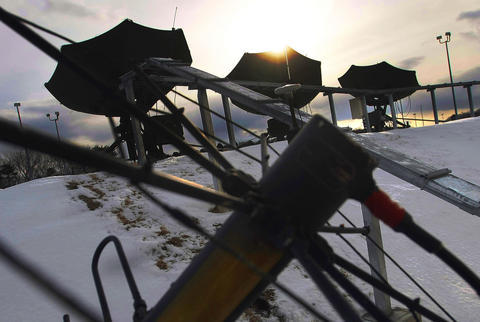
PHOTO: AP
The station here is the newest piece in the shield.
"Japan is one of our strongest allies in the ballistic missile defense arena," said Brigadier General John Seward, the deputy commanding general of operations for the US Army Space and Missile Defense Command.
In a recent mock-up of how it would work, US military satellites detect a flash of heat from a missile range in North Korea, and within seconds computers plot a rough trajectory across the Sea of Japan that ends in an oval splash-zone outlined in red near Japan's main island.
In a real-world crisis, the next 10 minutes or 15 minutes could be the beginning of an all-out shooting war. Millions could die. Or, two missiles could collide in mid-air over the ocean.
Washington and Tokyo are banking on the idea that early warning of the kind provided by the Joint Tactical Ground Station (JTAG) and another state-of-the-art "X-band" radar station recently deployed nearby will lead to the latter. They are pouring a huge amount of resources -- the US Missile Defense Agency is seeking an US$8 billion budget this year -- into establishing a credible warning and response network.
Though Washington's focus and world attention has shifted to Iran, North Korea has over the past several years made major strides in its development of nuclear weapons and the means to deliver them to the shores of other countries.
In October 2006, it conducted its first nuclear test -- a step that Iran has not taken -- and more than a decade ago shot a multistage ballistic missile over Japan's main island and well into the Pacific, almost reaching Alaska.
Japan's concerns are obvious: Its islands arc around the Korean Peninsula and relations between Pyongyang and its former colonial ruler have never been good.
But the threat to the US is also pressing.
Under a mutual security pact, the US has about 50,000 troops deployed around Japan -- all within reach of North Korea's missiles.
The US military last year deployed a Patriot missile battalion to Kadena Air Base, on Okinawa. The US and Japanese navies have also increased their ability to intercept ballistic missiles from sea-based launchers.
In a test off Hawaii last month, Japan became the first country after the US to shoot a missile out of the air with a ship-launched SM-3 interceptor. Japan hopes to equip its ships with such interceptor missiles over next several years.
The sea-based interceptors, which have a longer range than land-based Patriots, are Japan's first line of defense.
Seward said he hopes the alliance with Tokyo on ballistic missile defense will serve as a model for the world.
The US operates its three other JTAGs in Germany, Qatar and South Korea.

Republican US lawmakers on Friday criticized US President Joe Biden’s administration after sanctioned Chinese telecoms equipment giant Huawei unveiled a laptop this week powered by an Intel artificial intelligence (AI) chip. The US placed Huawei on a trade restriction list in 2019 for contravening Iran sanctions, part of a broader effort to hobble Beijing’s technological advances. Placement on the list means the company’s suppliers have to seek a special, difficult-to-obtain license before shipping to it. One such license, issued by then-US president Donald Trump’s administration, has allowed Intel to ship central processors to Huawei for use in laptops since 2020. China hardliners
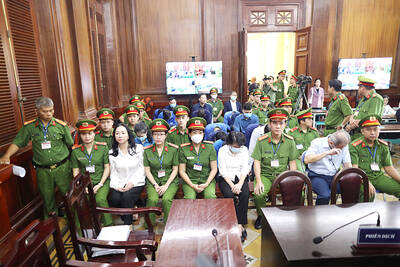
A top Vietnamese property tycoon was on Thursday sentenced to death in one of the biggest corruption cases in history, with an estimated US$27 billion in damages. A panel of three hand-picked jurors and two judges rejected all defense arguments by Truong My Lan, chair of major developer Van Thinh Phat, who was found guilty of swindling cash from Saigon Commercial Bank (SCB) over a decade. “The defendant’s actions ... eroded people’s trust in the leadership of the [Communist] Party and state,” read the verdict at the trial in Ho Chi Minh City. After the five-week trial, 85 others were also sentenced on

Conjoined twins Lori and George Schappell, who pursued separate careers, interests and relationships during lives that defied medical expectations, died this month in Pennsylvania, funeral home officials said. They were 62. The twins, listed by Guinness World Records as the oldest living conjoined twins, died on April 7 at the Hospital of the University of Pennsylvania, obituaries posted by Leibensperger Funeral Homes of Hamburg said. The cause of death was not detailed. “When we were born, the doctors didn’t think we’d make 30, but we proved them wrong,” Lori said in an interview when they turned 50, the Philadelphia Inquirer reported. The
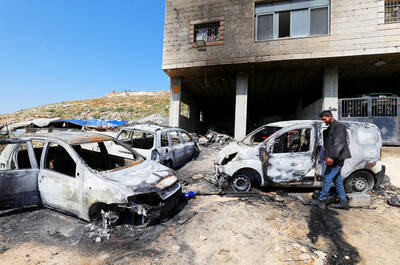
RAMPAGE: A Palestinian man was left dead after dozens of Israeli settlers searching for a missing 14-year-old boy stormed a village in the Israeli-occupied West Bank US President Joe Biden on Friday said he expected Iran to attack Israel “sooner, rather than later” and warned Tehran not to proceed. Asked by reporters about his message to Iran, Biden simply said: “Don’t,” underscoring Washington’s commitment to defend Israel. “We are devoted to the defense of Israel. We will support Israel. We will help defend Israel and Iran will not succeed,” he said. Biden said he would not divulge secure information, but said his expectation was that an attack could come “sooner, rather than later.” Israel braced on Friday for an attack by Iran or its proxies as warnings grew of


 RSS
RSS