


A newborn child in Sierra Leone has the lowest chance in the world of surviving until age 5, with the prospects almost as bad for children in Angola and Afghanistan, a report released yesterday by the UN's children's fund said.
In 2006, nearly 9.7 million children died worldwide before reaching the age of five, mostly from preventable causes such as diarrhea, malaria or malnutrition, UNICEF said in its annual report.
But progress has been made in several regions and strengthening local health services holds great promise for reducing the child mortality rate, said the 154-page document, The State of the World's Children 2008.
More than 26,000 children under the age of five die each day on average.
In 2006, the latest year for which statistics are available, Sierra Leone had the highest child mortality rate, with 270 deaths per 1,000 births. Angola came second with 260 deaths per 1,000 births, followed by Afghanistan with 257 deaths per 1,000 births.
The worldwide under-5 mortality rate in 2006 was 72 deaths per 1,000 births. The average rate of industrialized countries was six deaths per 1,000 births.
"The loss of 9.7 million young lives each year is unacceptable, especially when many of these deaths are preventable," UNICEF Executive Director Ann Veneman said.
The deaths could be prevented by simple health care measures, such as vaccination, insecticide-treated bed nets and vitamin supplements, the report said. But the measures must be taken all together and applied in each village to reach every child, even in the remotest regions of the world, it said.
"We know exactly what works," said Angela Hawke of UNICEF, referring to strategies the agency has been promoting for some time.
"But we need to make sure that these kinds of services are integrated at the most local level, in the villages where children live," she said, adding that governments and health experts should define the best solutions for each community.
"We want to make sure that there are local health services that really work with properly staffed health centers ... and there's a proper national health plan," Hawke told reporters.
Sierra Leone which suffered an 11-year civil war from 1991 to 2002 and is one of the poorest countries in the world, is, like Angola, Afghanistan and other war-torn regions, unable to offer sufficient health services to its citizens, the report said.
Although there has been progress in many countries and the under-5 mortality rate worldwide has been reduced by 23 percent since 1990, more needs to be done. If the world is to reach the UN objective of decreasing the global child mortality rate by two-thirds between 1990 and 2015, the current rate must be cut in half within the next seven years, the report said.
In Mexico, a program aimed at engaging the poorest families provides financial rewards to parents who bring their children regularly to health clinics to show that they take care of the child's health and nutrition according to a set of criteria. The child mortality rate in Mexico has been reduced by 34 percent since 1990.
But sub-Saharan Africa, where the child mortality rate went down only by 14 percent since 1990, is still the region of greatest concern, the report said.
The data was mainly drawn from statistics and studies by the WHO, the World Bank and the UN Populations Division.
Nearly half of China’s major cities are suffering “moderate to severe” levels of subsidence, putting millions of people at risk of flooding, especially as sea levels rise, according to a study of nationwide satellite data released yesterday. The authors of the paper, published by the journal Science, found that 45 percent of China’s urban land was sinking faster than 3mm per year, with 16 percent at more than 10mm per year, driven not only by declining water tables, but also the sheer weight of the built environment. With China’s urban population already in excess of 900 million people, “even a small portion

UNSETTLING IMAGES: The scene took place in front of TV crews covering the Trump trial, with a CNN anchor calling it an ‘emotional and unbelievably disturbing moment’ A man who doused himself in an accelerant and set himself on fire outside the courthouse where former US president Donald Trump is on trial has died, police said yesterday. The New York City Police Department (NYPD) said the man was declared dead by staff at an area hospital. The man was in Collect Pond Park at about 1:30pm on Friday when he took out pamphlets espousing conspiracy theories, tossed them around, then doused himself in an accelerant and set himself on fire, officials and witnesses said. A large number of police officers were nearby when it happened. Some officers and bystanders rushed
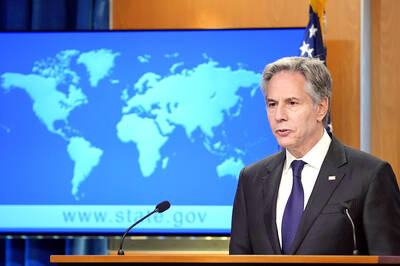
Beijing is continuing to commit genocide and crimes against humanity against Uyghurs and other Muslim minorities in its western Xinjiang province, U.S. Secretary of State Antony Blinken said in a report published on Monday, ahead of his planned visit to China this week. The State Department’s annual human rights report, which documents abuses recorded all over the world during the previous calendar year, repeated language from previous years on the treatment of Muslims in Xinjiang, but the publication raises the issue ahead of delicate talks, including on the war in Ukraine and global trade, between the top U.S. diplomat and Chinese

HYPOCRISY? The Chinese Ministry of Foreign Affairs yesterday asked whether Biden was talking about China or the US when he used the word ‘xenophobic’ US President Joe Biden on Wednesday called for a hike in steel tariffs on China, accusing Beijing of cheating as he spoke at a campaign event in Pennsylvania. Biden accused China of xenophobia, too, in a speech to union members in Pittsburgh. “They’re not competing, they’re cheating. They’re cheating and we’ve seen the damage here in America,” Biden said. Chinese steel companies “don’t need to worry about making a profit because the Chinese government is subsidizing them so heavily,” he said. Biden said he had called for the US Trade Representative to triple the tariff rates for Chinese steel and aluminum if Beijing was


 RSS
RSS