


US farmers have been given the green light to produce cloned meat for the human food chain. In a 968 page report billed as a "final risk assessment" of the technology, the US Food and Drug Administration has concluded that healthy cloned animals and products from them such as milk are safe for consumers.
Although the announcement in effect removes the final regulatory barrier to selling cloned meat in the US it is likely to be years before meat from cloned animals or their progeny is sold in stores.
The announcement follows the launch of a public consultation on the issue by the European Food Safety Authority. Its "draft opinion" on the technology gave provisional backing on the grounds that there was no evidence for food safety or environmental concerns.
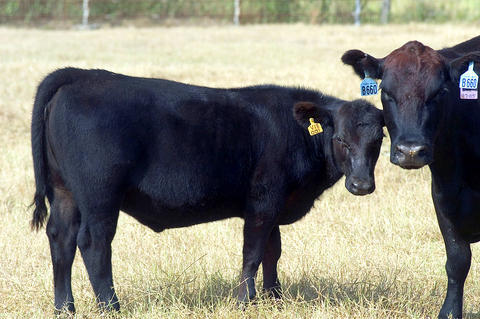
PHOTO: AP
"No differences exceeding the normal variability have been observed in the composition and nutritional value of meat and milk between healthy clones or the progeny of clones and their conventional counterpart," the report said.
It did, though, highlight animal welfare concerns.
Scientists stress that cloning will not be used to create herds of identical animals that are themselves destined for the dinner plate. Rather it will be used as a breeding tool to create high-value breeding animals with desirable traits such as disease resistance or a faster growth rate. It is the progeny of clones that could potentially reach dinner plates.
"At this stage, in terms of commercial food production it's not going to be beneficial because it's such an expensive process," said Helen Ferrier, the UK's National Farmers' Union's food science adviser.
The NFU has adopted a wait-and-see attitude to the technology but she added: "Generally our views on the safety or the acceptability, etc, are really based on the opinions of independent scientific experts."
If cloning is adopted, though, she said the NFU did not favour labelling cloned meat.
"If the product is absolutely the same as its equivalent but using a different system it's not necessarily very useful to label it because it's misleading to the consumer and it's impossible to enforce," she said.
Critics of using cloning in agriculture point out that the method used to create identical animals -- essentially the same used to produce Dolly the sheep -- is inefficient, with a significant proportion of embryos not developing to maturity. Even some apparently successful cloned embryos are prone to severe developmental problems after birth. Scientists say the loss rates are coming down as the technology improves.
"It's a technology that has arisen out of a huge burden of animal suffering and that is still going on," said Joyce D'Silva, of Compassion in World Farming.
But she said even if the embryo loss rates were brought down to acceptable levels, the technology would be detrimental to animal welfare.
"It looks like it is going to be used to produce the most highly productive animals -- the cows that produce the most milk, the pigs with the meatiest bodies. These are the high- producing animals that have the most endemic welfare problems anyway," she said.
Scientists counter that cloning can be used to enhance animal welfare, for example by spreading useful genetic mutations that make animals resistant to diseases such as scrapie. Another possible use would be to keep cells on ice from rare breeds that have gone out of fashion.
These cells could be cloned to produce adult animals in future, preserving a genetic heritage which could be used to adapt farm animals to changing climate or new diseases.
The technology could also be used to produce identical replacements for high-value animals such as breeding bulls if they were injured.
D'Silva is concerned that cloned meat could enter the European food chain even if consumers here reject it. Theoretically, that would be illegal because food imported into the UK, for example, must be produced to the same standards as food produced here. However, cloned meat is essentially identical to non-cloned meat, so the rule would be impossible to enforce.
At a briefing on the technology last year, the cloning expert Professor Keith Campbell, of Nottingham University, who was part of the Dolly team, said: "With cloning we can actually collect cells from these animals, store them and bring them back from the dead, so to speak. We can then use them in breeding programs ... It's a way of maintaining rare breeds without having to maintain the animals."
Nearly half of China’s major cities are suffering “moderate to severe” levels of subsidence, putting millions of people at risk of flooding, especially as sea levels rise, according to a study of nationwide satellite data released yesterday. The authors of the paper, published by the journal Science, found that 45 percent of China’s urban land was sinking faster than 3mm per year, with 16 percent at more than 10mm per year, driven not only by declining water tables, but also the sheer weight of the built environment. With China’s urban population already in excess of 900 million people, “even a small portion

‘IN A DIFFERENT PLACE’: The envoy first visited Shanghai, where he attended a Chinese basketball playoff match, and is to meet top officials in Beijing tomorrow US Secretary of State Antony Blinken yesterday arrived in China on his second visit in a year as the US ramps up pressure on its rival over its support for Russia while also seeking to manage tensions with Beijing. The US diplomat tomorrow is to meet China’s top brass in Beijing, where he is also expected to plead for restraint as Taiwan inaugurates president-elect William Lai (賴清德), and to raise US concerns on Chinese trade practices. However, Blinken is also seeking to stabilize ties, with tensions between the world’s two largest economies easing since his previous visit in June last year. At the

UNSETTLING IMAGES: The scene took place in front of TV crews covering the Trump trial, with a CNN anchor calling it an ‘emotional and unbelievably disturbing moment’ A man who doused himself in an accelerant and set himself on fire outside the courthouse where former US president Donald Trump is on trial has died, police said yesterday. The New York City Police Department (NYPD) said the man was declared dead by staff at an area hospital. The man was in Collect Pond Park at about 1:30pm on Friday when he took out pamphlets espousing conspiracy theories, tossed them around, then doused himself in an accelerant and set himself on fire, officials and witnesses said. A large number of police officers were nearby when it happened. Some officers and bystanders rushed

Beijing is continuing to commit genocide and crimes against humanity against Uyghurs and other Muslim minorities in its western Xinjiang province, U.S. Secretary of State Antony Blinken said in a report published on Monday, ahead of his planned visit to China this week. The State Department’s annual human rights report, which documents abuses recorded all over the world during the previous calendar year, repeated language from previous years on the treatment of Muslims in Xinjiang, but the publication raises the issue ahead of delicate talks, including on the war in Ukraine and global trade, between the top U.S. diplomat and Chinese


 RSS
RSS