


Thailand's banning of a rare "warts and all" biography of revered King Bhumibol Adulyadej only stokes interest in the book and risks an eventual explosion of pent-up political tension, an academic said.
"Banning books is usually something we associate with fascist and repressive regimes," Australian anthropologist Annette Hamilton told a seminar on The King Never Smiles at an international Thai studies conference in Bangkok on Thursday.
"When silence is enforced for a long time, noise -- when it comes -- is deafening," he said.
The book, by US journalist Paul Handley, portrays Bhumibol as an austere and deeply political monarch whose desire for stability and unity has stifled democratic development.
`This book raises in a dramatic way some of the most important matters concerning the past, the present and the future of the kingdom,'' Hamilton said, adding that it "presents such a profound challenge to a prevailing Thai world-view that we can see that many people would respond with fear and negativity."
Many Thais regard the king as semi-divine and credit him with steering Thailand through huge political and social turbulence.
However, critics say this perception is propped up by draconian lese majeste laws, which make any insult or threat to the monarchy punishable by up to 15 years in jail. Even though Bhumibol made it clear in 2005 that he should not be above criticism, the government banned the book in January 2006, arguing it "could disrupt public order and the good morals of society."
Handley, declared persona non grata in Thailand, did not attend the conference, one of the few times the monarchy has ever been debated critically in public inside Thailand.
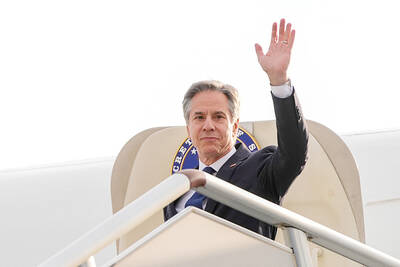
‘IN A DIFFERENT PLACE’: The envoy first visited Shanghai, where he attended a Chinese basketball playoff match, and is to meet top officials in Beijing tomorrow US Secretary of State Antony Blinken yesterday arrived in China on his second visit in a year as the US ramps up pressure on its rival over its support for Russia while also seeking to manage tensions with Beijing. The US diplomat tomorrow is to meet China’s top brass in Beijing, where he is also expected to plead for restraint as Taiwan inaugurates president-elect William Lai (賴清德), and to raise US concerns on Chinese trade practices. However, Blinken is also seeking to stabilize ties, with tensions between the world’s two largest economies easing since his previous visit in June last year. At the
Nearly half of China’s major cities are suffering “moderate to severe” levels of subsidence, putting millions of people at risk of flooding, especially as sea levels rise, according to a study of nationwide satellite data released yesterday. The authors of the paper, published by the journal Science, found that 45 percent of China’s urban land was sinking faster than 3mm per year, with 16 percent at more than 10mm per year, driven not only by declining water tables, but also the sheer weight of the built environment. With China’s urban population already in excess of 900 million people, “even a small portion

UNSETTLING IMAGES: The scene took place in front of TV crews covering the Trump trial, with a CNN anchor calling it an ‘emotional and unbelievably disturbing moment’ A man who doused himself in an accelerant and set himself on fire outside the courthouse where former US president Donald Trump is on trial has died, police said yesterday. The New York City Police Department (NYPD) said the man was declared dead by staff at an area hospital. The man was in Collect Pond Park at about 1:30pm on Friday when he took out pamphlets espousing conspiracy theories, tossed them around, then doused himself in an accelerant and set himself on fire, officials and witnesses said. A large number of police officers were nearby when it happened. Some officers and bystanders rushed

Beijing is continuing to commit genocide and crimes against humanity against Uyghurs and other Muslim minorities in its western Xinjiang province, U.S. Secretary of State Antony Blinken said in a report published on Monday, ahead of his planned visit to China this week. The State Department’s annual human rights report, which documents abuses recorded all over the world during the previous calendar year, repeated language from previous years on the treatment of Muslims in Xinjiang, but the publication raises the issue ahead of delicate talks, including on the war in Ukraine and global trade, between the top U.S. diplomat and Chinese


 RSS
RSS