


Israel will not remove its West Bank roadblocks, erected to stop attacks by militants, Israel's defense minister said, turning down a key Palestinian demand just days before US President George W. Bush arrives to promote recently restarted peace negotiations.
As part of Bush's visit, he is expected to meet with Israeli Prime Minister Ehud Olmert and Palestinian President Mahmoud Abbas, the Haaretz newspaper reported yesterday. Olmert's office did not confirm the report.
Defense Minister Ehud Barak's comments on Tuesday soured an already tense atmosphere. Israeli construction in east Jerusalem and the West Bank and violence between Israelis and Palestinians -- and among Palestinians themselves -- are threatening to overwhelm Bush's efforts.
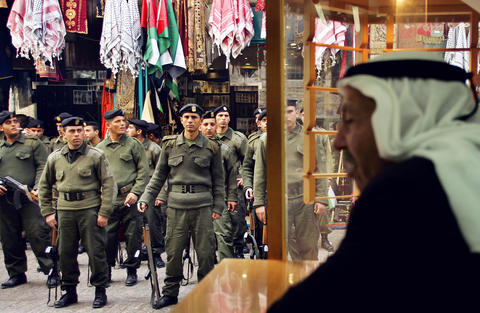
PHOTO: AP
Olmert told his people through a newspaper interview ahead of the visit that for their own good, they must consider giving up much of the West Bank and part of Jerusalem to the Palestinians.
Late on Tuesday, Israeli security released a statement saying two gunmen who killed two Israeli hikers in the West Bank on Friday were Fatah activists, a disclosure that could further complicate peace moves. Abbas is the leader of Fatah. The statement said the two turned themselves in to Palestinian police to avoid arrest by Israeli forces.
In response, Olmert convened senior ministers yesterday to discuss the implications of the involvement of Fatah members in the attack, Israel Radio reported.
Olmert spokesman Mark Regev called on Abbas to reform Fatah.
"I think everyone is aware of the very real challenge that faces the Palestinian government in dealing with renegade elements within Fatah," Regev said yesterday. "What is needed there is of course a comprehensive and thorough reform."
In violence yesterday, six Palestinian militants were killed in an Israeli operation in the central Gaza Strip, Hamas and Palestinian medical officials said. At least three of those killed were Hamas militants, Hamas said. Five gunmen were wounded, the group said.
The Israeli army confirmed that troops had operated in the area near Gaza City and that they had fired, together with Israeli aircraft, at gunmen who shot anti-tank missiles toward the soldiers.
The toll was the highest in recent days, although militants are frequently killed in such operations against Palestinian groups that fire rockets into southern Israel.
Removing roadblocks is a constant Palestinian demand, and Israel has pledged several times to take down some of the dozens of checkpoints that have choked economic and social life in the West Bank.
Israel erected the roadblocks after the Palestinian uprising erupted in 2000, when attackers infiltrated into Israel.
On Tuesday, however, Barak said the roadblocks have proved an effective obstacle to Palestinian attacks, and except in isolated cases, they would not be dismantled.
"There is no chance of effectively fighting terror without practical daily control in the field, and the roadblocks will stay," Barak said.
Palestinian negotiator Saeb Erekat said Barak's comments were "very unfortunate."
"I don't think we can do anything about the economy or improvement of life or revival of institution-building" as long as the roadblocks remain, Erekat said.
The roadblocks and Israel's plans for construction in areas the claimed by Palestinians are high on the Palestinian agenda for peace talks, which restarted after Bush's Middle East conference in Annapolis, Maryland, in November. Bush is likely to hear harsh Palestinian complaints about Israel's policies in those areas when he visits next week.
Ahead of the Bush mission, Olmert called for Israeli concessions.
When speaking of the future, "the world that is friendly to Israel ... speaks of Israel in terms of the 1967 borders. It speaks of the division of Jerusalem," Olmert said in an interview with the English-language Israeli daily the Jeru-salem Post.
Israel captured the West Bank, east Jerusalem and the Gaza Strip in the 1967 Middle East war. Palestinians want those territories for an independent state, with east Jerusalem as its capital.
"What will be if we don't want to separate?" Olmert said. "Will we live eternally in a confused reality where 50 percent of the population or more are residents but not equal citizens who have the right to vote like us?"
About 5.4 million Jews live in Israel alongside 1.4 million Israeli Arabs. Another 3.9 million Palestinians live in the West Bank and Gaza Strip. Israel pulled out of Gaza in 2005.
Nearly half of China’s major cities are suffering “moderate to severe” levels of subsidence, putting millions of people at risk of flooding, especially as sea levels rise, according to a study of nationwide satellite data released yesterday. The authors of the paper, published by the journal Science, found that 45 percent of China’s urban land was sinking faster than 3mm per year, with 16 percent at more than 10mm per year, driven not only by declining water tables, but also the sheer weight of the built environment. With China’s urban population already in excess of 900 million people, “even a small portion

UNSETTLING IMAGES: The scene took place in front of TV crews covering the Trump trial, with a CNN anchor calling it an ‘emotional and unbelievably disturbing moment’ A man who doused himself in an accelerant and set himself on fire outside the courthouse where former US president Donald Trump is on trial has died, police said yesterday. The New York City Police Department (NYPD) said the man was declared dead by staff at an area hospital. The man was in Collect Pond Park at about 1:30pm on Friday when he took out pamphlets espousing conspiracy theories, tossed them around, then doused himself in an accelerant and set himself on fire, officials and witnesses said. A large number of police officers were nearby when it happened. Some officers and bystanders rushed

Beijing is continuing to commit genocide and crimes against humanity against Uyghurs and other Muslim minorities in its western Xinjiang province, U.S. Secretary of State Antony Blinken said in a report published on Monday, ahead of his planned visit to China this week. The State Department’s annual human rights report, which documents abuses recorded all over the world during the previous calendar year, repeated language from previous years on the treatment of Muslims in Xinjiang, but the publication raises the issue ahead of delicate talks, including on the war in Ukraine and global trade, between the top U.S. diplomat and Chinese

HYPOCRISY? The Chinese Ministry of Foreign Affairs yesterday asked whether Biden was talking about China or the US when he used the word ‘xenophobic’ US President Joe Biden on Wednesday called for a hike in steel tariffs on China, accusing Beijing of cheating as he spoke at a campaign event in Pennsylvania. Biden accused China of xenophobia, too, in a speech to union members in Pittsburgh. “They’re not competing, they’re cheating. They’re cheating and we’ve seen the damage here in America,” Biden said. Chinese steel companies “don’t need to worry about making a profit because the Chinese government is subsidizing them so heavily,” he said. Biden said he had called for the US Trade Representative to triple the tariff rates for Chinese steel and aluminum if Beijing was


 RSS
RSS