


Federal prosecutors asked a judge to set a trial date for next summer for a former soldier accused of raping a 14-year-old Iraqi girl and killing her and her family.
In a motion filed on Friday, US Attorney David Huber requested an Aug. 4 trial date for Steve Green.
Huber said defense attorneys wanted a later trial date that would benefit Green as "memories begin to fade" of the attack in March last year. Four others who served with Green have been convicted in the attack.
Huber said Green's attorneys have argued the trial should not be scheduled prior to April 2009.
Such a timetable "unduly burdens the public's right to a speedy trial," Huber said, noting it would be 30 months after Green's indictment and 21 months after prosecutors said they intended to seek the death penalty.
Huber said the two sides cannot reach agreement on a trial date and asked a judge to set the date.
A call on Saturday morning to a defense attorney's office was not immediately returned.
The next hearing in the case is set for tomorrow in Louisville.
Green, of Midland, Texas, is charged with the rape and murder of Abeer Qassim al-Janabi and killing of three other members of her family.
The former private in the Fort Campbell-based 101st Airborne Division was discharged from the Army before being arrested in North Carolina last year. He has pleaded not guilty in the case.
Huber said other death penalty cases of "more complexity and breadth" have been litigated in federal courts in under two years.
Huber said it is not a case in which the defense has to review DNA or other complicated scientific evidence. Instead, the government's case against Green relies largely on the testimony of other soldiers accused of participating in the attack with Green, he said.
"In a case which is based almost entirely on testimonial evidence, delay inures only to the benefit of the defendant as memories begin to fade and the events of March 12, 2006, grow more distant by the day," he said.
"To the extent that certain witnesses in this case continue to serve in the United States Army and are deployed to Iraq and other locations, placing them once again [in] combat, this case presents the very real possibility that witnesses may not be available for trial," he said.
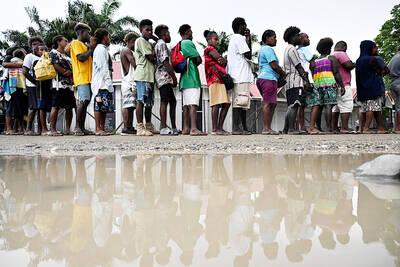
SEEKING CHANGE: A hospital worker said she did not vote in previous elections, but ‘now I can see that maybe my vote can change the system and the country’ Voting closed yesterday across the Solomon Islands in the south Pacific nation’s first general election since the government switched diplomatic allegiance from Taiwan to Beijing and struck a secret security pact that has raised fears of the Chinese navy gaining a foothold in the region. The Solomon Islands’ closer relationship with China and a troubled domestic economy weighed on voters’ minds as they cast their ballots. As many as 420,000 registered voters had their say across 50 national seats. For the first time, the national vote also coincided with elections for eight of the 10 local governments. Esther Maeluma cast her vote in the
Nearly half of China’s major cities are suffering “moderate to severe” levels of subsidence, putting millions of people at risk of flooding, especially as sea levels rise, according to a study of nationwide satellite data released yesterday. The authors of the paper, published by the journal Science, found that 45 percent of China’s urban land was sinking faster than 3mm per year, with 16 percent at more than 10mm per year, driven not only by declining water tables, but also the sheer weight of the built environment. With China’s urban population already in excess of 900 million people, “even a small portion

UNSETTLING IMAGES: The scene took place in front of TV crews covering the Trump trial, with a CNN anchor calling it an ‘emotional and unbelievably disturbing moment’ A man who doused himself in an accelerant and set himself on fire outside the courthouse where former US president Donald Trump is on trial has died, police said yesterday. The New York City Police Department (NYPD) said the man was declared dead by staff at an area hospital. The man was in Collect Pond Park at about 1:30pm on Friday when he took out pamphlets espousing conspiracy theories, tossed them around, then doused himself in an accelerant and set himself on fire, officials and witnesses said. A large number of police officers were nearby when it happened. Some officers and bystanders rushed

HYPOCRISY? The Chinese Ministry of Foreign Affairs yesterday asked whether Biden was talking about China or the US when he used the word ‘xenophobic’ US President Joe Biden on Wednesday called for a hike in steel tariffs on China, accusing Beijing of cheating as he spoke at a campaign event in Pennsylvania. Biden accused China of xenophobia, too, in a speech to union members in Pittsburgh. “They’re not competing, they’re cheating. They’re cheating and we’ve seen the damage here in America,” Biden said. Chinese steel companies “don’t need to worry about making a profit because the Chinese government is subsidizing them so heavily,” he said. Biden said he had called for the US Trade Representative to triple the tariff rates for Chinese steel and aluminum if Beijing was


 RSS
RSS