


Fidel Castro was nominated on Sunday as a National Assembly candidate, signaling that the ailing Cuban leader was not yet ready to give up politics and could even return to the presidency.
The 81-year-old, not seen in public since he temporarily stepped down in July last year following surgery, was included on a list of candidates for national elections on Jan. 20 in Santiago de Cuba, where he has traditionally been nominated for office.
To applause and cheers of "Viva Fidel, viva the commander in chief!", municipal officials in Santiago de Cuba unanimously approved Castro's nomination on a list of candidates for the National Assembly.
Castro must hold a seat in the National Assembly to officially resume the presidency.
The nomination was a response to the "immense affection, respect, consideration and recognition that our people have [for him]," Cuban Vice President Carlos Lage said.
SURGERY
Castro has led Cuba for almost five decades but "provisionally" handed over power to his younger brother and longtime No. 2 Raul, 76, after undergoing intestinal surgery 16 months ago.
Since then Cuban officials have said he keeps up with official business, and he has been writing opinion pieces on national and global affairs in the local media. But there had been until now no official indication of whether or when he would resume the presidency.
Opposition figures expressed frustration at the nomination, saying that if he were reelected president, Cuba would not progress.
"It will keep the country ... in stagnation," said dissident leader Marta Beatriz Roque.
"Castro is a brake" on reforms, said opposition economist Oscar Espinosa. "This is going to make many things worse."
From the ranks of the nominees for the national and provincial assemblies, 614 lawmakers will be elected next month and they will choose the Council of State. The council's president serves as head of Cuba's one-party government.
If Fidel had not been nominated on Sunday, that could have opened the way for Raul Castro -- also re-nominated on Sunday in Santiago de Cuba -- to formally take over Cuba's presidency next year.
Lage said Castro was needed as head of state "because there is no job more important in the world," a job that requires an awareness of the dangers facing the planet and "the needs of responsible citizens."
SPECULATION
Since Castro handed power over to his brother, speculation has been rife as to whether the he would formally return to power or even remain politically active.
Cuba-watchers say it is possible he might be elected an assembly deputy, but then choose not to run for re-election to the Council of State. Voting for the presidency is set to be held no later than March 5, next year.
Fidel, who rose to power in Cuba leading the 1959 revolution, continues to convalesce at an undisclosed location.
The US has made repeated calls for Cuba to hold free elections to launch a transition away from Castro's rule.
But Cuba maintains its electoral process, run without any campaigning, is "the most democratic in the world."
Nearly half of China’s major cities are suffering “moderate to severe” levels of subsidence, putting millions of people at risk of flooding, especially as sea levels rise, according to a study of nationwide satellite data released yesterday. The authors of the paper, published by the journal Science, found that 45 percent of China’s urban land was sinking faster than 3mm per year, with 16 percent at more than 10mm per year, driven not only by declining water tables, but also the sheer weight of the built environment. With China’s urban population already in excess of 900 million people, “even a small portion

UNSETTLING IMAGES: The scene took place in front of TV crews covering the Trump trial, with a CNN anchor calling it an ‘emotional and unbelievably disturbing moment’ A man who doused himself in an accelerant and set himself on fire outside the courthouse where former US president Donald Trump is on trial has died, police said yesterday. The New York City Police Department (NYPD) said the man was declared dead by staff at an area hospital. The man was in Collect Pond Park at about 1:30pm on Friday when he took out pamphlets espousing conspiracy theories, tossed them around, then doused himself in an accelerant and set himself on fire, officials and witnesses said. A large number of police officers were nearby when it happened. Some officers and bystanders rushed
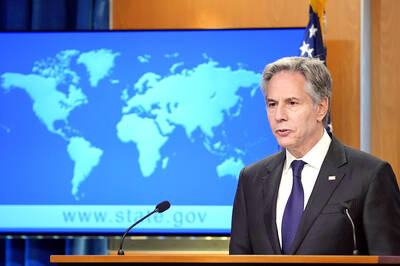
Beijing is continuing to commit genocide and crimes against humanity against Uyghurs and other Muslim minorities in its western Xinjiang province, U.S. Secretary of State Antony Blinken said in a report published on Monday, ahead of his planned visit to China this week. The State Department’s annual human rights report, which documents abuses recorded all over the world during the previous calendar year, repeated language from previous years on the treatment of Muslims in Xinjiang, but the publication raises the issue ahead of delicate talks, including on the war in Ukraine and global trade, between the top U.S. diplomat and Chinese
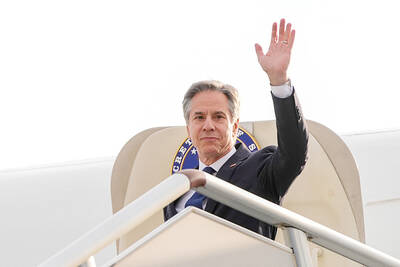
‘IN A DIFFERENT PLACE’: The envoy first visited Shanghai, where he attended a Chinese basketball playoff match, and is to meet top officials in Beijing tomorrow US Secretary of State Antony Blinken yesterday arrived in China on his second visit in a year as the US ramps up pressure on its rival over its support for Russia while also seeking to manage tensions with Beijing. The US diplomat tomorrow is to meet China’s top brass in Beijing, where he is also expected to plead for restraint as Taiwan inaugurates president-elect William Lai (賴清德), and to raise US concerns on Chinese trade practices. However, Blinken is also seeking to stabilize ties, with tensions between the world’s two largest economies easing since his previous visit in June last year. At the


 RSS
RSS