


Congress will likely hold off on sending US President George W. Bush money for Iraq until early next year, pushing the Pentagon to the brink of an accounting nightmare and deepening Democrats' conflict with the White House on the war.
Democrats say the tough approach is needed.
"Everybody knows that the president is stuck in his place, a place where he wants a 10-year war," said House Speaker Nancy Pelosi, a Democrat.
This week, the House passed, 218 to 203, a US$50 billion bill that would pay for combat operations in Iraq and Afghanistan but require that US troops start coming home. The measure sets a goal of ending combat by Dec. 15 next year.
The Senate planned to vote as early as yesterday on the measure, although it was not expected to pass. Democrats hold a narrow majority and 60 votes are needed to advance.
Senate Majority Leader Harry Reid, a Democrat, said on Thursday that if Congress was unable to pass legislation that sets a timetable on the war -- the most likely scenario -- they would drop the issue until next year. In the meantime, Democrats say, the Pentagon can eat into its US$471 billion annual budget without being forced to take drastic steps.
"The days of a free lunch are over," said Democratic Senator Chuck Schumer.
Defense Secretary Robert Gates said on Thursday that unless Congress passes funding for the Iraq war within days, he will direct the Army and Marine Corps to begin developing plans to lay off employees and terminate contracts early next year.
Gates, who met with members of Congress on Wednesday, said that he does not have the money or the flexibility to move funding around to adequately cover the costs of the continuing operations in Iraq and Afghanistan.
"There is a misperception that this department can continue funding our troops in the field for an indefinite period of time through accounting maneuvers, that we can shuffle money around the department. This is a serious misconception," Gates said.
As a result, he said that he is faced with the undesirable task of preparing to cease operations at Army bases by mid-February, and lay off about 100,000 defense department employees and an equal number of civilian contractors. A month later, he said, the Marines would have to make similar moves.
Some members of Congress believe the Pentagon can switch enough money to cover the war accounts, Gates said. But he added that he only has the flexibility to transfer about US$3.7 billion -- which is just one week's worth of war expenses. Lawmakers, he said, may not understand how complicated and restrictive the situation is.
Meanwhile, US State Department officials on Thursday said that they were close to filling all vacancies at the US embassy in Baghdad and in Iraqi provinces with volunteering Foreign Service officers, but that they were not abandoning a policy to order diplomats to Iraq if there was a need in the future.
As of Thursday night, officials said that only three or four positions of about 50 remained open and that those were expected to be filled once volunteers for those jobs had been formally approved.
US Secretary of State Condoleezza Rice said she remained committed to a policy of "directed assignments" if she found it necessary at a later time to fill positions in Iraq. She also said that Foreign Service officers, who are not permitted to carry guns, should be subject to the same requirements to accept assignments as the military.
"I don't think there's any question. I think people take a worldwide oath," Rice said on Thursday. "And I do feel strongly that there needs to be a sense within the service that everybody does the hardest work."
Rice added that "nobody has been more concerned about the security of our people than I have," but "unfortunately, the United States is in dangerous places, and we need diplomats in those places."
The uproar began at the end of last month when Harry Thomas, the director general of the Foreign Service, announced that the State Department would order as many as 50 officers to Iraq next year because of expected vacancies. If that had occurred, it would have been the first diplomatic call-up since the Vietnam War.
The prospect of the call-up has sent State Department employees into an uproar over the last three weeks. At a town hall meeting this month, some foreign officers bitterly protested the policy, causing a number of conservative commentators to call them cowards.
Shortly after the town hall meeting, a career foreign officer in Iraq, John Matel, posted "A Letter From Iraq to My Overwrought Colleagues" on the State Department's heavily visited blog, Dipnote, and asked his fellow officers to "get over it" and stop complaining.
Matel said that he assured Marines in Baghdad that most Foreign Service officers were not "wimps and weenies," but that "it is embarrassing for people with our privileges to paint ourselves as victims."
Foreign Service officers said they were being defined by a handful of people who spoke up and unfairly criticized as whiners.
Steve Kashkett, the vice president of the American Foreign Service Association, said that more than 2,000 Foreign Service officers had volunteered to serve in Iraq and Afghanistan since 2003.
"We feel very burned in this whole situation," he said, referring to the criticism of diplomats. "The Foreign Service has taken a real beating."
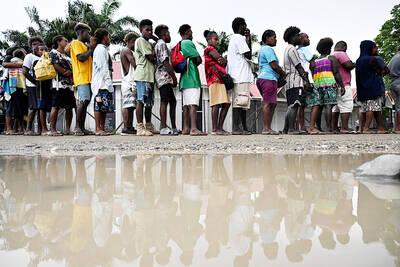
SEEKING CHANGE: A hospital worker said she did not vote in previous elections, but ‘now I can see that maybe my vote can change the system and the country’ Voting closed yesterday across the Solomon Islands in the south Pacific nation’s first general election since the government switched diplomatic allegiance from Taiwan to Beijing and struck a secret security pact that has raised fears of the Chinese navy gaining a foothold in the region. The Solomon Islands’ closer relationship with China and a troubled domestic economy weighed on voters’ minds as they cast their ballots. As many as 420,000 registered voters had their say across 50 national seats. For the first time, the national vote also coincided with elections for eight of the 10 local governments. Esther Maeluma cast her vote in the
Nearly half of China’s major cities are suffering “moderate to severe” levels of subsidence, putting millions of people at risk of flooding, especially as sea levels rise, according to a study of nationwide satellite data released yesterday. The authors of the paper, published by the journal Science, found that 45 percent of China’s urban land was sinking faster than 3mm per year, with 16 percent at more than 10mm per year, driven not only by declining water tables, but also the sheer weight of the built environment. With China’s urban population already in excess of 900 million people, “even a small portion

UNSETTLING IMAGES: The scene took place in front of TV crews covering the Trump trial, with a CNN anchor calling it an ‘emotional and unbelievably disturbing moment’ A man who doused himself in an accelerant and set himself on fire outside the courthouse where former US president Donald Trump is on trial has died, police said yesterday. The New York City Police Department (NYPD) said the man was declared dead by staff at an area hospital. The man was in Collect Pond Park at about 1:30pm on Friday when he took out pamphlets espousing conspiracy theories, tossed them around, then doused himself in an accelerant and set himself on fire, officials and witnesses said. A large number of police officers were nearby when it happened. Some officers and bystanders rushed

HYPOCRISY? The Chinese Ministry of Foreign Affairs yesterday asked whether Biden was talking about China or the US when he used the word ‘xenophobic’ US President Joe Biden on Wednesday called for a hike in steel tariffs on China, accusing Beijing of cheating as he spoke at a campaign event in Pennsylvania. Biden accused China of xenophobia, too, in a speech to union members in Pittsburgh. “They’re not competing, they’re cheating. They’re cheating and we’ve seen the damage here in America,” Biden said. Chinese steel companies “don’t need to worry about making a profit because the Chinese government is subsidizing them so heavily,” he said. Biden said he had called for the US Trade Representative to triple the tariff rates for Chinese steel and aluminum if Beijing was


 RSS
RSS