


The UN said an interpreter responsible for an erroneous report that Syria has a nuclear facility has been reprimanded and the world body has apologized to Syria's UN Mission.
On Friday, ABC News reported that before a Sept. 6 air strike, Israel had obtained detailed pictures of the Syrian complex from an apparent mole, which supported an Israeli belief the facility was nuclear and led to the strike.
Meanwhile, UN experts have begun analyzing satellite imagery of the site, diplomats said, disclosing what amounts to the first independent look at reports that Damascus was hiding a nuclear facility.
Earlier this week, Syria denied that one of its representatives told the UN General Assembly's committee that deals with disarmament on Tuesday that Israel had attacked a Syrian nuclear facility. It said the representative was misquoted, demanded a correction, and insisted that "such facilities do not exist in Syria."
After more than seven hours of investigation Wednesday, UN officials agreed the Syrian delegate was misquoted. UN associate spokesman Farhan Haq said "There was no use of the word nuclear."
The unidentified Syrian representative spoke in Arabic and the interpreter who worked from Arabic into French was fairly accurate, but the problem occurred when an interpreter translated the statement into English from French, Haq said.
"While it was indeed unfortunate, mistakes can occur, as in any other area of work. The Interpretation Service maintains high standards, and mistakes of this nature occur very rarely," he said.
The mistake made headlines in the Middle East and heightened concerns over Damascus' nuclear ambitions. Those ambitions were under scrutiny following a Sept. 6 Israeli airstrike on an unknown target in northeastern Syria near the border with Turkey. Widespread reports say it may have been a nuclear facility, a claim Syria has denied.
Meanwhile, ABC, citing a senior US official, said a person had provided several pictures of the complex from the ground before the air strike, and Israel showed the images to the CIA. The US spy agency helped pinpoint "drop points" to assist in potential targeting, ABC said.
Israel urged the US to destroy the complex, but Washington hesitated because no fissionable material was found that would prove the site was nuclear, ABC said.
The network quoted the official as saying the facility was of North Korean design and that Syria must have had "human" help from North Korea.
Syria has said only that the site was a building under construction.
"It was unmistakable what it was going to be. No doubt in my mind," ABC quoted the official as saying.
The US had begun to consider ways to destroy the complex, such as a special forces raid using helicopters, ABC said. But it said the White House sent word the US would not carry out a raid and urged Israel not to do it either.
Meanwhile, UN experts have begun analyzing satellite imagery of the site, diplomats said.
It remained unclear where the material was obtained or what exactly it showed. One of the diplomats who is linked to the International Atomic Energy Agency (IAEA) -- the UN nuclear watchdog examining the photos -- said IAEA experts were looking at commercial images, discounting suggestions from other quarters that the images had come from US intelligence.
Separately, a senior diplomat familiar with the issue indicated on Friday that agency experts were looking at several possible locations for the Israeli strike. Two other diplomats said initial perusal of the material had found no evidence that the target hit Sept. 6 was a nuclear installation. They emphasized, however, that it was too early to draw definite conclusions.
Daryl Kimball, executive director of the Arms Control Association, cautioned that commercial satellite imagery "may not be of sufficient quality to figure out difficult questions."

Republican US lawmakers on Friday criticized US President Joe Biden’s administration after sanctioned Chinese telecoms equipment giant Huawei unveiled a laptop this week powered by an Intel artificial intelligence (AI) chip. The US placed Huawei on a trade restriction list in 2019 for contravening Iran sanctions, part of a broader effort to hobble Beijing’s technological advances. Placement on the list means the company’s suppliers have to seek a special, difficult-to-obtain license before shipping to it. One such license, issued by then-US president Donald Trump’s administration, has allowed Intel to ship central processors to Huawei for use in laptops since 2020. China hardliners
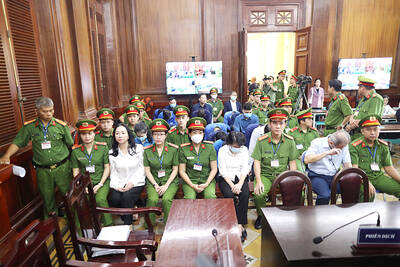
A top Vietnamese property tycoon was on Thursday sentenced to death in one of the biggest corruption cases in history, with an estimated US$27 billion in damages. A panel of three hand-picked jurors and two judges rejected all defense arguments by Truong My Lan, chair of major developer Van Thinh Phat, who was found guilty of swindling cash from Saigon Commercial Bank (SCB) over a decade. “The defendant’s actions ... eroded people’s trust in the leadership of the [Communist] Party and state,” read the verdict at the trial in Ho Chi Minh City. After the five-week trial, 85 others were also sentenced on

‘DELUSIONAL’: Targeting the families of Hamas’ leaders would not push the group to change its position or to give up its demands for Palestinians, Ismail Haniyeh said Israeli aircraft on Wednesday killed three sons of Hamas’ top political leader in the Gaza Strip, striking high-stakes targets at a time when Israel is holding delicate ceasefire negotiations with the militant group. Hamas said four of the leader’s grandchildren were also killed. Ismail Haniyeh’s sons are among the highest-profile figures to be killed in the war so far. Israel said they were Hamas operatives, and Haniyeh accused Israel of acting in “the spirit of revenge and murder.” The deaths threatened to strain the internationally mediated ceasefire talks, which appeared to gain steam in recent days even as the sides remain far
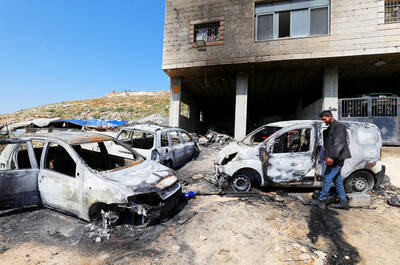
RAMPAGE: A Palestinian man was left dead after dozens of Israeli settlers searching for a missing 14-year-old boy stormed a village in the Israeli-occupied West Bank US President Joe Biden on Friday said he expected Iran to attack Israel “sooner, rather than later” and warned Tehran not to proceed. Asked by reporters about his message to Iran, Biden simply said: “Don’t,” underscoring Washington’s commitment to defend Israel. “We are devoted to the defense of Israel. We will support Israel. We will help defend Israel and Iran will not succeed,” he said. Biden said he would not divulge secure information, but said his expectation was that an attack could come “sooner, rather than later.” Israel braced on Friday for an attack by Iran or its proxies as warnings grew of


 RSS
RSS