


Khaled el-Masri's frightening tale of abduction and torture at the hands of the CIA can be discussed everywhere it seems -- except in US courts.
The US government acknowledged to Germany, el-Masri's adopted country, that it mistakenly seized him. The details of his claim -- being beaten, stripped and drugged by masked men he believes to be CIA agents -- are well known. German prosecutors found his story credible enough that they issued arrest warrants for the agents who were allegedly involved.
No matter, the US Supreme Court indicated on Tuesday. Without any comment, the justices said they would not give a hearing to el-Masri, agreeing with lower federal courts that tossed out his lawsuit on the grounds that secrets would be revealed if it went forward.
The administration of US President George W. Bush had urged that course, saying that even if el-Masri's case has been discussed in public, government officials have never done so.
President Bush and others have confirmed the existence of the CIA's controversial extraordinary rendition program, but the facts central to el-Masri's claims "concern the highly classified methods and means of the program," the government said.
By refusing to hear el-Masri's case, the high court passed up an opportunity to review the doctrine of state secrets, which has been employed by this administration more frequently than its predecessors.
El-Masri, 44, a German citizen of Lebanese descent, says he was a mistaken victim of the CIA program. He was detained while entering Macedonia on New Year's Eve 2003 and eventually transferred to a CIA-run prison known as the "salt pit" in the Afghan capital of Kabul.
Five months after his seizure, el-Masri says, he was dumped on a hilltop in Albania and told to walk down a path without looking back.
The lawsuit against former CIA director George Tenet, unidentified CIA agents and others sought damages of at least US$75,000.
The court's action dismayed el-Masri's lawyers.
"We are very disappointed," Manfred Gnijdic, el-Masri's attorney in Germany, said in a telephone interview from his office in Ulm.
"It will shatter all trust in the American justice system," Gnijdic said, charging that the US expects every other nation to act responsibly, but refuses to take responsibility for its own actions.
"That is a disaster," Gnijdic said.
El-Masri's case centers on the rendition program, in which terrorism suspects are captured and taken to foreign countries for interrogation. Human rights activists have objected to the program.
Bush has repeatedly defended the policies in the war on terror, saying as recently as last week that the US does not engage in torture.
El-Masri's lawsuit had been seen as a test of the administration's legal strategy to invoke the doctrine of state secrets and stop national security lawsuits before any evidence is presented in private to a judge. Another lawsuit over the administration's warrantless wiretapping program, also dismissed by a federal court on state secrets grounds, still is pending before the justices.
Conservative legal scholar Douglas Kmiec said the Bush White House uses the doctrine too broadly.
"The notion that state secrets can't be preserved by a judge who has taken an oath to protect the Constitution, that a judge cannot examine the strength of the claim is too troubling to be accepted," said Kmiec, a law professor at Pepperdine University.
The court has not examined the state secrets privilege in more than 50 years.
A coalition of groups favoring greater openness in government says the Bush administration has used the state secrets privilege much more frequently than its predecessors.
At the height of Cold War tensions between the US and the former Soviet Union, US presidents used the state secrets privilege six times from 1953 to 1976, according to OpenTheGovernment.org. Since 2001, it has been used 39 times, enabling the government to unilaterally withhold documents from the court system, the group said.
The state secrets privilege arose from a 1953 Supreme Court ruling that allowed the executive branch to keep secret, even from the court, details about a military plane's fatal crash.
Three widows sued to get the accident report after their husbands died aboard a B-29 bomber, but the Air Force refused to release it claiming that the plane was on a secret mission to test new equipment.
The high court accepted the argument, but when the report was released decades later there was nothing in it about a secret mission or equipment.
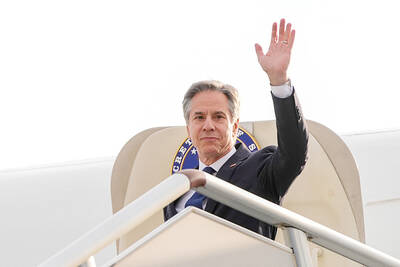
‘IN A DIFFERENT PLACE’: The envoy first visited Shanghai, where he attended a Chinese basketball playoff match, and is to meet top officials in Beijing tomorrow US Secretary of State Antony Blinken yesterday arrived in China on his second visit in a year as the US ramps up pressure on its rival over its support for Russia while also seeking to manage tensions with Beijing. The US diplomat tomorrow is to meet China’s top brass in Beijing, where he is also expected to plead for restraint as Taiwan inaugurates president-elect William Lai (賴清德), and to raise US concerns on Chinese trade practices. However, Blinken is also seeking to stabilize ties, with tensions between the world’s two largest economies easing since his previous visit in June last year. At the
Nearly half of China’s major cities are suffering “moderate to severe” levels of subsidence, putting millions of people at risk of flooding, especially as sea levels rise, according to a study of nationwide satellite data released yesterday. The authors of the paper, published by the journal Science, found that 45 percent of China’s urban land was sinking faster than 3mm per year, with 16 percent at more than 10mm per year, driven not only by declining water tables, but also the sheer weight of the built environment. With China’s urban population already in excess of 900 million people, “even a small portion

UNSETTLING IMAGES: The scene took place in front of TV crews covering the Trump trial, with a CNN anchor calling it an ‘emotional and unbelievably disturbing moment’ A man who doused himself in an accelerant and set himself on fire outside the courthouse where former US president Donald Trump is on trial has died, police said yesterday. The New York City Police Department (NYPD) said the man was declared dead by staff at an area hospital. The man was in Collect Pond Park at about 1:30pm on Friday when he took out pamphlets espousing conspiracy theories, tossed them around, then doused himself in an accelerant and set himself on fire, officials and witnesses said. A large number of police officers were nearby when it happened. Some officers and bystanders rushed

Beijing is continuing to commit genocide and crimes against humanity against Uyghurs and other Muslim minorities in its western Xinjiang province, U.S. Secretary of State Antony Blinken said in a report published on Monday, ahead of his planned visit to China this week. The State Department’s annual human rights report, which documents abuses recorded all over the world during the previous calendar year, repeated language from previous years on the treatment of Muslims in Xinjiang, but the publication raises the issue ahead of delicate talks, including on the war in Ukraine and global trade, between the top U.S. diplomat and Chinese


 RSS
RSS