


Vietnam plans to restore the ruins of an ancient imperial city in central Hanoi dating back to the 7th century with help from Japan and the UN cultural organization, heritage officials say.
Work is expected to start next year to preserve the old citadel ahead of the capital's 1,000th birthday in 2010 and would strengthen Hanoi's chances of having its historic cultural heart declared a World Heritage site in future.
The remains of the ancient citadel and relics from five feudal dynasties were first discovered in 2002 during excavation work to build a new national assembly in the center of the capital, putting construction on hold.
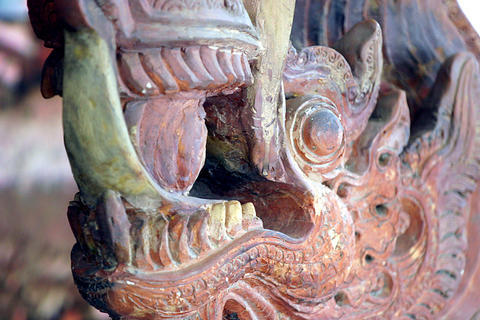
PHOTO: AFP
Archeologists discovered millions of priceless artifacts from the city once known as Thang Long (Ascending Dragon), including terracotta figures of dragons and phoenix heads, ceramics, canons, swords and coins.
The find started a dispute between heritage and development forces over what to do with the ruins located in what has been Vietnam's center of political power for most of its history, from ancient times until today.
The 20,000m2 dig shares a city block with the existing Ba Dinh national assembly and is located near the mausoleum of Ho Chi Minh, Vietnam's revolutionary leader and first president.
At one stage, Vietnam's government considered moving the legislature to the outskirts of Hanoi, but it has now decided to build the new assembly on the site of the existing Ba Dinh Hall, adjacent to the ancient city ruins.
Authorities have put on display 17 design models for the new assembly. The exact size of the new building remains unclear, but officials say the development will allow for the adjacent ruins to be saved.
"The government has decided to preserve the area, not to build a national assembly building here," said Bui Minh Tri, secretary of the Thang Long Imperial Citadel site project and deputy director of Vietnam's Institute of Archeology. "We will build a museum or a historical park."
Workers are now excavating palace structures and artifacts in the area, which is shielded by a large plastic roof and closed to the general public, but work is set to be stepped up under the new project.
Japan has offered to provide financial and technical aid to protect and restore the citadel via a Japan-UNESCO (UN Educational, Scientific and Cultural Organization) fund, the state-run An Ninh Thu Do newspaper reported.
"Our goal is to preserve this historical site for the long term, not only for the celebrations of the 1,000th anniversary of Thang Long-Hanoi," said Tran Quang Dung, deputy chief for the National Steering Committee for 1,000 Years of Thang Long-Hanoi, according to the report.
Hanoi became the capital of Vietnam in 1010 under the Ly dynasty. The name Thang Long, or Ascending Dragon, symbolized the desire for independence after a thousand years of Chinese domination, historians say.
The dig has unearthed ancient palace foundations and the remains of the central forbidden city, with ruins dating back 1,300 years to the Chinese Tang dynasty.

Republican US lawmakers on Friday criticized US President Joe Biden’s administration after sanctioned Chinese telecoms equipment giant Huawei unveiled a laptop this week powered by an Intel artificial intelligence (AI) chip. The US placed Huawei on a trade restriction list in 2019 for contravening Iran sanctions, part of a broader effort to hobble Beijing’s technological advances. Placement on the list means the company’s suppliers have to seek a special, difficult-to-obtain license before shipping to it. One such license, issued by then-US president Donald Trump’s administration, has allowed Intel to ship central processors to Huawei for use in laptops since 2020. China hardliners

DISADVANTAGE: Erin O’Toole, who led the Conservatives during the election campaign in 2021, estimated that the interference cost his party as many as nine legislative seats Canada’s domestic spy agency on Monday concluded that China interfered in the past two elections, an official probe heard, the firmest evidence so far of suspected Chinese meddling in Canadian politics. Canadian Prime Minister Justin Trudeau’s Liberal Party won both the elections, held in 2019 and 2021. Under pressure from opposition lawmakers unhappy about media reports on China’s possible role, Trudeau set up a commission into foreign interference. The commission was shown a slide on Monday containing an extract of a briefing in February last year from the Canadian Security Intelligence Service (CSIS). “We know that the PRC [People’s Republic of China] clandestinely
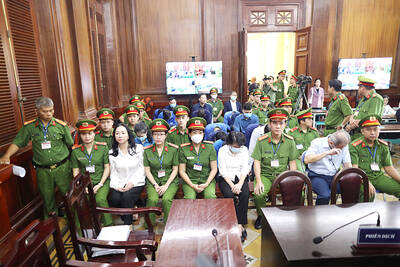
A top Vietnamese property tycoon was on Thursday sentenced to death in one of the biggest corruption cases in history, with an estimated US$27 billion in damages. A panel of three hand-picked jurors and two judges rejected all defense arguments by Truong My Lan, chair of major developer Van Thinh Phat, who was found guilty of swindling cash from Saigon Commercial Bank (SCB) over a decade. “The defendant’s actions ... eroded people’s trust in the leadership of the [Communist] Party and state,” read the verdict at the trial in Ho Chi Minh City. After the five-week trial, 85 others were also sentenced on

‘DELUSIONAL’: Targeting the families of Hamas’ leaders would not push the group to change its position or to give up its demands for Palestinians, Ismail Haniyeh said Israeli aircraft on Wednesday killed three sons of Hamas’ top political leader in the Gaza Strip, striking high-stakes targets at a time when Israel is holding delicate ceasefire negotiations with the militant group. Hamas said four of the leader’s grandchildren were also killed. Ismail Haniyeh’s sons are among the highest-profile figures to be killed in the war so far. Israel said they were Hamas operatives, and Haniyeh accused Israel of acting in “the spirit of revenge and murder.” The deaths threatened to strain the internationally mediated ceasefire talks, which appeared to gain steam in recent days even as the sides remain far


 RSS
RSS