


Iraqi political leaders prepared for a crisis council yesterday as Prime Minister Nouri al-Maliki sought to save his crumbling government. About 16,000 US and Iraqi troops began a new operation north of Baghdad targeting insurgents who have fled a crackdown in the restive city of Baqubah, the military said.
A suicide truck bomb killed two people, wounded five and badly damaged a bridge linking Baghdad to northern Iraq yesterday, Iraqi security forces said.
Part of the bridge collapsed in the attack near Taiji, in which a fuel tanker was used.

PHOTO: AFP
One side of the bridge was badly damaged in a previous bombing on May 11.
Local officials, meanwhile, said four civilians, including a three-year-old girl, were killed yesterday during a raid by joint US-Iraqi forces in Baghdad's Shiite district of Sadr City. The US military said four militants were killed after a fierce gunfight, but it had no reports of civilian deaths.
Operation Lightning Hammer, which began late on Monday with an air assault, was part of a broader US push announced on Monday to build on successes in Baghdad and surrounding areas by targeting al-Qaeda in Iraq and Iranian-allied Shiite militia fighters nationwide.
Major General Benjamin Mixon, the commander of US forces in northern Iraq, said the troops were pursuing al-Qaeda cells that had been disrupted and forced into hiding by previous operations.
"Our main goal with Lightning Hammer is to eliminate the terrorist organizations ... and show them that they truly have no safehaven -- especially in Diyala," he said in a statement.
The military did not immediately provide results from the operation because it was in the beginning stages.
Spokesman Lieutenant Colonel Michael Donnelly said the effort would not interrupt operations in Baqubah, where US forces have flushed out al-Qaeda and Shiite militiamen who had fomented a virtual civil war there.
"We are not drawing down in Baqubah at all, in fact, we are in the build and hold portion of the operation there," he said.
The military has claimed success in quelling the violence in the city, 60km northeast of Baghdad, as well as in the capital, but it also acknowledges that Shiite and Sunni extremists fled to outlying areas where attacks have been increasing.
The sinking fortunes of al-Maliki and his Shiite-led administration have become something of a second front for Washington.
Al-Maliki appeared to have cleared the way, with a last-minute push from US Ambassador Ryan Crocker, for a crisis council that seeks to save his crumbling government, but the timing of the meeting was uncertain.
Al-Maliki's government -- a shaky coalition of Shiites, Sunnis and Kurds -- has been gutted by boycotts and defections. A full-scale disintegration could touch off power grabs on all sides and seriously complicate US-led efforts to stabilize Iraq.
Al-Maliki has struggled over the past days to pull together a summit of Iraq's main religious and ethnic groups. The meeting finally appeared likely after Crocker called on Vice President Tariq al-Hashemi, the lone Sunni Arab invited to the talks. Al-Hashemi's attendance had been in question.
A senior US official, who spoke in Baghdad, said Monday that the stage was set for major changes in the "structure, nature and direction of the Iraqi state." The official spoke on condition of anonymity because of the delicate nature of the planned gathering.
But ending the political impasse would likely require concessions from al-Maliki's embattled government toward Sunnis, who account for up to 20 percent of Iraq's population but complain they have been sidelined in trying to rebuild Iraq after former president Saddam Hussein.
If al-Maliki were able to bring al-Hashemi on board, he then could try to welcome back Sunni Cabinet ministers who quit earlier this month. Should they refuse, he has said he was ready to name rival Sunnis to the vacant Cabinet posts.
Meanwhile, a police officer in Sadr City, speaking on condition of anonymity because he wasn't authorized to release the information, said the four civilians were killed and five others were wounded as US and Iraqi troops backed by helicopters, conducted house-to-house searches in the sprawling area in eastern Baghdad.
Nearly half of China’s major cities are suffering “moderate to severe” levels of subsidence, putting millions of people at risk of flooding, especially as sea levels rise, according to a study of nationwide satellite data released yesterday. The authors of the paper, published by the journal Science, found that 45 percent of China’s urban land was sinking faster than 3mm per year, with 16 percent at more than 10mm per year, driven not only by declining water tables, but also the sheer weight of the built environment. With China’s urban population already in excess of 900 million people, “even a small portion

UNSETTLING IMAGES: The scene took place in front of TV crews covering the Trump trial, with a CNN anchor calling it an ‘emotional and unbelievably disturbing moment’ A man who doused himself in an accelerant and set himself on fire outside the courthouse where former US president Donald Trump is on trial has died, police said yesterday. The New York City Police Department (NYPD) said the man was declared dead by staff at an area hospital. The man was in Collect Pond Park at about 1:30pm on Friday when he took out pamphlets espousing conspiracy theories, tossed them around, then doused himself in an accelerant and set himself on fire, officials and witnesses said. A large number of police officers were nearby when it happened. Some officers and bystanders rushed

HYPOCRISY? The Chinese Ministry of Foreign Affairs yesterday asked whether Biden was talking about China or the US when he used the word ‘xenophobic’ US President Joe Biden on Wednesday called for a hike in steel tariffs on China, accusing Beijing of cheating as he spoke at a campaign event in Pennsylvania. Biden accused China of xenophobia, too, in a speech to union members in Pittsburgh. “They’re not competing, they’re cheating. They’re cheating and we’ve seen the damage here in America,” Biden said. Chinese steel companies “don’t need to worry about making a profit because the Chinese government is subsidizing them so heavily,” he said. Biden said he had called for the US Trade Representative to triple the tariff rates for Chinese steel and aluminum if Beijing was
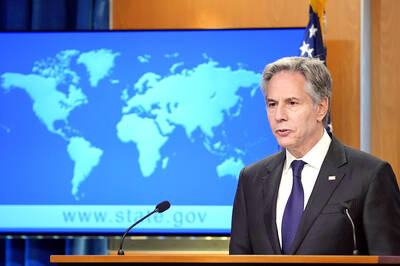
Beijing is continuing to commit genocide and crimes against humanity against Uyghurs and other Muslim minorities in its western Xinjiang province, U.S. Secretary of State Antony Blinken said in a report published on Monday, ahead of his planned visit to China this week. The State Department’s annual human rights report, which documents abuses recorded all over the world during the previous calendar year, repeated language from previous years on the treatment of Muslims in Xinjiang, but the publication raises the issue ahead of delicate talks, including on the war in Ukraine and global trade, between the top U.S. diplomat and Chinese


 RSS
RSS