


When he came to, the US Marine's arm hung lamely. It was broken by ball bearings hurled so hard from a suicide bomb that they also became embedded in his gun. Yet Brendan Poelaert's thoughts quickly turned to his patrol dog.
The powerful Belgian Malinois named Flapoor had served him as partner and protector for the past four months in Iraq. Now, the dog staggered a few steps along the Ramadi street, then stared blankly. Blood poured from his chest.
"I didn't care about my injuries, my arm," his handler says. "I'm telling the medic, `I got to get my dog to the vet!'"
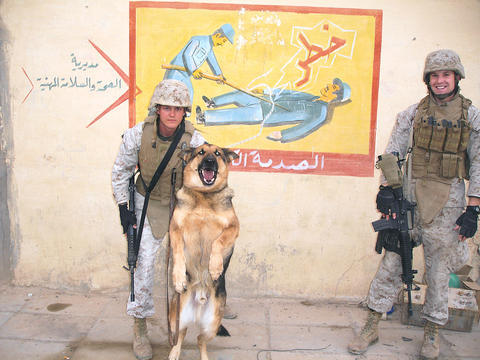
PHOTO: AP
About 2,000 of these working dogs confront danger beside US soldiers, largely in the Middle East. With noses that detect scents up to 1.6km away, many sniff for explosives in Iraq. Their numbers have been growing about 20 percent a year since the terrorist attacks of 2001, says Air Force Captain Jeffrey McKamey, who helps run the program.
In doing their jobs, dozens of these dogs have also become war wounded -- scorched by the desert, slashed by broken glass, pelted by stray bullets, pounded by roadside bombs.
Their services are so valued, though, that wounded dogs are treated much like wounded troops. "They are cared for as well as any soldier," insists Senior Airman Ronald Harden, a dog handler in Iraq.
Their first aid comes out of doggy field kits bearing everything from medicine to syringes. Some are evacuated to military veterinary centers hundreds of kilometers away and even to Germany and the US for rehabilitation. Many recover and return to duty.
On the day of the Ramadi blast in January last year, Poelaert, trained in veterinary first aid, began care as soon as both were loaded into an SUV. He pressed his finger to his dog's chest to stop him from bleeding to death.
When they reached the base camp, a medic with veterinary training took over, starting Flapoor on an IV. Poelaert departed reluctantly for his own surgery.
Flapoor -- the name means "droopy-eared" in the Dutch language of his homeland -- would eventually go to Baghdad for more care of his punctured lung and belly wounds. He'd later rejoin his handler and fly in a cargo plane to the US for physical rehab.
Healing under the California sun at Camp Pendleton, Flapoor is now back to his usual self in most ways: fast, friendly, eager-to-please. But he still suffers a sort of canine post-traumatic stress disorder. "He's really jumpy around loud noises now," Poelaert says.
Military dogs must be in top condition to perform the duties they're assigned. And training is rigorous.
Dogs take their basic training at Lackland Air Force Base in San Antonio, where they learn to tolerate the crack of gunfire and sputter of helicopters. They are trained to sniff for explosives on command, freezing and staring at suspicious objects.
Merely baring their teeth, they can cow a crowd. Commanded to strike, they can easily flatten a big man with one leap, flying like a 23km sand bag tossed from a truck.
Smart and strong Malinois and shepherds predominate, but other breeds are trained too. Even small dogs, like beagles or poodles, are occasionally taught to detect explosives in submarines and other close quarters.
In Iraq, the demand for explosives-finding dogs has escalated. They lead patrols with their handlers in tow, sniffing bags and other suspicious objects along the way.
The bombs have bulked up in past months, putting dogs and handlers at more risk. To protect handlers, some dogs are now trained to wear backpacks with radios and respond to remote voice commands.
"As much as I love these dogs, their job is to take a bullet for me," says trainer Sergeant Douglas Timberlake.
The military estimates spending six months and US$25,000 to buy, feed, train and care for the average dog. They are tended by 440 Army veterinarians worldwide.
The dogs get two physical exams each year, more often than most people. They get blood tests, X-rays, and electrocardiograms.
When dogs break teeth with their powerful bites, military vets sometimes do root canals to save the teeth.
"Here we treat them, because that's part of that dog's equipment: to use his teeth," says Lorraine Linn, a dog surgeon at Lackland.
Dogs have been weapons of war since ancient times. Thousands were enlisted in this country's fights in World War I and II and in Vietnam. Dogs cannot be awarded medals under military protocol, but commanders sometimes honor them unofficially.
Nearly half of China’s major cities are suffering “moderate to severe” levels of subsidence, putting millions of people at risk of flooding, especially as sea levels rise, according to a study of nationwide satellite data released yesterday. The authors of the paper, published by the journal Science, found that 45 percent of China’s urban land was sinking faster than 3mm per year, with 16 percent at more than 10mm per year, driven not only by declining water tables, but also the sheer weight of the built environment. With China’s urban population already in excess of 900 million people, “even a small portion

UNSETTLING IMAGES: The scene took place in front of TV crews covering the Trump trial, with a CNN anchor calling it an ‘emotional and unbelievably disturbing moment’ A man who doused himself in an accelerant and set himself on fire outside the courthouse where former US president Donald Trump is on trial has died, police said yesterday. The New York City Police Department (NYPD) said the man was declared dead by staff at an area hospital. The man was in Collect Pond Park at about 1:30pm on Friday when he took out pamphlets espousing conspiracy theories, tossed them around, then doused himself in an accelerant and set himself on fire, officials and witnesses said. A large number of police officers were nearby when it happened. Some officers and bystanders rushed

Beijing is continuing to commit genocide and crimes against humanity against Uyghurs and other Muslim minorities in its western Xinjiang province, U.S. Secretary of State Antony Blinken said in a report published on Monday, ahead of his planned visit to China this week. The State Department’s annual human rights report, which documents abuses recorded all over the world during the previous calendar year, repeated language from previous years on the treatment of Muslims in Xinjiang, but the publication raises the issue ahead of delicate talks, including on the war in Ukraine and global trade, between the top U.S. diplomat and Chinese

HYPOCRISY? The Chinese Ministry of Foreign Affairs yesterday asked whether Biden was talking about China or the US when he used the word ‘xenophobic’ US President Joe Biden on Wednesday called for a hike in steel tariffs on China, accusing Beijing of cheating as he spoke at a campaign event in Pennsylvania. Biden accused China of xenophobia, too, in a speech to union members in Pittsburgh. “They’re not competing, they’re cheating. They’re cheating and we’ve seen the damage here in America,” Biden said. Chinese steel companies “don’t need to worry about making a profit because the Chinese government is subsidizing them so heavily,” he said. Biden said he had called for the US Trade Representative to triple the tariff rates for Chinese steel and aluminum if Beijing was


 RSS
RSS