


Mexican archeologists using ground-penetrating radar have detected underground chambers they believe contain the remains of Emperor Ahuizotl, who ruled the Aztecs when Columbus landed in the New World. It would be the first tomb of an Aztec ruler ever found.
The find could provide an extraordinary window into Aztec civilization at its apogee. Ahuizotl, an empire-builder who extended the Aztecs' reach as far as Guatemala, was the last emperor to complete his rule before the Spanish Conquest.
Accounts written by Spanish priests suggest the area was used by the Aztecs to cremate and bury their rulers. But no tomb of an Aztec ruler has ever been found, in part because the Spanish conquerors built their own city atop the Aztec's ceremonial center, leaving behind colonial structures too historically valuable to remove for excavations.
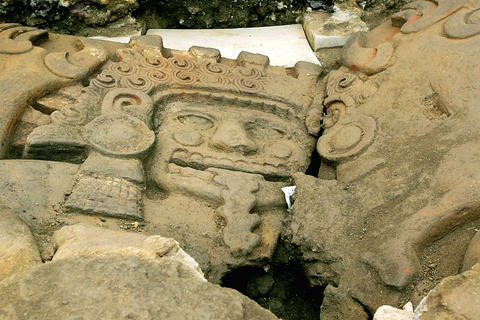
PHOTO: AP
One of those colonial buildings was so damaged in a 1985 earthquake that it had to be torn down, eventually giving experts their first chance to examine the site off Mexico City's Zocalo Plaza, between the Metropolitan Cathedral and the ruins of the Templo Mayor pyramid.
Archeologists said they have located what appears to be a 2m-by-2m entryway into the tomb about 4m below ground. The passage is filled with water, rocks and mud, forcing workers to dig delicately while suspended from slings. Pumps work to keep the water level down.
"We are doing it very, very slowly ... because the responsibility is very great and we want to register everything," said Leonardo Lopez Lujan, the lead government archeologist on the project.
"It's a totally new situation for us, and we don't know exactly what it will be like down there," he said.
As early as this fall, they hope to enter the inner chambers -- a damp, low-ceilinged space -- and discover the ashes of Ahuizotl, who was likely cremated on a funeral pyre in 1502.
By that time, Columbus had already landed in the New World. But the Aztecs' first contact with Europeans came 17 years later, in 1519, when Hernan Cortes and his band of conquistadors marched into the Mexico Valley and took Ahuizotl's successor hostage, his nephew Montezuma.
Ahuizotl's son Cuauhtemoc took over from Montezuma and led the last resistance to the Spaniards in the battle for Mexico City in 1521. He was later taken prisoner and killed. Like Montezuma, his burial place is unknown.
Because no Aztec royal tomb has ever been found, the archeologists are literally digging into the unknown. Radar indicates the tomb has up to four chambers, and scientists think they will find a constellation of elaborate offerings to the gods on the floor.
"He must have been buried with solemn ceremony and rich offerings, like vases, ornaments ... and certainly some objects he personally used," said Luis Alberto Martos, director of archeological studies at Mexico's National Institute of Anthropology and History.
The tomb's curse -- water -- may also be its blessing. Lopez Lujan said the constant temperature of the pH-neutral water in the flooded chambers, together with the lack of oxygen, discourages decomposition of materials like wood and bone that have been found at other digs around the pyramid, which was all but destroyed in the Conquest.
`This would be quite an important find for Aztec archeology,'' said Michael Smith, an archeologist at Arizona State University who is not connected to the dig. ``It would be tremendously important because it would be direct information about kingship, burial and the empire that is difficult to come by otherwise.''
All signs found so far point to Ahuizotl. The site lies directly below a huge, recently discovered stone monolith carved with a representation of Tlaltecuhtli, the Aztec god of the earth.
Depicted as a woman with huge claws and a stream of blood flowing into her mouth as she squats to give birth, Tlaltecuhtli was believed to devour the dead and then give them new life.
The god was so fearsome that Aztecs normally buried her depictions face down in the earth. However, this one is face-up.
In the claw of her right foot, the god holds a rabbit and ten dots, indicating the date "Ten Rabbit" -- 1502, the year of Ahuizotl's death.
Any artifacts linked to Ahuizotl would bring tremendous pride to Mexico.
The country has sought unsuccessfully to recover Aztec artifacts like the feather-adorned "shield of Ahuizotl" and the "Montezuma headdress" from the Ethnology Museum in Vienna, Austria.
"Imagine it -- this wasn't just any high-ranking man. The Aztecs were the most powerful society of their time before the arrival of the Spaniards," Martos said. "That's why Ahuizotl's tomb down there is so important."

Republican US lawmakers on Friday criticized US President Joe Biden’s administration after sanctioned Chinese telecoms equipment giant Huawei unveiled a laptop this week powered by an Intel artificial intelligence (AI) chip. The US placed Huawei on a trade restriction list in 2019 for contravening Iran sanctions, part of a broader effort to hobble Beijing’s technological advances. Placement on the list means the company’s suppliers have to seek a special, difficult-to-obtain license before shipping to it. One such license, issued by then-US president Donald Trump’s administration, has allowed Intel to ship central processors to Huawei for use in laptops since 2020. China hardliners
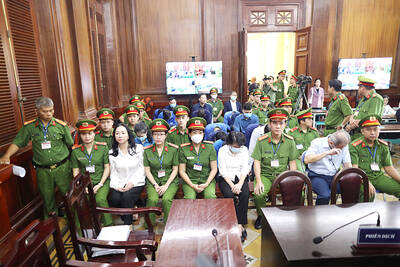
A top Vietnamese property tycoon was on Thursday sentenced to death in one of the biggest corruption cases in history, with an estimated US$27 billion in damages. A panel of three hand-picked jurors and two judges rejected all defense arguments by Truong My Lan, chair of major developer Van Thinh Phat, who was found guilty of swindling cash from Saigon Commercial Bank (SCB) over a decade. “The defendant’s actions ... eroded people’s trust in the leadership of the [Communist] Party and state,” read the verdict at the trial in Ho Chi Minh City. After the five-week trial, 85 others were also sentenced on

Conjoined twins Lori and George Schappell, who pursued separate careers, interests and relationships during lives that defied medical expectations, died this month in Pennsylvania, funeral home officials said. They were 62. The twins, listed by Guinness World Records as the oldest living conjoined twins, died on April 7 at the Hospital of the University of Pennsylvania, obituaries posted by Leibensperger Funeral Homes of Hamburg said. The cause of death was not detailed. “When we were born, the doctors didn’t think we’d make 30, but we proved them wrong,” Lori said in an interview when they turned 50, the Philadelphia Inquirer reported. The

RAMPAGE: A Palestinian man was left dead after dozens of Israeli settlers searching for a missing 14-year-old boy stormed a village in the Israeli-occupied West Bank US President Joe Biden on Friday said he expected Iran to attack Israel “sooner, rather than later” and warned Tehran not to proceed. Asked by reporters about his message to Iran, Biden simply said: “Don’t,” underscoring Washington’s commitment to defend Israel. “We are devoted to the defense of Israel. We will support Israel. We will help defend Israel and Iran will not succeed,” he said. Biden said he would not divulge secure information, but said his expectation was that an attack could come “sooner, rather than later.” Israel braced on Friday for an attack by Iran or its proxies as warnings grew of


 RSS
RSS