


Dozens of Shiite villagers in the north were massacred by Sunni extremists, two officials said yesterday, while a car bomb exploded across the street from the Iranian embassy in the heart of Baghdad and killed four civilians.
Also yesterday, Shiite legislators loyal to anti-US cleric Moqtada al-Sadr decided to end their five-week boycott of parliament, one of their leaders said. The Shiite protest along with a separate Sunni boycott had blocked work on key benchmark legislation demanded by the US
Police Colonel Ragheb Radhi al-Omairi said 29 members of a Shiite tribe were massacred overnight in Diyala Province when dozens of suspected Sunni gunmen raided their village near Muqdadiyah, about 95km northeast of Baghdad. The dead included four women, al-Omairi said.

PHOTO: AP
Al-Omairi said he had not seen the bodies and it was unclear whether they had been retrieved.
An Iraqi army officer said the attack occurred in the village of Diwailiya and that at least 10 bodies were mutilated in the hour-long raid.
In Baghdad, the blast near the Iranian Embassy occurred in late morning a few hundred yards north of the US-controlled Green Zone, sending a huge cloud of black smoke over the city. Three civilians also were wounded, said police.
Also yesterday, the bodies of two security guards were found in the western Baghdad neighborhood of Mansour, two days after they were kidnapped from the office of a cellphone company where they worked, police said.
The leader of the 30-member Sadrist bloc in parliament, Nasser al-Rubaie, said the decision to end the boycott was taken after the government agreed to rebuild a Shiite mosque in Samarra which was destroyed in two bombings and to secure the highway from Baghdad and the shrine.
Pressure is now expected to mount on the Sunnis to end their boycott, which began over the ouster of the Sunni speaker of parliament last month. Sunni leaders say an agreement is near on ending the protest.
Both protests have paralyzed work in Iraq's fractious, 275-member assembly.
In Kirkuk, families collected the bodies of relatives from hospitals a day after a triple bombing killed about 80 people and wounded more than 150. Others were searching debris still left on the street, hoping for clues about what happened to friends and relatives whose bodies have not been identified.
All but one of the victims died when a huge truck bomb exploded near the Kirkuk Castle and the headquarters of the Patriotic Union of Kurdistan, the party of Iraqi President Jalal Talabani.
It was the deadliest attack in Kirkuk, where Arabs, Turkomen and Kurds are competing for control of the city at the heart of Iraq's northern oil region.
Voters in the city are to decide whether to join the Kurdish self-ruled region in a referendum by year's end.
With three ethnic groups competing for control, violence in Kirkuk has been frequent. But Monday's blasts were on a far bigger scale than most attacks.

Republican US lawmakers on Friday criticized US President Joe Biden’s administration after sanctioned Chinese telecoms equipment giant Huawei unveiled a laptop this week powered by an Intel artificial intelligence (AI) chip. The US placed Huawei on a trade restriction list in 2019 for contravening Iran sanctions, part of a broader effort to hobble Beijing’s technological advances. Placement on the list means the company’s suppliers have to seek a special, difficult-to-obtain license before shipping to it. One such license, issued by then-US president Donald Trump’s administration, has allowed Intel to ship central processors to Huawei for use in laptops since 2020. China hardliners

Conjoined twins Lori and George Schappell, who pursued separate careers, interests and relationships during lives that defied medical expectations, died this month in Pennsylvania, funeral home officials said. They were 62. The twins, listed by Guinness World Records as the oldest living conjoined twins, died on April 7 at the Hospital of the University of Pennsylvania, obituaries posted by Leibensperger Funeral Homes of Hamburg said. The cause of death was not detailed. “When we were born, the doctors didn’t think we’d make 30, but we proved them wrong,” Lori said in an interview when they turned 50, the Philadelphia Inquirer reported. The
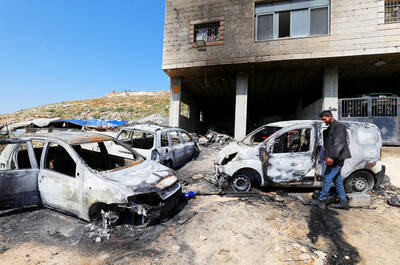
RAMPAGE: A Palestinian man was left dead after dozens of Israeli settlers searching for a missing 14-year-old boy stormed a village in the Israeli-occupied West Bank US President Joe Biden on Friday said he expected Iran to attack Israel “sooner, rather than later” and warned Tehran not to proceed. Asked by reporters about his message to Iran, Biden simply said: “Don’t,” underscoring Washington’s commitment to defend Israel. “We are devoted to the defense of Israel. We will support Israel. We will help defend Israel and Iran will not succeed,” he said. Biden said he would not divulge secure information, but said his expectation was that an attack could come “sooner, rather than later.” Israel braced on Friday for an attack by Iran or its proxies as warnings grew of
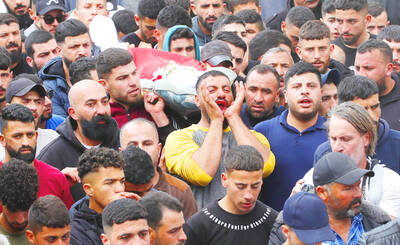
IN PURSUIT: Israel’s defense minister said the revenge attacks by Israeli settlers would make it difficult for security forces to find those responsible for the 14-year-old’s death Israeli Prime Minister Benjamin Netanyahu on Saturday condemned the “heinous murder” of an Israeli teenager in the occupied West Bank as attacks on Palestinian villages intensified following news of his death. After Benjamin Achimeir, 14, was reported missing near Ramallah on Friday, hundreds of Jewish settlers backed by Israeli forces raided nearby Palestinian villages, torching vehicles and homes, leaving at least one villager dead and dozens wounded. The attacks escalated in several villages on Saturday after Achimeir’s body was found near the Malachi Hashalom outpost. Agence France-Presse correspondents saw smoke rising from burned houses and fields. Mayor Amin Abu Alyah, of the


 RSS
RSS