


A much-delayed Somali reconciliation conference was due to start yesterday in Mogadishu amid fears of insurgent attacks and in the absence of the embattled government's main foes.
Some 1,300 delegates were expected at the meeting, billed as the latest bid to restore stability in a country mired in civil conflict which has defeated more than a dozen peace initiatives since 1991.
The reconciliation conference was called by the Transitional Federal Government (TFG) after it defeated an Islamist movement with the help of Ethiopia in January, but their main adversaries have rejected the meeting.
The virtually homeless government, which has failed to bring the restive country under control in three years of existence, is staging the conference at a former police warehouse in northern Mogadishu.
"Adequate security is in place and the delegates will be safe," said General Abdi Hassan Awale Qeybdid, a former warlord and the country's police chief.
Ethiopia-backed government troops sealed off the venue.
But observers have said insurgent attacks could still thwart the latest peace initiative.
Sporadic gunfire was heard in Mogadishu overnight and a senior official was killed in a roadside bomb attack outside the capital early yesterday.
Hassan Ahmed Hassan, the deputy district commissioner of Afgoye, about 30km west of the capital Mogadishu, died in the blast. A boy was killed and three others were injured, police said.
The conference was designed to discuss a power-sharing arrangement known as "4.5," bringing four major clans and a smaller one together.
The meeting's 11-point agenda includes discussions on clan reconciliation, disarmament, the sharing of natural resources and "the nature and impact of radical Islam."
Yet the conference has been rejected outright by the Islamic Courts Union (ICU), which was toppled after weeks of heavy fighting with the joint TFG and Ethiopian forces, who demanded that such a conference be held outside of Somalia in a neutral country.
The Hawiye clan, dominant in the capital and many of whose members also belong to the ICU, is divided over the conference.
"The conference would make sense if it was bringing rival politicians and armed groups to the same table," said Ahmed Diriye, a spokesman for the Hawiye.
"But if the idea is to talk about a non-existent tribal conflict, it's a waste of money and energy," he said.
Another Hawiye faction said it would attend the conference.
Roland Marchal, an expert from France's Centre d'Etudes et de Recherches Internationales called the talks a non-starter.
"It's billed as a clan reconciliation, but the problem isn't so much between clans. It's between the government and the insurgents," he said.
"These talks are going down the wrong path ... The time wasted trying to make this conference work will allow the violence to grow and evolve," he said.
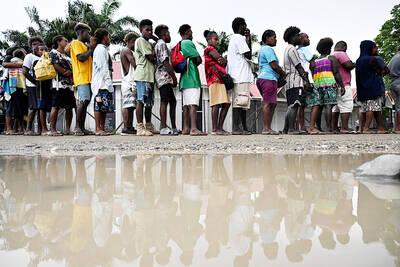
SEEKING CHANGE: A hospital worker said she did not vote in previous elections, but ‘now I can see that maybe my vote can change the system and the country’ Voting closed yesterday across the Solomon Islands in the south Pacific nation’s first general election since the government switched diplomatic allegiance from Taiwan to Beijing and struck a secret security pact that has raised fears of the Chinese navy gaining a foothold in the region. The Solomon Islands’ closer relationship with China and a troubled domestic economy weighed on voters’ minds as they cast their ballots. As many as 420,000 registered voters had their say across 50 national seats. For the first time, the national vote also coincided with elections for eight of the 10 local governments. Esther Maeluma cast her vote in the
Nearly half of China’s major cities are suffering “moderate to severe” levels of subsidence, putting millions of people at risk of flooding, especially as sea levels rise, according to a study of nationwide satellite data released yesterday. The authors of the paper, published by the journal Science, found that 45 percent of China’s urban land was sinking faster than 3mm per year, with 16 percent at more than 10mm per year, driven not only by declining water tables, but also the sheer weight of the built environment. With China’s urban population already in excess of 900 million people, “even a small portion

UNSETTLING IMAGES: The scene took place in front of TV crews covering the Trump trial, with a CNN anchor calling it an ‘emotional and unbelievably disturbing moment’ A man who doused himself in an accelerant and set himself on fire outside the courthouse where former US president Donald Trump is on trial has died, police said yesterday. The New York City Police Department (NYPD) said the man was declared dead by staff at an area hospital. The man was in Collect Pond Park at about 1:30pm on Friday when he took out pamphlets espousing conspiracy theories, tossed them around, then doused himself in an accelerant and set himself on fire, officials and witnesses said. A large number of police officers were nearby when it happened. Some officers and bystanders rushed

HYPOCRISY? The Chinese Ministry of Foreign Affairs yesterday asked whether Biden was talking about China or the US when he used the word ‘xenophobic’ US President Joe Biden on Wednesday called for a hike in steel tariffs on China, accusing Beijing of cheating as he spoke at a campaign event in Pennsylvania. Biden accused China of xenophobia, too, in a speech to union members in Pittsburgh. “They’re not competing, they’re cheating. They’re cheating and we’ve seen the damage here in America,” Biden said. Chinese steel companies “don’t need to worry about making a profit because the Chinese government is subsidizing them so heavily,” he said. Biden said he had called for the US Trade Representative to triple the tariff rates for Chinese steel and aluminum if Beijing was


 RSS
RSS