


Two Japanese men are neck deep in water at Sharks' Cove opening a new front in Sri Lanka's battle against one of its biggest killers -- water.
The two lifesaving experts have been teaching 16 men how to save people from drowning, one of the island's top causes of death, aside from traffic accidents and the 35-year-old separatist conflict.
Sharks' Cove, or Morawala, in Negombo, 40km north of Colombo, features a deceptively powerful surf. According to legend, sharks once came to Morawala to give birth, but there are no sightings now.
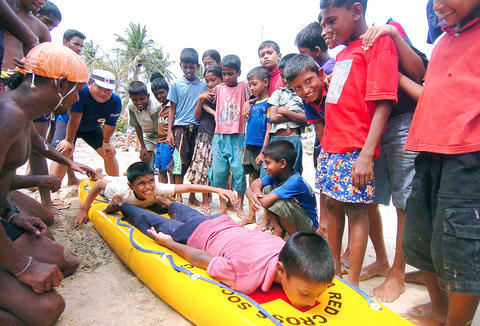
PHOTO: AP
The sea claimed five lives here in May alone -- swimming is not a widely taught skill on the island -- and the lifesavers are just getting ready to wade into the water for their training session.
Unlike the Baywatch television series, the lifeguards do not use high-tech flotation devices, beach buggies, helicopters or power boats.
Instead, they deploy plastic shopping bags, beach buckets and empty cola bottles as flotation aides. Their amber-painted surf boards are locally made.
Satoshi Funahashi, who is the Japanese Red Cross country coordinator for Sri Lanka, said they are spending a modest US$200,000 over three years to build an army of lifesavers.
Members of the small Life Saving Association have saved 3,200 lives since 1947, but say the number could have been higher if they'd had more help.
"Official figures show about 1,500 people drown annually," the association's vice president Piyadasa Silva said. "Lots of cases are not reported and we think the actual number is much higher."
That figure excludes the estimated 31,000 people who perished in the December 2004 tsunami which devastated the coastline.
But it is close to the average 1,715 people killed annually in the island's 35-year-old Tamil separatist conflict and just below the death toll on Sri Lanka's perilous roads that averages around 2,000 fatalities annually.
Many drown on Sri Lanka's golden sandy beaches and in lakes lagoons, and white water rapids. But they also drown in hydro-electricity reservoirs, irrigation tanks, and even drinking water wells.
The high number of tsunami fatalities made authorities focus on coming up with a water-safety program.
COMMUNITY TRAINING
"We'll train trainers who will go back and train their communities and create awareness," Funahashi said as men displayed their new life-saving skills on a sunny morning at Sharks' Cove.
"The idea is to develop a beach patrol eventually," he said as the men jumped into the choppy waters and dragged out colleagues acting as "victims."
Red Cross official Rajeew Gamage said they plan to offer basic training to another 2,500 people while nearly 300 will undergo a more advanced course.
FEW SWIMMERS
"We initiated this work because there was no lifesaving in this area," Gamage said. "What's strange is that although Sri Lanka is an island, only a few people can swim. Very few know the basics of first aid or lifesaving."
Swimming is not taught in most schools.
The popularity of Sharks' Cove and a few other beach spots along the west coast inspired the local Red Cross to ask for help from their Japanese counterparts in Chiba who are renowned for their lifesaving skills.
"There's a strong and a complicated current here and those who go sea bathing can get into trouble," says Mashio Kanjo, 55, the chief instructor.
Kanjo's co-trainer, Naoto Tsuda, 40, said their basic training for locals should help them in case there is another tsunami. People are taught to simply float. Learning to swim takes longer.
Kanjo says language has not been a barrier. "Most of the teaching is through demonstration and gestures," he said. "It has been easy to communicate. Sri Lankans pick up very fast."
Fisherman Shantha Basnayake, 41, said he had saved about 25 people from drowning along Wattala and Negombo, but believes he could have done more if he had the Japanese training before.
He and fellow lifesaver, Ruban Bosco, 22, saved two girls and two boys from drowning last month.
"While playing cricket on the beach, we saw them getting dragged out and the boys were not able to help the girls," Basnayake said. "They were lucky we happened to be there."
Another couple who were boating were not so lucky. After their inflatable dingy capsized, only the body of the woman was found. A Sri Lankan navy sailor who went to their rescue also drowned.

‘IN A DIFFERENT PLACE’: The envoy first visited Shanghai, where he attended a Chinese basketball playoff match, and is to meet top officials in Beijing tomorrow US Secretary of State Antony Blinken yesterday arrived in China on his second visit in a year as the US ramps up pressure on its rival over its support for Russia while also seeking to manage tensions with Beijing. The US diplomat tomorrow is to meet China’s top brass in Beijing, where he is also expected to plead for restraint as Taiwan inaugurates president-elect William Lai (賴清德), and to raise US concerns on Chinese trade practices. However, Blinken is also seeking to stabilize ties, with tensions between the world’s two largest economies easing since his previous visit in June last year. At the
Nearly half of China’s major cities are suffering “moderate to severe” levels of subsidence, putting millions of people at risk of flooding, especially as sea levels rise, according to a study of nationwide satellite data released yesterday. The authors of the paper, published by the journal Science, found that 45 percent of China’s urban land was sinking faster than 3mm per year, with 16 percent at more than 10mm per year, driven not only by declining water tables, but also the sheer weight of the built environment. With China’s urban population already in excess of 900 million people, “even a small portion

UNSETTLING IMAGES: The scene took place in front of TV crews covering the Trump trial, with a CNN anchor calling it an ‘emotional and unbelievably disturbing moment’ A man who doused himself in an accelerant and set himself on fire outside the courthouse where former US president Donald Trump is on trial has died, police said yesterday. The New York City Police Department (NYPD) said the man was declared dead by staff at an area hospital. The man was in Collect Pond Park at about 1:30pm on Friday when he took out pamphlets espousing conspiracy theories, tossed them around, then doused himself in an accelerant and set himself on fire, officials and witnesses said. A large number of police officers were nearby when it happened. Some officers and bystanders rushed

Beijing is continuing to commit genocide and crimes against humanity against Uyghurs and other Muslim minorities in its western Xinjiang province, U.S. Secretary of State Antony Blinken said in a report published on Monday, ahead of his planned visit to China this week. The State Department’s annual human rights report, which documents abuses recorded all over the world during the previous calendar year, repeated language from previous years on the treatment of Muslims in Xinjiang, but the publication raises the issue ahead of delicate talks, including on the war in Ukraine and global trade, between the top U.S. diplomat and Chinese


 RSS
RSS