


US President George W. Bush insisted the Iraq war could still be won and dismissed mounting calls for a change in strategy as US lawmakers voted again for troop withdrawals.
Bush struck a defiant tone on Thursday, insisting on his authority to run the war despite a report from his administration showing the Iraqi government was making only paltry progress and growing anxiety over the war from fellow Republicans.
"I believe we can succeed in Iraq, and I know we must," Bush said at a news conference dominated by the unpopular war, which has now killed 3,612 US troops.
Bush frequently invoked al-Qaeda, warning the withdrawal of 160,000 US troops in the country would mean "surrendering the future of Iraq to al-Qaeda."
The House of Representatives answered Bush with a vote to withdraw most combat troops by April, as Democratic leaders blasted his handling of the war.
The House voted by 223 votes to 201 to pass the measure, but the Republican coalition stayed intact -- only four party members voted with the Democrats.
The troop withdrawal deadlines have almost no chance of becoming law as the Democrats are well short of the two-thirds majority needed to override a Bush veto.
But the Democrats see votes for troop withdrawals as a way of keeping up pressure on the president and his Republican allies.
"The president hasn't seen the last of these votes," said Jim Manley, spokesman for Senate Majority Leader Harry Reid.
"We'll look forward to additional votes in September," he said.
Bush reiterated that he is not ready to consider any change of course in Iraq until the commander of US forces in Iraq, General David Petraeus, issues his assessment of the US troop "surge" strategy in September.
Bush accused his Democratic foes of trying to encroach his legal authority as commander-in-chief.
"I don't think Congress ought to be running the war," he said.
Bush also pledged to launch another bout of diplomacy on Iraq, by sending US Secretary of State Condoleezza Rice and Secretary of Defense Robert Gates to the Middle East next month to consult US allies on the conflict.
Both had postponed foreign trips to launch an intense lobbying effort of wavering lawmakers, after several key Republican senators broke with Bush in recent weeks.
The political combat came as the White House issued to Congress a much-anticipated interim report on Bush's strategy to deploy extra troops.
The report found satisfactory progress by the Baghdad government on only eight of 18 security and political benchmarks set by Congress. Both sides cited the report as proof for their entrenched positions, with Bush saying he still had "confidence" in Iraqi Prime Minister Nuri al-Maliki.
The report revealed efforts by Iraq to get its armed forces operating independently of US units -- a key goal of the US administration -- had made "unsatisfactory progress."
Iraq had made "unsatisfactory" progress on legislation explicitly endorsed by Washington as central to efforts to quiet sectarian violence, the report said.
There was more optimism on the situation in some regions, like Anbar Province, echoing recent US statements that local tribal leaders had turned sharply against al-Qaeda.
The report said "satisfactory" progress had been made toward reducing sectarian violence, though not yet to acceptable levels.
Bush defended his decisions on Iraq: "I will be able to say, I looked in the mirror and made decisions based upon principle, not based upon politics."

Republican US lawmakers on Friday criticized US President Joe Biden’s administration after sanctioned Chinese telecoms equipment giant Huawei unveiled a laptop this week powered by an Intel artificial intelligence (AI) chip. The US placed Huawei on a trade restriction list in 2019 for contravening Iran sanctions, part of a broader effort to hobble Beijing’s technological advances. Placement on the list means the company’s suppliers have to seek a special, difficult-to-obtain license before shipping to it. One such license, issued by then-US president Donald Trump’s administration, has allowed Intel to ship central processors to Huawei for use in laptops since 2020. China hardliners
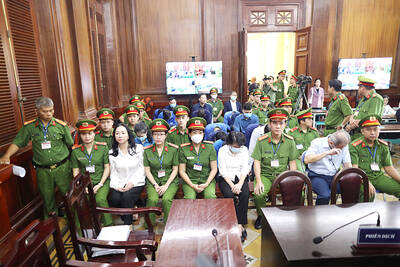
A top Vietnamese property tycoon was on Thursday sentenced to death in one of the biggest corruption cases in history, with an estimated US$27 billion in damages. A panel of three hand-picked jurors and two judges rejected all defense arguments by Truong My Lan, chair of major developer Van Thinh Phat, who was found guilty of swindling cash from Saigon Commercial Bank (SCB) over a decade. “The defendant’s actions ... eroded people’s trust in the leadership of the [Communist] Party and state,” read the verdict at the trial in Ho Chi Minh City. After the five-week trial, 85 others were also sentenced on

‘DELUSIONAL’: Targeting the families of Hamas’ leaders would not push the group to change its position or to give up its demands for Palestinians, Ismail Haniyeh said Israeli aircraft on Wednesday killed three sons of Hamas’ top political leader in the Gaza Strip, striking high-stakes targets at a time when Israel is holding delicate ceasefire negotiations with the militant group. Hamas said four of the leader’s grandchildren were also killed. Ismail Haniyeh’s sons are among the highest-profile figures to be killed in the war so far. Israel said they were Hamas operatives, and Haniyeh accused Israel of acting in “the spirit of revenge and murder.” The deaths threatened to strain the internationally mediated ceasefire talks, which appeared to gain steam in recent days even as the sides remain far
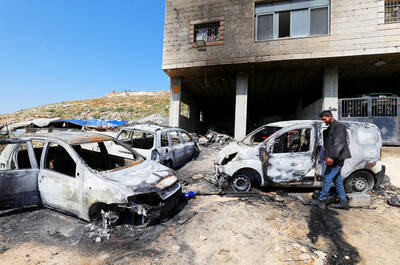
RAMPAGE: A Palestinian man was left dead after dozens of Israeli settlers searching for a missing 14-year-old boy stormed a village in the Israeli-occupied West Bank US President Joe Biden on Friday said he expected Iran to attack Israel “sooner, rather than later” and warned Tehran not to proceed. Asked by reporters about his message to Iran, Biden simply said: “Don’t,” underscoring Washington’s commitment to defend Israel. “We are devoted to the defense of Israel. We will support Israel. We will help defend Israel and Iran will not succeed,” he said. Biden said he would not divulge secure information, but said his expectation was that an attack could come “sooner, rather than later.” Israel braced on Friday for an attack by Iran or its proxies as warnings grew of


 RSS
RSS