


Unease with US foreign policy and President George W. Bush has intensified in countries that are some of the closest US allies and elsewhere around the globe, while Russia and China also face growing international wariness, according to a new survey.
Support for the US-led war in Iraq, the NATO military action in Afghanistan and worldwide US efforts against terrorism have dropped since 2002, according to an international survey by the nonpartisan Pew Research Center that was released on Wednesday. Views of the US in much of the Muslim world remain particularly negative.
In one strong measure of Bush's unpopularity, the poll showed he is less trusted on foreign policy than Russian President Vladimir Putin by allies Britain, Germany and Canada, even as faith in Putin has plummeted. About half in the US say they have little or no trust in either leader's conduct of foreign affairs.
Bush's sagging numbers partly reflect widespread opposition to the US war in Iraq. Of the countries surveyed -- which included the US -- more people favored the removal of US forces from Iraq in all but Israel, Ghana, Nigeria and Kenya.
"Even though there is a mixed view of the United States around the world, there is increasing disapproval of the principal cornerstones of our foreign policy," said Pew President Andrew Kohut.
Speaking at the Islamic Center of Washington on Wednesday, Bush accused religious extremists in the Middle East of seeking to fan anti-US sentiment.
"This enemy falsely claims that America is at war with Muslims and the Muslim faith, when in fact it is these radicals who are Islam's true enemy," he said.
The poll covered 46 nations plus the Palestinian territories.
The US is still seen favorably in most countries surveyed, including India, Japan, Italy, Israel and many countries in Africa. American culture and technology are widely admired, and many believe a better life can be had by moving to the US.
Yet wide-ranging majorities think the US does not consider their interests when formulating foreign policy; worry that US customs are hurting their countries; and think the US contributes to the gap between rich and poor nations.
As the US has waged its war on terrorism over the past five years, its overall image has worsened. It has dropped from 75 percent favorable in Britain in 2002 to 51 percent now; from 60 percent to 30 percent in Germany; and from 64 percent to 56 percent in Mexico.
Views of the US have also slipped in Russia, Indonesia, Canada, China and India. The US is seen favorably by 9 percent in NATO ally Turkey, the lowest of any country measured; 13 percent in the Palestinian territories; and by 15 percent in Pakistan and 20 percent in Jordan, both terror-war partners.
Though Putin is popular in Russia, his worldwide image has declined. Only in China, Ukraine and a handful of African nations did most express trust in his foreign policy.
Views of Russia are mixed, with slightly favorable opinions in the US, China, India and South Korea. Majorities in most European countries express worries about reliance on Russian energy, following last year's Russian cutoff of natural gas to Ukraine during a clash over prices.
Though more than half the nations polled have positive views of China, its image has widely worsened. China is seen most favorably by countries in Africa and Latin America, where its trade has recently grown, and in Asia, though two-thirds in regional rival Japan view it negatively.
Majorities in most countries think China's economic growth is good for them, with concerns expressed in Western Europe and India. Unease with Beijing's military was wider spread, with majorities in most countries surveyed expressing worries -- notably neighbors Japan and South Korea, much of Europe and the US.
The number of people interviewed in each country ranged from 500 to 3,142, with the margin of sampling error ranging from plus or minus 2 to 4 percentage points. Most of the surveys were national, though in eight nations -- Bolivia, Brazil, Venezuela, Pakistan, China, India, Ivory Coast and South Africa -- they were mostly or completely urban.

Republican US lawmakers on Friday criticized US President Joe Biden’s administration after sanctioned Chinese telecoms equipment giant Huawei unveiled a laptop this week powered by an Intel artificial intelligence (AI) chip. The US placed Huawei on a trade restriction list in 2019 for contravening Iran sanctions, part of a broader effort to hobble Beijing’s technological advances. Placement on the list means the company’s suppliers have to seek a special, difficult-to-obtain license before shipping to it. One such license, issued by then-US president Donald Trump’s administration, has allowed Intel to ship central processors to Huawei for use in laptops since 2020. China hardliners
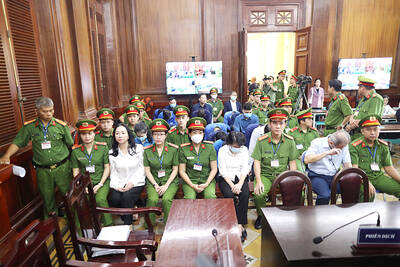
A top Vietnamese property tycoon was on Thursday sentenced to death in one of the biggest corruption cases in history, with an estimated US$27 billion in damages. A panel of three hand-picked jurors and two judges rejected all defense arguments by Truong My Lan, chair of major developer Van Thinh Phat, who was found guilty of swindling cash from Saigon Commercial Bank (SCB) over a decade. “The defendant’s actions ... eroded people’s trust in the leadership of the [Communist] Party and state,” read the verdict at the trial in Ho Chi Minh City. After the five-week trial, 85 others were also sentenced on

‘DELUSIONAL’: Targeting the families of Hamas’ leaders would not push the group to change its position or to give up its demands for Palestinians, Ismail Haniyeh said Israeli aircraft on Wednesday killed three sons of Hamas’ top political leader in the Gaza Strip, striking high-stakes targets at a time when Israel is holding delicate ceasefire negotiations with the militant group. Hamas said four of the leader’s grandchildren were also killed. Ismail Haniyeh’s sons are among the highest-profile figures to be killed in the war so far. Israel said they were Hamas operatives, and Haniyeh accused Israel of acting in “the spirit of revenge and murder.” The deaths threatened to strain the internationally mediated ceasefire talks, which appeared to gain steam in recent days even as the sides remain far
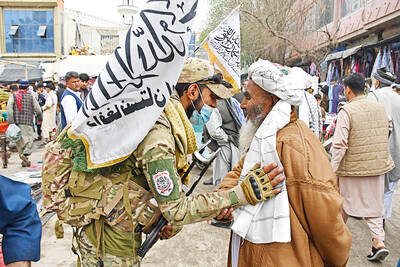
The Taliban’s reclusive supreme leader made a rare public appearance yesterday, an Afghan government spokesman said, leading thousands of worshipers in prayers marking Eid al-Fitr. Hibatullah Akhundzada has made only a handful of public appearances since inheriting the leadership of the Taliban in 2016 and leading the movement back to power with the withdrawal of US forces in 2021. Taliban government spokesman Zabihullah Mujahid said prayer in the largest mosque in Kandahar was “performed under the leadership of the supreme leader.” In a statement on X, he said the early-morning service “was attended by thousands of compatriots” in the southern province considered the


 RSS
RSS