


Pakistan and Iran summoned the top British envoys in their countries on Tuesday to protest against the award of a knighthood to Salman Rushdie, who was accused of blasphemy by Iran's former leader and whose novel The Satanic Verses outraged many Muslims.
Rushdie, whose book prompted the late Iranian leader Ayatollah Ruhollah Khomeini to issue a 1989 fatwa death warrant against him for blasphemy, was awarded a knighthood for services to literature in Queen Elizabeth's birthday honors list.
Pakistanis protested in several cities on Tuesday chanting "Death to Rushdie" and burning effigies of the British author, born in Bombay to Muslim parents in 1947 and educated at an exclusive British school and Cambridge University.
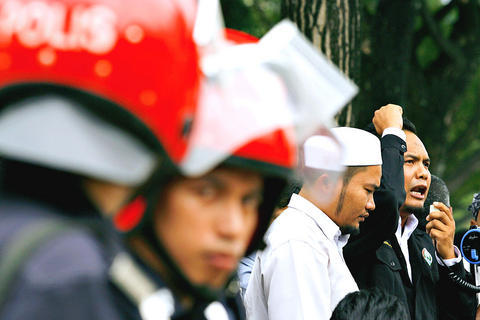
PHOTO: AFP
Pakistan's Foreign Ministry spokeswoman Tasnim Aslam said British High Commissioner Robert Brinkley had been called in.
"He was told that Salman Rushdie has been a controversial figure who is known less for his literary contribution and more for his offensive and insulting writing which deeply hurts the sentiments of Muslims all over the world," she said.
"Conferment of a knighthood on Salman Rushdie shows an utter lack of sensitivity on the part of the British government," she said.
Iran's Foreign Ministry had similar words for Britain's ambassador to Tehran, Geoffrey Adams.
"This insulting, suspicious and improper act by the British government is an obvious example of fighting against Islam," Ebrahim Rahimpour, Foreign Ministry director for Western Europe, told Adams, the official IRNA news agency said.
"It has seriously wounded the beliefs of 1.5 billion Muslims and followers of other religions ... we hold the British government and queen responsible for the circumstances of this provocation, which caused the anger of Muslims," Rahimpour said.
In the meeting, Iranian Foreign Ministry official Ebrahim Rahimpour told Adams that the decision was a "provocative act" that has angered Muslims.
IRNA quoted Adams as saying the Rushdie's award was a cultural, not a political, act.
The Satanic Verses prompted protests, some violent, by Muslims in many countries after it was published in 1988.
Muslims say the novel blasphemed the Prophet Mohammed and ridiculed the Koran and events in early Muslim history.
The Iranian government declared in 1998 that it would not support but could not rescind the fatwa, which had forced Rushdie into hiding for nine years. Hardline groups in Iran still regularly renew the call for his murder, saying the fatwa is irrevocable.
The Pakistani parliament passed a resolution on Monday deploring the knighthood. Religious Affairs Minister Mohammad Ejaz-ul-Haq said it could be used to justify suicide bombings.
Haq said his comments on Monday were not meant to incite violence but it was a fact that the ``honor could motivate potential suicide bombers. He said the knighthood should be withdrawn and the UK should apologize to all Muslims.
"These are things which inflame sentiments, which create provocation and which lead to spreading extremism," he said at a news conference. "These are steps which add fuel to the fire of hatred."

Republican US lawmakers on Friday criticized US President Joe Biden’s administration after sanctioned Chinese telecoms equipment giant Huawei unveiled a laptop this week powered by an Intel artificial intelligence (AI) chip. The US placed Huawei on a trade restriction list in 2019 for contravening Iran sanctions, part of a broader effort to hobble Beijing’s technological advances. Placement on the list means the company’s suppliers have to seek a special, difficult-to-obtain license before shipping to it. One such license, issued by then-US president Donald Trump’s administration, has allowed Intel to ship central processors to Huawei for use in laptops since 2020. China hardliners

Conjoined twins Lori and George Schappell, who pursued separate careers, interests and relationships during lives that defied medical expectations, died this month in Pennsylvania, funeral home officials said. They were 62. The twins, listed by Guinness World Records as the oldest living conjoined twins, died on April 7 at the Hospital of the University of Pennsylvania, obituaries posted by Leibensperger Funeral Homes of Hamburg said. The cause of death was not detailed. “When we were born, the doctors didn’t think we’d make 30, but we proved them wrong,” Lori said in an interview when they turned 50, the Philadelphia Inquirer reported. The
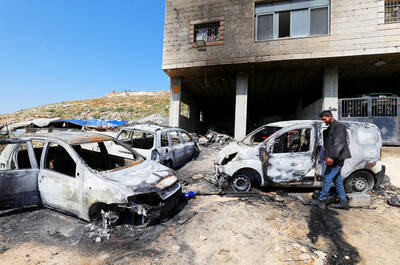
RAMPAGE: A Palestinian man was left dead after dozens of Israeli settlers searching for a missing 14-year-old boy stormed a village in the Israeli-occupied West Bank US President Joe Biden on Friday said he expected Iran to attack Israel “sooner, rather than later” and warned Tehran not to proceed. Asked by reporters about his message to Iran, Biden simply said: “Don’t,” underscoring Washington’s commitment to defend Israel. “We are devoted to the defense of Israel. We will support Israel. We will help defend Israel and Iran will not succeed,” he said. Biden said he would not divulge secure information, but said his expectation was that an attack could come “sooner, rather than later.” Israel braced on Friday for an attack by Iran or its proxies as warnings grew of
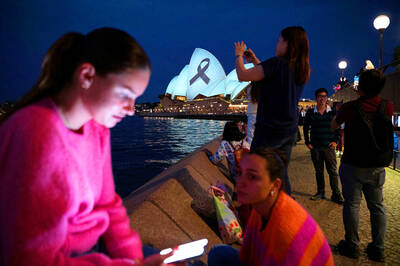
A prominent Christian leader has allegedly been stabbed at the altar during a Mass yesterday in southwest Sydney. Bishop Mar Mari Emmanuel was saying Mass at Christ The Good Shepherd Church in Wakeley just after 7pm when a man approached him at the altar and allegedly stabbed toward his head multiple times. A live stream of the Mass shows the congregation swarm forward toward Emmanuel before it was cut off. The church leader gained prominence during the COVID-19 pandemic, amassing a large online following, Officers attached to Fairfield City police area command attended a location on Welcome Street, Wakeley following reports a number


 RSS
RSS