


A senior British Army surgeon said troops injured in the battlefields of Iraq and Afghanistan faced delays of several hours before being transported to field hospitals, newspapers reported yesterday.
US troops fighting in the Vietnam War 40-odd years ago were treated far more quickly than British soldiers nowadays, the Sunday Telegraph and the Sunday Mirror reported Lieutenant Colonel Paul Parker as saying.
Parker cited a lack of dedicated helicopter ambulances and too many layers of decision-making for causing the delays which meant that it could take several hours to transport casualties even short distances to a field hospital.
The Ministry of Defence (MoD) insisted that military medics had the resources needed and that Vietnam comparisons were misleading due to advances in military capabilities.
Parker, writing in the Journal of the Royal Army Medical Corps after completing a tour of duty last year in Afghanistan, wrote that in the Vietnam war between October 1968 and July 1969, wounded soldiers arrived in hospital within 45 minutes -- most within 25 minutes, the Sunday Mirror said.
"On Operation Herrick IV [Afghanistan last year] the average pre-hospital time was seven hours," Parker was quoted as writing.
"A Casevac [casualty evacuation] request has to go through too many layers of command. There seems little point in providing high technology in-hospital care when our patients still take several hours to travel a few miles to us," he wrote.
"We use support or anti-tank helicopters that are re-roled on an ad hoc basis for the critical care and transport of our sickest patients," his report said.
"We still do not have a dedicated all-weather military helicopter evacuation fleet. Should we not be asking why?" he wrote.
"We have gone backwards in terms of our evacuation time-lines," Parker wrote.
An MoD spokeswoman said that comparisons with Vietnam were misleading, saying that advances in warfare mean that airlift teams can successfully cover larger areas.
The military is satisfied with the level of care being provided and does not feel that a dedicated helicopter evacuation fleet is necessary, she said.
Military commanders do not approve operations before ensuring that casualty evacuation and treatment facilities are in place, and medics were with troops in the battlefield, she said.
The ministry said there was a dedicated helicopter permanently on call, with others able to be assigned if required.
Transit times were improving, and unlike in the Vietnam War, specialists could now perform advanced interventions in the helicopter, it said.
During the period of time covered by Parker's paper, of those who were expected to survive, no wounded soldiers lost their lives in transit, while four who were not expected to survive, did, the ministry said.
"The care that we provide is equal to that which would be expected in any major trauma center in Europe and the US," the UK Surgeon General, Lieutenant General Louis Lillywhite, said in a statement.
"Helicopters are always available to the medical services when required and are manned by highly qualified medical teams. It is damaging to the morale of our troops to falsely suggest that the care is other than excellent," the statement said.

Republican US lawmakers on Friday criticized US President Joe Biden’s administration after sanctioned Chinese telecoms equipment giant Huawei unveiled a laptop this week powered by an Intel artificial intelligence (AI) chip. The US placed Huawei on a trade restriction list in 2019 for contravening Iran sanctions, part of a broader effort to hobble Beijing’s technological advances. Placement on the list means the company’s suppliers have to seek a special, difficult-to-obtain license before shipping to it. One such license, issued by then-US president Donald Trump’s administration, has allowed Intel to ship central processors to Huawei for use in laptops since 2020. China hardliners

Conjoined twins Lori and George Schappell, who pursued separate careers, interests and relationships during lives that defied medical expectations, died this month in Pennsylvania, funeral home officials said. They were 62. The twins, listed by Guinness World Records as the oldest living conjoined twins, died on April 7 at the Hospital of the University of Pennsylvania, obituaries posted by Leibensperger Funeral Homes of Hamburg said. The cause of death was not detailed. “When we were born, the doctors didn’t think we’d make 30, but we proved them wrong,” Lori said in an interview when they turned 50, the Philadelphia Inquirer reported. The
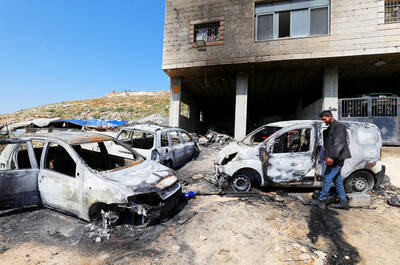
RAMPAGE: A Palestinian man was left dead after dozens of Israeli settlers searching for a missing 14-year-old boy stormed a village in the Israeli-occupied West Bank US President Joe Biden on Friday said he expected Iran to attack Israel “sooner, rather than later” and warned Tehran not to proceed. Asked by reporters about his message to Iran, Biden simply said: “Don’t,” underscoring Washington’s commitment to defend Israel. “We are devoted to the defense of Israel. We will support Israel. We will help defend Israel and Iran will not succeed,” he said. Biden said he would not divulge secure information, but said his expectation was that an attack could come “sooner, rather than later.” Israel braced on Friday for an attack by Iran or its proxies as warnings grew of

A prominent Christian leader has allegedly been stabbed at the altar during a Mass yesterday in southwest Sydney. Bishop Mar Mari Emmanuel was saying Mass at Christ The Good Shepherd Church in Wakeley just after 7pm when a man approached him at the altar and allegedly stabbed toward his head multiple times. A live stream of the Mass shows the congregation swarm forward toward Emmanuel before it was cut off. The church leader gained prominence during the COVID-19 pandemic, amassing a large online following, Officers attached to Fairfield City police area command attended a location on Welcome Street, Wakeley following reports a number


 RSS
RSS