


For more than 50 years, the governments of Arizona and its Mexican neighboring state, Sonora, have gathered regularly to strike agreements, pledge cooperation and bask in border bonhomie.
But the meeting in Arizona over two days, as border violence and drug trafficking have swelled and the US Senate considers the most significant changes to immigration law in 20 years, a deep sense of urgency, even anxiety, hung over the proceedings.
While describing cooperation between the two states as good, Arizona Governor Janet Napolitano said she remained concerned about an increase in drug seizures and the recent spate of violence.
Most alarming, Napolitano said, was a firefight last month among rival drug cartels and the police in the Sonoran city of Cananea, about 160km south of Tucson. Nearly two dozen people were killed.
Such incidents are more typical in border cities near Texas. Although the violence has not usually crossed into the US, Napolitano said in an interview, "you don't want to run that risk, either."
"I hope it is an anomaly," she said, "but I think if it is our goal to have the safest part of the US-Mexican border, then you can't presume that it's an anomaly."
Law enforcement officials have said weapons used in the fighting have come from the US.
Daniel Duran Puente, a spokesman for Sonora Governor Eduardo Bours, said that while "we hope it won't happen again," it was "a sign of what has been happening in the whole country."
Puente said Sonora has been cracking down on organized crime groups, but is seeking more cooperation from the government on drug trafficking intelligence to thwart violence.
At the Arizona-Mexico Commission's meeting, there was the usual signing of agreements between two states that figure prominently in any discussion of the border -- Sonora as the principal staging ground for illegal crossers and Arizona as the state that receives more of them than any other.
To crack down on the financial network that supports human smuggling, Arizona will train Sonora detectives to investigate wire transfers that may be directed to guides, known as coyotes, that bring people over the border.
Arizona officials have claimed success in seizing wire transfers suspected of being used to pay smugglers in their state, but they now believe the money is flowing to Sonora to avoid their efforts.
The two governments also signed agreements to improve radio communication among local, state and federal law enforcement agencies and to more closely track stolen vehicles used in drug and human smuggling on both sides of the border.
Napolitano also met privately with officials from the Drug Enforcement Agency and the Border Patrol, which has been reporting an increase in drug seizures, principally marijuana, in the past year along the Arizona border.
Since October, the Border Patrol has seized 1.4 million kilograms of marijuana, a 71 percent increase over the previous year, in the Tucson sector. Over the same period, arrests of illegal crossers dropped 10 percent, to 270,000 people.
Border Patrol officials have attributed both trends to the presence of thousands of National Guard troops who arrived last summer, deterring crossers while freeing up agents to make drug arrests.

Republican US lawmakers on Friday criticized US President Joe Biden’s administration after sanctioned Chinese telecoms equipment giant Huawei unveiled a laptop this week powered by an Intel artificial intelligence (AI) chip. The US placed Huawei on a trade restriction list in 2019 for contravening Iran sanctions, part of a broader effort to hobble Beijing’s technological advances. Placement on the list means the company’s suppliers have to seek a special, difficult-to-obtain license before shipping to it. One such license, issued by then-US president Donald Trump’s administration, has allowed Intel to ship central processors to Huawei for use in laptops since 2020. China hardliners
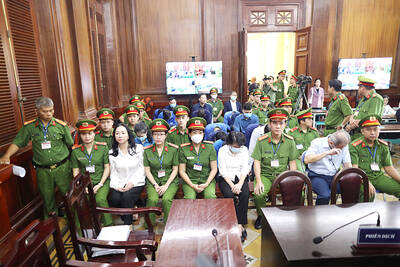
A top Vietnamese property tycoon was on Thursday sentenced to death in one of the biggest corruption cases in history, with an estimated US$27 billion in damages. A panel of three hand-picked jurors and two judges rejected all defense arguments by Truong My Lan, chair of major developer Van Thinh Phat, who was found guilty of swindling cash from Saigon Commercial Bank (SCB) over a decade. “The defendant’s actions ... eroded people’s trust in the leadership of the [Communist] Party and state,” read the verdict at the trial in Ho Chi Minh City. After the five-week trial, 85 others were also sentenced on

Conjoined twins Lori and George Schappell, who pursued separate careers, interests and relationships during lives that defied medical expectations, died this month in Pennsylvania, funeral home officials said. They were 62. The twins, listed by Guinness World Records as the oldest living conjoined twins, died on April 7 at the Hospital of the University of Pennsylvania, obituaries posted by Leibensperger Funeral Homes of Hamburg said. The cause of death was not detailed. “When we were born, the doctors didn’t think we’d make 30, but we proved them wrong,” Lori said in an interview when they turned 50, the Philadelphia Inquirer reported. The
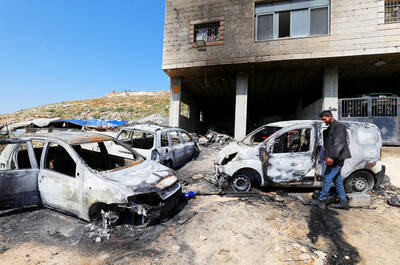
RAMPAGE: A Palestinian man was left dead after dozens of Israeli settlers searching for a missing 14-year-old boy stormed a village in the Israeli-occupied West Bank US President Joe Biden on Friday said he expected Iran to attack Israel “sooner, rather than later” and warned Tehran not to proceed. Asked by reporters about his message to Iran, Biden simply said: “Don’t,” underscoring Washington’s commitment to defend Israel. “We are devoted to the defense of Israel. We will support Israel. We will help defend Israel and Iran will not succeed,” he said. Biden said he would not divulge secure information, but said his expectation was that an attack could come “sooner, rather than later.” Israel braced on Friday for an attack by Iran or its proxies as warnings grew of


 RSS
RSS