


Indonesia's capture of the leader and military boss of Southeast Asian militant group Jemaah Islamiyah (JI) has dealt the network a major blow but it still has the ability to bounce back, analysts say.
Indonesia's anti-terror police announced on Friday they were holding Zarkasi, an Indonesian-born veteran of the Afghanistan conflict, who coolly admitted on a video aired by police that he had headed JI since 2004.
Two days earlier, police revealed they had captured the extremist group's military chief Abu Dujana, another Afghan veteran, in raids earlier this month on the island of Java. Zarkasi, 45, was caught just hours later.
Bantarto Bandoro, an analyst at the Center for Strategic and International Studies in Jakarta, said despite the netting of the pair, JI members would continue to pursue their goal of creating a regional pan-Islamic state.
The arrests "will disrupt JI's development for sure, but they won't stop their activities as long as their objective is not yet achieved," he said.
"In the long term, they will try to find new methods [of operation] so their network won't be easily detected," Bandoro said.
The shadowy organization has been blamed for a string of atrocities in the region, including the 2002 bombings on the resort island of Bali, which left 202 people dead.
Indonesia has been criticized for failing to outlaw JI, a move politically difficult in the world's most populous Muslim nation, while its court system is widely seen as being open to corruption.
"The military wing of JI, and JI as an organization, has suffered very significantly with the detention of these two individuals," al-Qaeda and terrorism expert Rohan Gunaratna said.
But he said that the group should have been proscribed, blacklisted and criminalized in order to build a societal norm against support for JI.
"The ideology of JI is still intact and JI remains a legal organization in Indonesia," he said.
Gunaratna bestowed praise on Detachment 88, the unit named after the 88 Australians killed in the 2002 Bali attacks, for tracking down Zarkasi and Dujana.
However, he said: "Indonesia must improve both the legislative and judicial systems if the fight against terrorism is to be successful."
In a report last month, the International Crisis Group (ICG) said JI was probably comprised of more than 900 members across Indonesia and was likely not growing, though it retains deep roots and its vision of creating an Islamic state.
Detachment 88 chief Surya Dharma said on Friday that JI members, though not launching any serious attacks since October 2005, had been "building a network by recruitment, training and stockpiling weapons and ready-to-use bombs."

‘IN A DIFFERENT PLACE’: The envoy first visited Shanghai, where he attended a Chinese basketball playoff match, and is to meet top officials in Beijing tomorrow US Secretary of State Antony Blinken yesterday arrived in China on his second visit in a year as the US ramps up pressure on its rival over its support for Russia while also seeking to manage tensions with Beijing. The US diplomat tomorrow is to meet China’s top brass in Beijing, where he is also expected to plead for restraint as Taiwan inaugurates president-elect William Lai (賴清德), and to raise US concerns on Chinese trade practices. However, Blinken is also seeking to stabilize ties, with tensions between the world’s two largest economies easing since his previous visit in June last year. At the
Nearly half of China’s major cities are suffering “moderate to severe” levels of subsidence, putting millions of people at risk of flooding, especially as sea levels rise, according to a study of nationwide satellite data released yesterday. The authors of the paper, published by the journal Science, found that 45 percent of China’s urban land was sinking faster than 3mm per year, with 16 percent at more than 10mm per year, driven not only by declining water tables, but also the sheer weight of the built environment. With China’s urban population already in excess of 900 million people, “even a small portion

UNSETTLING IMAGES: The scene took place in front of TV crews covering the Trump trial, with a CNN anchor calling it an ‘emotional and unbelievably disturbing moment’ A man who doused himself in an accelerant and set himself on fire outside the courthouse where former US president Donald Trump is on trial has died, police said yesterday. The New York City Police Department (NYPD) said the man was declared dead by staff at an area hospital. The man was in Collect Pond Park at about 1:30pm on Friday when he took out pamphlets espousing conspiracy theories, tossed them around, then doused himself in an accelerant and set himself on fire, officials and witnesses said. A large number of police officers were nearby when it happened. Some officers and bystanders rushed
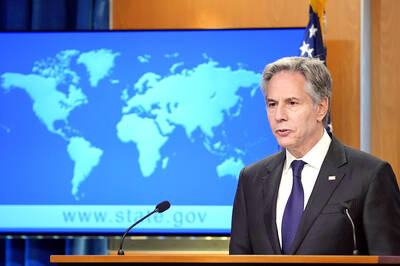
Beijing is continuing to commit genocide and crimes against humanity against Uyghurs and other Muslim minorities in its western Xinjiang province, U.S. Secretary of State Antony Blinken said in a report published on Monday, ahead of his planned visit to China this week. The State Department’s annual human rights report, which documents abuses recorded all over the world during the previous calendar year, repeated language from previous years on the treatment of Muslims in Xinjiang, but the publication raises the issue ahead of delicate talks, including on the war in Ukraine and global trade, between the top U.S. diplomat and Chinese


 RSS
RSS