


The Nigerian government filed a lawsuit against Pfizer Inc, asking for US$7 billion in damages over allegations the pharmaceutical giant conducted a drug experiment that led to deaths and disabilities among children more than a decade ago, court papers showed.
The civil case filed on Monday in the capital, Abuja, is separate from a legal challenge launched last month in the northern state of Kano that seeks US$2 billion from Pfizer, although all the cases stem from the same mid-1990s drug study.
Pfizer has denied the charges in the Kano case, which are substantively similar to those in the Abuja-based suit.
In the civil suit filed in Kano, authorities allege Pfizer illegally conducted a drug experiment on 200 children during a meningitis epidemic in the state's main city, also called Kano, in 1996, resulting in deaths, brain damage, paralysis and slurred speech in many of the children.
Pfizer treated 100 meningitis-infected children with an experimental antibiotic, Trovan. Another 100 children, who were control patients in the study, received an approved antibiotic, ceftriaxone -- but the dose was lower than recommended, the families' lawyers alleged.
Up to 11 children in the study died, while others suffered physical disabilities and brain damage. But Pfizer always insisted its records show none of the deaths was linked to Trovan or substandard treatment. That civil suit is asking the judge to award Kano state US$2 billion. Both that case and a related criminal action against Pfizer officers were both postponed on Monday after the plaintiff's counsel failed to show up for the initial court hearing.
The judge hearing the case said criminal proceedings lodged against company officers would now begin July 4, while a related civil case seeking the monetary damages was to begin July 9.
State and company officials were not immediately available for comment. Nigeria's government is in disarray after the May 29 inauguration of new governors, state assemblies and elected federal officers, including a new president.
In the Abuja civil case, the government is asking for US$500 million for treatment, compensation and support for the victims of the drug test and their families. Another US$450 million is earmarked for damages related to money spent to overcome societal misgivings related to the test, and US$1 billion is sought to pay for health programs. The federal government is also seeking US$5 billion as general damages.
New York-based Pfizer, the world's largest drug maker, has denied any wrongdoing.
A federal court in Manhattan dismissed a 2001 lawsuit by disabled Nigerians who allegedly took part in the study, but the case is under appeal.
Kano state authorities are blaming the Pfizer controversy for widespread suspicion of government public health policies, particularly the global effort to vaccinate children against polio, which has met veru strong resistance in northern Nigeria.
Islamic leaders in largely Muslim Kano had seized on the Pfizer controversy as evidence of a US-led conspiracy. Rumors that polio vaccines spread AIDS or infertility spurred Kano and another heavily Muslim state, Zamfara, to boycott a long-term campaign to vaccinate millions.
Vaccination programs restarted in Nigeria in 2004, after an 11-month boycott. But the delay set back global eradication -- the boycott was blamed for causing an outbreak that spread the disease across Africa and into the Middle East.

Republican US lawmakers on Friday criticized US President Joe Biden’s administration after sanctioned Chinese telecoms equipment giant Huawei unveiled a laptop this week powered by an Intel artificial intelligence (AI) chip. The US placed Huawei on a trade restriction list in 2019 for contravening Iran sanctions, part of a broader effort to hobble Beijing’s technological advances. Placement on the list means the company’s suppliers have to seek a special, difficult-to-obtain license before shipping to it. One such license, issued by then-US president Donald Trump’s administration, has allowed Intel to ship central processors to Huawei for use in laptops since 2020. China hardliners
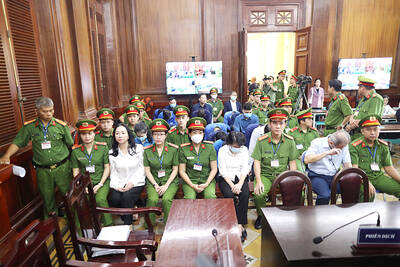
A top Vietnamese property tycoon was on Thursday sentenced to death in one of the biggest corruption cases in history, with an estimated US$27 billion in damages. A panel of three hand-picked jurors and two judges rejected all defense arguments by Truong My Lan, chair of major developer Van Thinh Phat, who was found guilty of swindling cash from Saigon Commercial Bank (SCB) over a decade. “The defendant’s actions ... eroded people’s trust in the leadership of the [Communist] Party and state,” read the verdict at the trial in Ho Chi Minh City. After the five-week trial, 85 others were also sentenced on

Conjoined twins Lori and George Schappell, who pursued separate careers, interests and relationships during lives that defied medical expectations, died this month in Pennsylvania, funeral home officials said. They were 62. The twins, listed by Guinness World Records as the oldest living conjoined twins, died on April 7 at the Hospital of the University of Pennsylvania, obituaries posted by Leibensperger Funeral Homes of Hamburg said. The cause of death was not detailed. “When we were born, the doctors didn’t think we’d make 30, but we proved them wrong,” Lori said in an interview when they turned 50, the Philadelphia Inquirer reported. The

RAMPAGE: A Palestinian man was left dead after dozens of Israeli settlers searching for a missing 14-year-old boy stormed a village in the Israeli-occupied West Bank US President Joe Biden on Friday said he expected Iran to attack Israel “sooner, rather than later” and warned Tehran not to proceed. Asked by reporters about his message to Iran, Biden simply said: “Don’t,” underscoring Washington’s commitment to defend Israel. “We are devoted to the defense of Israel. We will support Israel. We will help defend Israel and Iran will not succeed,” he said. Biden said he would not divulge secure information, but said his expectation was that an attack could come “sooner, rather than later.” Israel braced on Friday for an attack by Iran or its proxies as warnings grew of


 RSS
RSS