


Prime Minister Bertie Ahern's long-dominant Fianna Fail party marched toward its sixth straight election victory on Saturday after voters stuck with a popular leader who has presided over unprecedented economic success.
Ballot-counting resumed on Saturday morning with 145 of 166 seats filled in the Dail Eireann parliament and final results expected in the afternoon.
Fianna Fail had already won 73 seats with 41.6 percent of votes while its nearest rival, fellow center-ground party Fine Gael, had 43 seats.
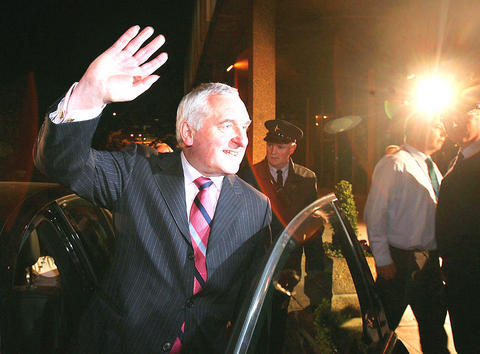
PHOTO: AP
"It's a great night for Fianna Fail, and it's a great night for the party machine," Ahern, 55, declared.
Ireland's complex system of proportional representation typically requires a two-day count. It encourages voters to rank candidates in order of preference. Ballots must be recounted multiple times so that lower-preference votes can be transferred from the ballots of victorious or eliminated candidates to those still in the race.
Fine Gael had hoped to rise to power in alliance with the left-wing Labour Party. But while Fine Gael fully recovered from its disastrous performance in the 2002 election, Labour failed to make any significant gains, leaving them unable to get close to the 83-seat total required to form a majority administration.
Analysts forecast the final result on Saturday would be Fianna Fail 78, down three seats from 2002; Fine Gael 51, up 20; Labour unchanged at 20; Progressive Democrats two, down six; Greens unchanged at six; Sinn Fein four, down one and independents five, down 10.
Analysts agreed that Labour was best positioned to help Fianna Fail, not Fine Gael, reach a majority.
But Labour leader Pat Rabbitte, a critic of the outgoing government, dedicated his campaign to ousting Fianna Fail from power. Neither Ahern nor Rabbitte was willing to discuss the prospects of a Fianna Fail-Labour combination, a combination that was tried in 1992-94 and collapsed in acrimony.
Ahern said his only goal now was "to command a stable government for a five-year term," which could also mean forging an alliance with the Greens or Fianna Fail-sympathetic independents. He confirmed his intention to serve as prime minister until mid-2012.
Fianna Fail's coalition partner, the Progressive Democrats -- whose tax-cutting, pro-business agenda influenced Ahern's policies -- suffered electoral meltdown.
The party's leader, Deputy Prime Minister Michael McDowell announced his immediate retirement from politics after he, his party deputy leader and party president all lost their seats.
"I love my country. I am deeply ambitious for it, but ... my period in public life as a public representative is over," said McDowell, who is also Ireland's justice minister.
The election's surprise losers were Sinn Fein, the Irish Republican Army-linked party that had expected to capitalize on its high profile in the neighboring British territory of Northern Ireland, where earlier this month it began running a power-sharing government alongside the British Protestant majority.
Analysts tipped Sinn Fein, with its good finances and an army of volunteers, to double its 2002 seat total to 10. But instead it lost ground, dealing the party its first electoral setback since the IRA cease-fire of 1997.
Ahern is already the second-longest-serving prime minister in Irish history behind the founder of Fianna Fail, Eamon de Valera, who won seven elections from 1932 to 1957.

Republican US lawmakers on Friday criticized US President Joe Biden’s administration after sanctioned Chinese telecoms equipment giant Huawei unveiled a laptop this week powered by an Intel artificial intelligence (AI) chip. The US placed Huawei on a trade restriction list in 2019 for contravening Iran sanctions, part of a broader effort to hobble Beijing’s technological advances. Placement on the list means the company’s suppliers have to seek a special, difficult-to-obtain license before shipping to it. One such license, issued by then-US president Donald Trump’s administration, has allowed Intel to ship central processors to Huawei for use in laptops since 2020. China hardliners
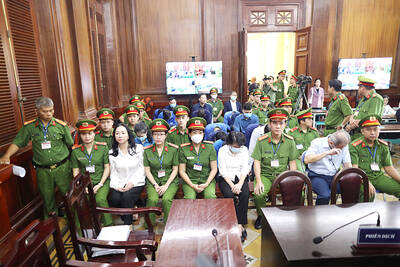
A top Vietnamese property tycoon was on Thursday sentenced to death in one of the biggest corruption cases in history, with an estimated US$27 billion in damages. A panel of three hand-picked jurors and two judges rejected all defense arguments by Truong My Lan, chair of major developer Van Thinh Phat, who was found guilty of swindling cash from Saigon Commercial Bank (SCB) over a decade. “The defendant’s actions ... eroded people’s trust in the leadership of the [Communist] Party and state,” read the verdict at the trial in Ho Chi Minh City. After the five-week trial, 85 others were also sentenced on

Conjoined twins Lori and George Schappell, who pursued separate careers, interests and relationships during lives that defied medical expectations, died this month in Pennsylvania, funeral home officials said. They were 62. The twins, listed by Guinness World Records as the oldest living conjoined twins, died on April 7 at the Hospital of the University of Pennsylvania, obituaries posted by Leibensperger Funeral Homes of Hamburg said. The cause of death was not detailed. “When we were born, the doctors didn’t think we’d make 30, but we proved them wrong,” Lori said in an interview when they turned 50, the Philadelphia Inquirer reported. The
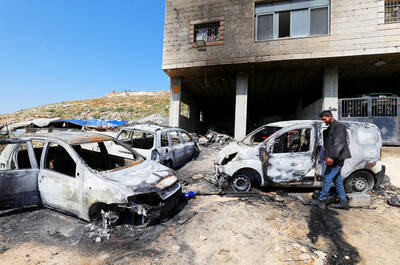
RAMPAGE: A Palestinian man was left dead after dozens of Israeli settlers searching for a missing 14-year-old boy stormed a village in the Israeli-occupied West Bank US President Joe Biden on Friday said he expected Iran to attack Israel “sooner, rather than later” and warned Tehran not to proceed. Asked by reporters about his message to Iran, Biden simply said: “Don’t,” underscoring Washington’s commitment to defend Israel. “We are devoted to the defense of Israel. We will support Israel. We will help defend Israel and Iran will not succeed,” he said. Biden said he would not divulge secure information, but said his expectation was that an attack could come “sooner, rather than later.” Israel braced on Friday for an attack by Iran or its proxies as warnings grew of


 RSS
RSS