


US Vice President Dick Cheney made a surprise visit to Baghdad yesterday to tell top Iraqi leaders to redouble efforts to promote national reconciliation and warn them US patience is running short.
"There's a lot going on. This is a very important time. There's a lot to talk about," Cheney said as he met with US Ambassador to Iraq Ryan Crocker and the top commander of US forces in Iraq, General David Petraeus.
The vice president was to hammer home Washington's powerful objections to Iraqi lawmakers' planned two-month summer recess, Crocker told reporters traveling aboard Cheney's plane.
"That's clearly part of the message. It's been part of the message now for some time. I've said it, [US] Secretary [of State Condoleezza] Rice has said it. I'm confident the vice president is going to say it," Crocker said.
"The reality is, with the major effort we're making, [the] major effort the Iraqi security forces and military are making, themselves, for the Iraqi parliament to take a two-month vacation in summer is impossible to understand."
With Cheney gearing up for a day of talks with top US and Iraqi officials, a Cheney senior aide said: "Everybody's got to sit down, raise their game, redouble their efforts."
Cheney, whose trip here was shrouded in secrecy, was to hold meetings with Iraqi Prime Minister Nuri al-Maliki, his top ministers and members of Iraq's three-member presidency council, the aide said on condition of anonymity.
With US President George W. Bush's Democratic foes battling the White House in an effort to end US involvement in Iraq, Cheney was likely to leave no doubt that Washington's patience is at an ebb.
"It's game time, let's go," the Cheney aide said, urging Iraqis to "achieve some kind of national compact that marginalizes the extremes," both majority Shiite and minority Sunni, who have been locked in deadly sectarian violence.
US officials have increasingly expressed exasperation over the slow pace of key legislation, including efforts to regulate oil revenues and allow members of the Baath party to hold government jobs.
Cheney's schedule called for talks with al-Maliki -- including perhaps a one-on-one meeting.
Cheney was then to attend a lunch with al-Maliki and Iraq's oil minister, defense minister, foreign minister, interior minister and finance minister before meeting with Iraqi President Jalal Talabani.
After that, he was to meet jointly with Talabani and vice presidents Tareq Hashemi and Adel Abdel Mehdi, followed by separate talks with the rival vice presidents and a one-on-one with top Shiite leader Abdel Aziz al-Hakim.
Cheney was expected to hold a dinner with al-Maliki, the presidency council, Hakim and representatives of Kurdish leader Massud Barzani, the aide said.
He was to put emphasis on the political and economic fronts because "the military part of this isn't going to stand alone," the aide said.
"Iraq is making progress, but there's much more work to be done," he said.
"The vice president is coming out, at this time, to deliver this message," the aide said.
The stopover was part of tour of the Middle East, with planned visits to the United Arab Emirates, Saudi Arabia, Egypt and Jordan to urge Sunni governments to persuade Iraq's Sunni minority to join the fledgling political process.
Meanwhile, a suicide truck bomb blamed on al-Qaeda linked insurgents exploded yesterday outside the Interior Ministry in the Kurdish city of Irbil, killing at least 19 people and wounding 80, security and hospital officials said.
Kurdish television showed footage of the badly damaged Interior Ministry building. Rubble lay in piles and long metal beams were twisted. Rescue workers reached into the wreckage to pull out one of the victims of the blast.
Windows were blown out down the street and wreckage was scattered nearly 100m away.
The blast also damaged the nearby security headquarters.
Zariyan Othman, the Kurdish health minister, said 19 were killed and 80 were wounded, including five who were in serious condition.
Hamza Ahmed, a spokesman for the Irbil governor's office, said the dead and wounded included police and civilians.
Irbil, located 350km north of Baghdad, is the capital of the Iraq's autonomous Kurdistan region, which has been relatively calm, despite the violence wracking much of the rest of Iraq.
Kurdish lawmaker Mahmoud Othman blamed the attack on Ansar al-Sunnah, a Sunni Arab insurgent group, and Ansar al-Islam, a mostly Kurdish militant group with ties to al-Qaeda in Iraq.
Ansar al-Islam has been blamed for a number of attacks, including attempts to assassinate Kurdish officials.
Othman said that authorities learned that insurgents were planning a large attack a week ago when police arrested a militant cell in the town of Sulamaniya.
"During questioning they confessed that were getting training lessons in a neighboring country and that was Iran," he said.
The last major attack in Irbil took place Feb. 1, 2004, when twin suicide bombers killed 109 people in two Kurdish party offices. Ansar al-Sunnah claimed responsibility for that attack.
The Interior Ministry is next to the parliament for the Kurdish autonomous region of northern Iraq.
"Kurdistan is a safe region and this will have its affect on trade and companies will fear coming to this region," Othman said.

Republican US lawmakers on Friday criticized US President Joe Biden’s administration after sanctioned Chinese telecoms equipment giant Huawei unveiled a laptop this week powered by an Intel artificial intelligence (AI) chip. The US placed Huawei on a trade restriction list in 2019 for contravening Iran sanctions, part of a broader effort to hobble Beijing’s technological advances. Placement on the list means the company’s suppliers have to seek a special, difficult-to-obtain license before shipping to it. One such license, issued by then-US president Donald Trump’s administration, has allowed Intel to ship central processors to Huawei for use in laptops since 2020. China hardliners
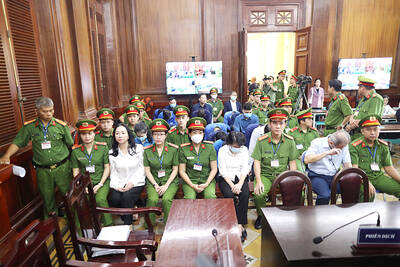
A top Vietnamese property tycoon was on Thursday sentenced to death in one of the biggest corruption cases in history, with an estimated US$27 billion in damages. A panel of three hand-picked jurors and two judges rejected all defense arguments by Truong My Lan, chair of major developer Van Thinh Phat, who was found guilty of swindling cash from Saigon Commercial Bank (SCB) over a decade. “The defendant’s actions ... eroded people’s trust in the leadership of the [Communist] Party and state,” read the verdict at the trial in Ho Chi Minh City. After the five-week trial, 85 others were also sentenced on

‘DELUSIONAL’: Targeting the families of Hamas’ leaders would not push the group to change its position or to give up its demands for Palestinians, Ismail Haniyeh said Israeli aircraft on Wednesday killed three sons of Hamas’ top political leader in the Gaza Strip, striking high-stakes targets at a time when Israel is holding delicate ceasefire negotiations with the militant group. Hamas said four of the leader’s grandchildren were also killed. Ismail Haniyeh’s sons are among the highest-profile figures to be killed in the war so far. Israel said they were Hamas operatives, and Haniyeh accused Israel of acting in “the spirit of revenge and murder.” The deaths threatened to strain the internationally mediated ceasefire talks, which appeared to gain steam in recent days even as the sides remain far
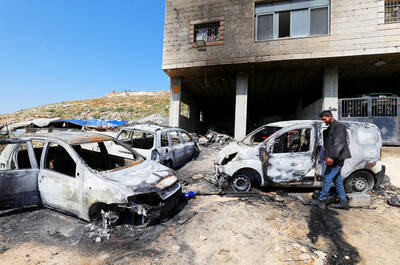
RAMPAGE: A Palestinian man was left dead after dozens of Israeli settlers searching for a missing 14-year-old boy stormed a village in the Israeli-occupied West Bank US President Joe Biden on Friday said he expected Iran to attack Israel “sooner, rather than later” and warned Tehran not to proceed. Asked by reporters about his message to Iran, Biden simply said: “Don’t,” underscoring Washington’s commitment to defend Israel. “We are devoted to the defense of Israel. We will support Israel. We will help defend Israel and Iran will not succeed,” he said. Biden said he would not divulge secure information, but said his expectation was that an attack could come “sooner, rather than later.” Israel braced on Friday for an attack by Iran or its proxies as warnings grew of


 RSS
RSS