


A six-month truce appeared shaky when Israeli aircraft blasted a car in the Gaza Strip following repeated Palestinian rocket attacks, and Israeli Prime Minister Ehud Olmert warned he was losing patience with the rocket barrages on southern Israel.
The Israeli military said aircraft attacked an explosives-laden vehicle carrying militants preparing to fire rockets at Israel on Monday. The attack was near Beit Hanoun, a frequent launching ground for rocket squads.
The Islamic Jihad militant group said its members were in the car on a "holy mission."
It said the men escaped the blast, and that a passer-by was wounded.
At a meeting with visiting German Foreign Minister Frank-Walter Steinmeier on Monday, Olmert said the Palestinians would face severe consequences if the latest wave of rocket fire persists.
"The [rocket] attacks constitute a tangible threat to Israel. Israel cannot show restraint forever," Olmert said in a statement issued by his office.
Despite the truce declared last November, militants in Gaza have continued to fire the homemade rockets into southern Israel, though fewer than before then. But in recent days, the rocket fire has increased.
The truce almost completely halted Israeli airstrikes and ground operations in Gaza, but continued rocket fire could provoke further Israeli military action and a collapse of the ceasefire.
The army said 14 rockets have been fired since Friday. One rocket hit a house early on Monday, damaging the building. There were no injuries.
Israel has grown increasingly concerned by arms smuggling into the Gaza Strip and the rocket fire. Senior military officials have called for a large-scale military operation in Gaza. However, similar operations since Israel withdrew from Gaza in 2005 have failed to halt the rocket fire.
On Monday, Israeli Foreign Minister Tzipi Livni said Israel should not rush into a military operation there.
"Gaza is turning into a terror nest. We know all this," Livni said. "It is the government's responsibility to hold an intelligent and comprehensive decision process."
Palestinian President Mahmoud Abbas has repeatedly condemned the rocket attacks, but has been unable to halt them. Ending the rocket fire is a key component of a new US proposal for easing Israeli restrictions on Palestinian movement while also improving Israeli security.
The document proposes a timeline from this month to August that calls for Israel to remove many West Bank roadblocks and improve operations at Gaza's crossings. The Palestinians are asked to halt rocket fire from Gaza and weapons smuggling into the coastal strip.
In a meeting with his Fatah Party, Abbas urged Israel to cooperate with the plan.
The document is "a start to end the suffering of the Palestinian people," he said, the official WAFA news agency reported.
The Islamic Hamas, Abbas' partner in the coalition government, has rejected the document.
In Jerusalem, Olmert said he is still considering the US proposal and will finalize his position soon. He noted that Israel already has committed to some of the proposals, such as improving movement through Gaza's border crossings.
A scathing report issued last week by an official government commission that criticized Olmert for "very severe failures" during last year's war in Lebanon, has badly weakened the prime minister and caused divisions within the government.
Nearly half of China’s major cities are suffering “moderate to severe” levels of subsidence, putting millions of people at risk of flooding, especially as sea levels rise, according to a study of nationwide satellite data released yesterday. The authors of the paper, published by the journal Science, found that 45 percent of China’s urban land was sinking faster than 3mm per year, with 16 percent at more than 10mm per year, driven not only by declining water tables, but also the sheer weight of the built environment. With China’s urban population already in excess of 900 million people, “even a small portion

UNSETTLING IMAGES: The scene took place in front of TV crews covering the Trump trial, with a CNN anchor calling it an ‘emotional and unbelievably disturbing moment’ A man who doused himself in an accelerant and set himself on fire outside the courthouse where former US president Donald Trump is on trial has died, police said yesterday. The New York City Police Department (NYPD) said the man was declared dead by staff at an area hospital. The man was in Collect Pond Park at about 1:30pm on Friday when he took out pamphlets espousing conspiracy theories, tossed them around, then doused himself in an accelerant and set himself on fire, officials and witnesses said. A large number of police officers were nearby when it happened. Some officers and bystanders rushed
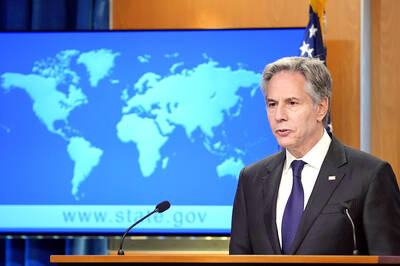
Beijing is continuing to commit genocide and crimes against humanity against Uyghurs and other Muslim minorities in its western Xinjiang province, U.S. Secretary of State Antony Blinken said in a report published on Monday, ahead of his planned visit to China this week. The State Department’s annual human rights report, which documents abuses recorded all over the world during the previous calendar year, repeated language from previous years on the treatment of Muslims in Xinjiang, but the publication raises the issue ahead of delicate talks, including on the war in Ukraine and global trade, between the top U.S. diplomat and Chinese

HYPOCRISY? The Chinese Ministry of Foreign Affairs yesterday asked whether Biden was talking about China or the US when he used the word ‘xenophobic’ US President Joe Biden on Wednesday called for a hike in steel tariffs on China, accusing Beijing of cheating as he spoke at a campaign event in Pennsylvania. Biden accused China of xenophobia, too, in a speech to union members in Pittsburgh. “They’re not competing, they’re cheating. They’re cheating and we’ve seen the damage here in America,” Biden said. Chinese steel companies “don’t need to worry about making a profit because the Chinese government is subsidizing them so heavily,” he said. Biden said he had called for the US Trade Representative to triple the tariff rates for Chinese steel and aluminum if Beijing was


 RSS
RSS