


Congress failed to override US President George W. Bush's veto of legislation requiring the withdrawal of US troops from Iraq, a defeat for anti-war Democrats that triggered immediate work on new legislation to pay for the war.
Wednesday's vote in the House was 222-203, 62 shy of the two-thirds majority needed to override a veto. With few exceptions, Republicans stood fast with Bush in the tactical clash.
"I'm confident we can reach agreement," the president said after the vote as he sat down at the White House with leaders of the Democratic-controlled Congress, who have vowed repeatedly to force him to change his war policy.
Democrats flashed defiance, yet signaled they were ready to make significant concessions such as jettisoning the troop withdrawal timetable and cutting some of the domestic projects that are part of the vetoed bill.
In turn, the president defended his decision to send more troops to Iraq. "The question is, Who ought to make that decision?" Bush said in answer to a question after a speech. "The Congress or the commanders? And as you know, my position is clear -- I'm the commander guy."
There was early talk in both parties of setting goals for the government of Iraq to meet as it strives to develop a self-defending, democratic society, but no agreement on what form they should take, or on how -- or whether -- to enforce them.
"Make no mistake, Democrats are committed to ending this war," Speaker Nancy Pelosi, senior member of the Democratic majority in the House of Representatives, said on a day of carefully scripted political drama. "We hope to do so in unison with the president of the United States."
At the same time, Republicans who have helped Bush sustain his policy quickly signaled a new impatience with a war that has claimed the lives of more than 3,300 US troops and tens of thousands of Iraqis.
"Obviously the president would prefer a straight funding bill, no benchmarks, no conditions, no reports. Many of us on both sides of the aisle don't agree with that," said Republican Senator Susan Collins. She expressed interest in a proposal to cut reconstruction aid to Iraq if President Nouri al-Maliki's government does not live up to its promises.
Collins' sentiment was echoed by several House Republicans, who said that while they had cast their votes to sustain the veto, they wanted to signal impatience with a war that is unpopular with the public and with the administration's policy. They spoke on condition of anonymity, saying they were not yet ready to differ publicly with the White House.
The vote to overturn the veto hewed closely to party lines, with 220 Democrats and two Republicans in favor of overriding the president, and 196 Republicans and seven Democrats voting to sustain him.
Despite the magnitude of the issue, Bush's political victory was preordained, and the one-hour debate on the House floor was suspenseless.
While Pelosi and other Democrats took turns criticizing Bush, Representative John Boehner, the Republican leader, said terrorists had made Iraq the central focus of their war against the US.
"If we're not going to stand up to them in Iraq, we're not going to take them on in Iraq and defeat them there, where and when will we do it?" he asked.
The day's developments unfolded as the fourth of five brigades ordered into the war zone in January, poured into Baghdad. Bush decided on the increased deployment as part of an attempt to quell sectarian violence.
Bush's veto marked only the second time in 6 years that Bush has rejected a bill sent to him. In his formal veto message, he wrote that "the micromanagement in this legislation is unacceptable."
He also called the original bill unconstitutional for directing war operations "in a way that infringes upon the powers vested in the presidency."

Republican US lawmakers on Friday criticized US President Joe Biden’s administration after sanctioned Chinese telecoms equipment giant Huawei unveiled a laptop this week powered by an Intel artificial intelligence (AI) chip. The US placed Huawei on a trade restriction list in 2019 for contravening Iran sanctions, part of a broader effort to hobble Beijing’s technological advances. Placement on the list means the company’s suppliers have to seek a special, difficult-to-obtain license before shipping to it. One such license, issued by then-US president Donald Trump’s administration, has allowed Intel to ship central processors to Huawei for use in laptops since 2020. China hardliners

DISADVANTAGE: Erin O’Toole, who led the Conservatives during the election campaign in 2021, estimated that the interference cost his party as many as nine legislative seats Canada’s domestic spy agency on Monday concluded that China interfered in the past two elections, an official probe heard, the firmest evidence so far of suspected Chinese meddling in Canadian politics. Canadian Prime Minister Justin Trudeau’s Liberal Party won both the elections, held in 2019 and 2021. Under pressure from opposition lawmakers unhappy about media reports on China’s possible role, Trudeau set up a commission into foreign interference. The commission was shown a slide on Monday containing an extract of a briefing in February last year from the Canadian Security Intelligence Service (CSIS). “We know that the PRC [People’s Republic of China] clandestinely
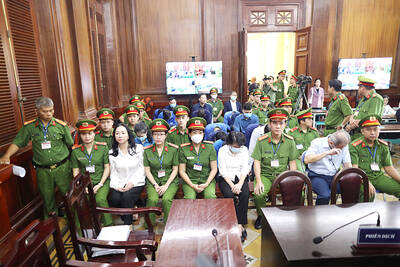
A top Vietnamese property tycoon was on Thursday sentenced to death in one of the biggest corruption cases in history, with an estimated US$27 billion in damages. A panel of three hand-picked jurors and two judges rejected all defense arguments by Truong My Lan, chair of major developer Van Thinh Phat, who was found guilty of swindling cash from Saigon Commercial Bank (SCB) over a decade. “The defendant’s actions ... eroded people’s trust in the leadership of the [Communist] Party and state,” read the verdict at the trial in Ho Chi Minh City. After the five-week trial, 85 others were also sentenced on

‘DELUSIONAL’: Targeting the families of Hamas’ leaders would not push the group to change its position or to give up its demands for Palestinians, Ismail Haniyeh said Israeli aircraft on Wednesday killed three sons of Hamas’ top political leader in the Gaza Strip, striking high-stakes targets at a time when Israel is holding delicate ceasefire negotiations with the militant group. Hamas said four of the leader’s grandchildren were also killed. Ismail Haniyeh’s sons are among the highest-profile figures to be killed in the war so far. Israel said they were Hamas operatives, and Haniyeh accused Israel of acting in “the spirit of revenge and murder.” The deaths threatened to strain the internationally mediated ceasefire talks, which appeared to gain steam in recent days even as the sides remain far


 RSS
RSS